On this page
Here are the formulas from Chapter 4 of the rationalised NCERT Class 11 Mathematics textbook (Reprint 2026-27), grouped by syllabus topic, each with a worked example and one pitfall.
The CBSE 2026-27 Mathematics curriculum lists three topics for this chapter: the need for complex numbers, especially √−1, algebraic properties of complex numbers, and the Argand plane. This sheet covers those three; polar form is not on it. For the full chapter, see our Class 11 complex numbers and quadratic equations guide.
What is a complex number? Definitions and powers of i
i = √−1, so i² = −1 (a, b, c, d, x, y are real throughout). The square roots of −1 are i and −i, but the symbol √−1 means i only.
A complex number is z = a + ib. Re z = a is the real part and Im z = b is the imaginary part.
Equality: a + ib = c + id exactly when a = c and b = d.
Powers of i, for any integer k: i⁴ᵏ = 1, i⁴ᵏ⁺¹ = i, i⁴ᵏ⁺² = −1, i⁴ᵏ⁺³ = −i.
Negative powers follow the same cycle: i⁻¹ = −i, i⁻² = −1, i⁻³ = i, i⁻⁴ = 1.
Square root of a negative number: √−a = √a i, for a > 0.
√a × √b = √(ab) holds when at least one of a, b is non-negative. It fails when both a and b are negative.
Worked example. Find i²⁰²⁷ + i⁻³.
2027 = 4 × 506 + 3, so i²⁰²⁷ = i³ = −i.
i⁻³ = 1 ÷ (−i) = i, so the sum is 0.
Watch for: √−16 × √−25 is not √400 = 20. Write 4i × 5i = 20i² = −20.
Algebra of complex numbers: the four operations
Let z₁ = a + ib and z₂ = c + id.
Sum: z₁ + z₂ = (a + c) + i(b + d).
Difference: z₁ − z₂ = (a − c) + i(b − d).
Product: z₁ z₂ = (ac − bd) + i(ad + bc).
Quotient, for z₂ ≠ 0: z₁ ÷ z₂ = [(ac + bd) + i(bc − ad)] ÷ (c² + d²).
Additive identity 0 = 0 + i0; additive inverse −z = −a − ib.
Multiplicative identity 1 = 1 + i0; multiplicative inverse, for z ≠ 0: z⁻¹ = (a − ib) ÷ (a² + b²).
Both operations are commutative and associative, and z₁(z₂ + z₃) = z₁z₂ + z₁z₃ for any complex z₁, z₂, z₃.
Identities that hold for all complex z₁, z₂: (z₁ ± z₂)² = z₁² ± 2z₁z₂ + z₂²; (z₁ + z₂)³ = z₁³ + 3z₁²z₂ + 3z₁z₂² + z₂³; (z₁ − z₂)³ = z₁³ − 3z₁²z₂ + 3z₁z₂² − z₂³; z₁² − z₂² = (z₁ + z₂)(z₁ − z₂).
Worked example. Express (4 + 7i) ÷ (2 + i) as a + ib.
Multiply top and bottom by 2 − i. Top: (4 + 7i)(2 − i) = 8 − 4i + 14i − 7i² = 15 + 10i.
Bottom: (2 + i)(2 − i) = 4 + 1 = 5.
Answer: 3 + 2i. Check: (3 + 2i)(2 + i) = 4 + 7i.
Watch for: the denominator is c² + d², not c² − d².
What are the modulus and conjugate formulas?
For z = a + ib:
Modulus: |z| = √(a² + b²) ≥ 0.
Conjugate: z̄ = a − ib.
z z̄ = |z|² = a² + b².
Inverse using these: z⁻¹ = z̄ ÷ |z|², for z ≠ 0.
Modulus of a product and quotient: |z₁ z₂| = |z₁| |z₂|; |z₁ ÷ z₂| = |z₁| ÷ |z₂|, for z₂ ≠ 0.
Conjugate of a sum, difference, product and quotient: (z₁ ± z₂)‾ = z̄₁ ± z̄₂; (z₁ z₂)‾ = z̄₁ z̄₂; (z₁ ÷ z₂)‾ = z̄₁ ÷ z̄₂, for z₂ ≠ 0.
Also, (z̄)‾ = z, z + z̄ = 2 Re z and z − z̄ = 2i Im z.
Worked example. For z = 5 − 12i, find |z|, z̄ and z⁻¹.
|z| = √(25 + 144) = √169 = 13.
z̄ = 5 + 12i.
z⁻¹ = z̄ ÷ |z|² = (5 + 12i) ÷ 169 = 5/169 + (12/169)i.
Watch for: |z| uses b, not ib. |5 − 12i| is √(25 + 144), never √(25 − 144).
How do you show a complex number on the Argand plane?
The complex number z = x + iy is the point P(x, y). The x-axis is the real axis and the y-axis is the imaginary axis.
a + i0 lies on the real axis; 0 + ib on the imaginary axis.
|z| = √(x² + y²) is the distance of P from the origin O.
z̄ = x − iy is the point Q(x, −y), the mirror image of P in the real axis.
The distance between the points for z₁ and z₂ is |z₁ − z₂|, the distance formula in complex form.
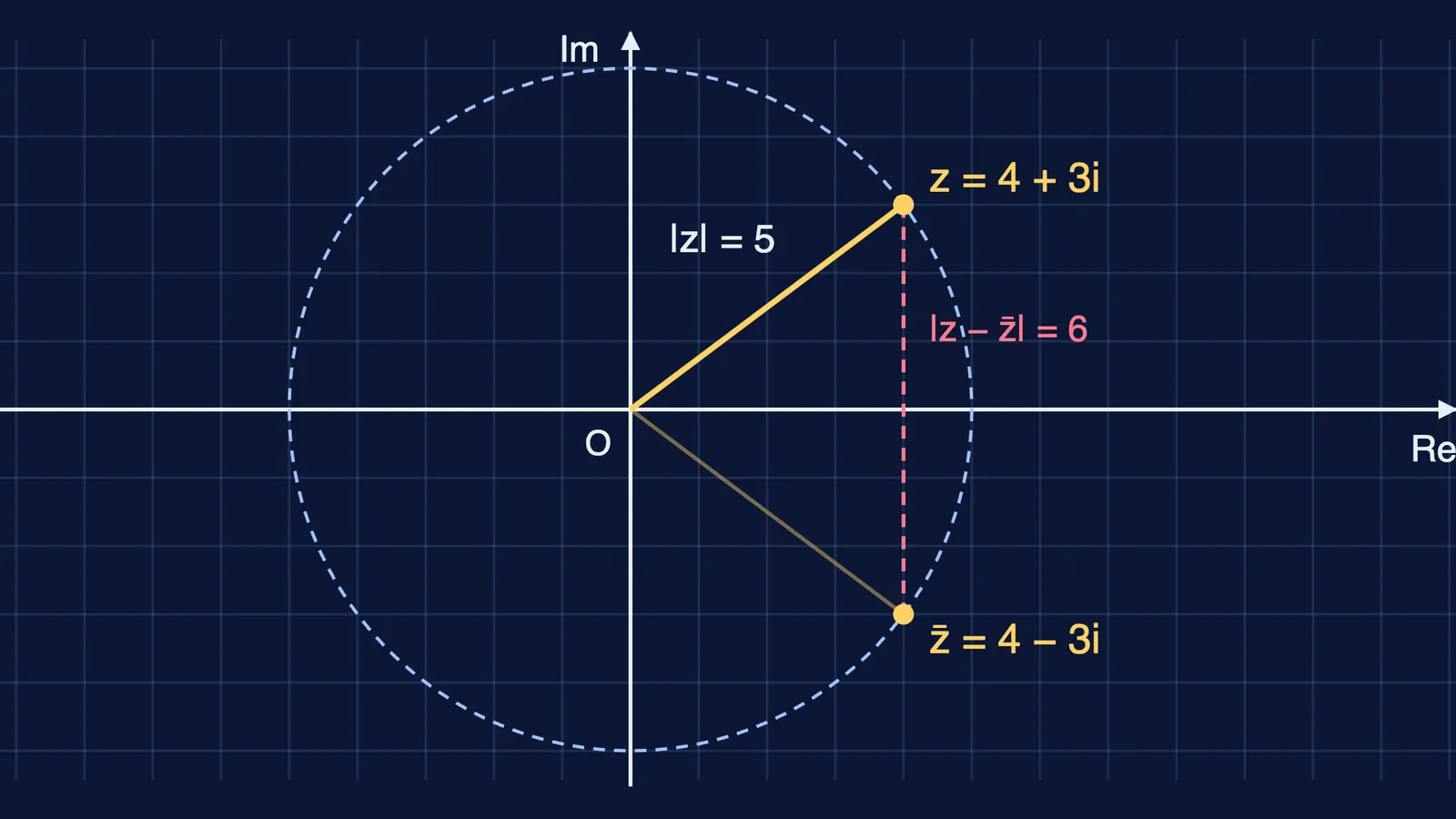
Worked example. Take z = 4 + 3i, drawn in the diagram at the top.
z is the point (4, 3) and |z| = √(16 + 9) = 5.
z̄ = 4 − 3i is the point (4, −3), on the same circle of radius 5.
The distance between them is |z − z̄| = |6i| = 6, which is 2|Im z|.
Watch for: the conjugate reflects in the real axis; −z̄ = −4 + 3i is the reflection in the imaginary axis.
How to revise this formula sheet
Reduce any power of i, negative ones included, by its remainder on division by 4.
Do one division a day for a week, multiplying back each time.
Sketch the Argand point for every modulus or conjugate question; a wrong quadrant shows a sign error at once.
Then mix question types: our assertion-reason questions on complex numbers test the conditions, and the complex numbers case study set applies them. If a step keeps going wrong, the Fermi Problem Library has worked problems with a step-by-step solver that explains the reasoning rather than printing an answer.