On this page
This sheet collects the key formulas of Chapter 2 of the NCERT Class 12 Physics Part I textbook (Reprint 2026-27), matched to the Chapter 2 topics in the CBSE Class XII Physics syllabus for 2026-27. For answer layout and derivations, read our Electrostatic potential and capacitance Class 12 board guide.
Notation: ε₀ = 8.854 × 10⁻¹² C² N⁻¹ m⁻², 1/(4πε₀) ≈ 9 × 10⁹ N m² C⁻². SI units throughout; V = 0 at infinity.
What are the formulas for electric potential?
Potential difference: V_P − V_R = W_RP/q, the external work per unit charge from R to P (1 V = 1 J C⁻¹).
Point charge Q at distance r: V = Q/(4πε₀r), for either sign of Q.
System of charges: V = (1/4πε₀)(q₁/r₁P + q₂/r₂P + … + qₙ/rₙP), an algebraic sum with signs kept.
Dipole of moment p = q × 2a (C m): V = p cos θ/(4πε₀r²), θ measured from p; exact for a point dipole, approximate for r ≫ a.
On the axis: V = ±p/(4πε₀r²). On the equatorial plane (θ = 90°): V = 0.
Field from potential: E = −dV/dl along the normal to the equipotential surface, pointing towards decreasing V (V m⁻¹ = N C⁻¹).
Uniform field between equipotentials a distance d apart: E = ΔV/d.
Worked example: +4 nC sits at x = 0 and −2 nC at x = 0.30 m. At x = 0.10 m, V = 9 × 10⁹ × (4 × 10⁻⁹/0.10 − 2 × 10⁻⁹/0.20) = 270 V. V = 0 between them where 4/x = 2/(0.30 − x), at x = 0.20 m.
Watch for: a point charge's potential falls as 1/r, a dipole's as 1/r². Zero potential on the equatorial plane does not mean zero field.
How do you find electrostatic potential energy?
Two charges: U = q₁q₂/(4πε₀r₁₂), negative when they attract.
Three charges: U = (1/4πε₀)(q₁q₂/r₁₂ + q₁q₃/r₁₃ + q₂q₃/r₂₃), one term per pair.
Charge in an external potential: U = qV(r).
Dipole in a uniform field E: torque τ = p × E, magnitude pE sin θ.
Dipole energy: U(θ) = −pE cos θ = −p · E, with U = 0 at θ = 90°.
Work to rotate a dipole from θ₀ to θ₁: W = pE(cos θ₀ − cos θ₁).
Worked example: +3 μC and −5 μC sit 0.15 m apart, so U = 9 × 10⁹ × (3 × 10⁻⁶)(−5 × 10⁻⁶)/0.15 = −0.90 J. A dipole of 2 × 10⁻⁸ C m in 5 × 10⁴ N C⁻¹ needs 1.0 × 10⁻³ J to turn from 0° to 90°, and 2.0 × 10⁻³ J to reach 180°.
Watch for: keep the charges' signs inside U, and count each pair once.
Conductors, dielectrics and polarisation
Inside a conductor in electrostatics: E = 0, and V is constant throughout and on the surface.
Just outside a charged conductor: E = (σ/ε₀) n̂, with σ the surface charge density (C m⁻²) and n̂ the outward normal.
Inside an empty cavity of a conductor: E = 0.
Polarisation of a linear dielectric: P = ε₀χₑE, with χₑ the electric susceptibility.
Permittivity of a medium: ε = ε₀K, so K = ε/ε₀ (dimensionless) and K > 1 for a dielectric.
Worked example: σ = 2.0 × 10⁻⁶ C m⁻² gives E = 2.0 × 10⁻⁶/8.854 × 10⁻¹² ≈ 2.26 × 10⁵ N C⁻¹ just outside, normal to the surface; inside, zero.
Watch for: σ/ε₀ is for just outside a conductor; an isolated thin sheet gives σ/2ε₀ (Chapter 1).
Capacitance and combinations of capacitors
Definition: C = Q/V, with ±Q on the two conductors (1 F = 1 C V⁻¹).
Parallel plates in vacuum: C₀ = ε₀A/d, plate area A, gap d, with d² ≪ A (edge effects ignored).
Field between the plates: E = Q/(ε₀A), and V = Ed.
Dielectric filling the gap: C = KC₀.
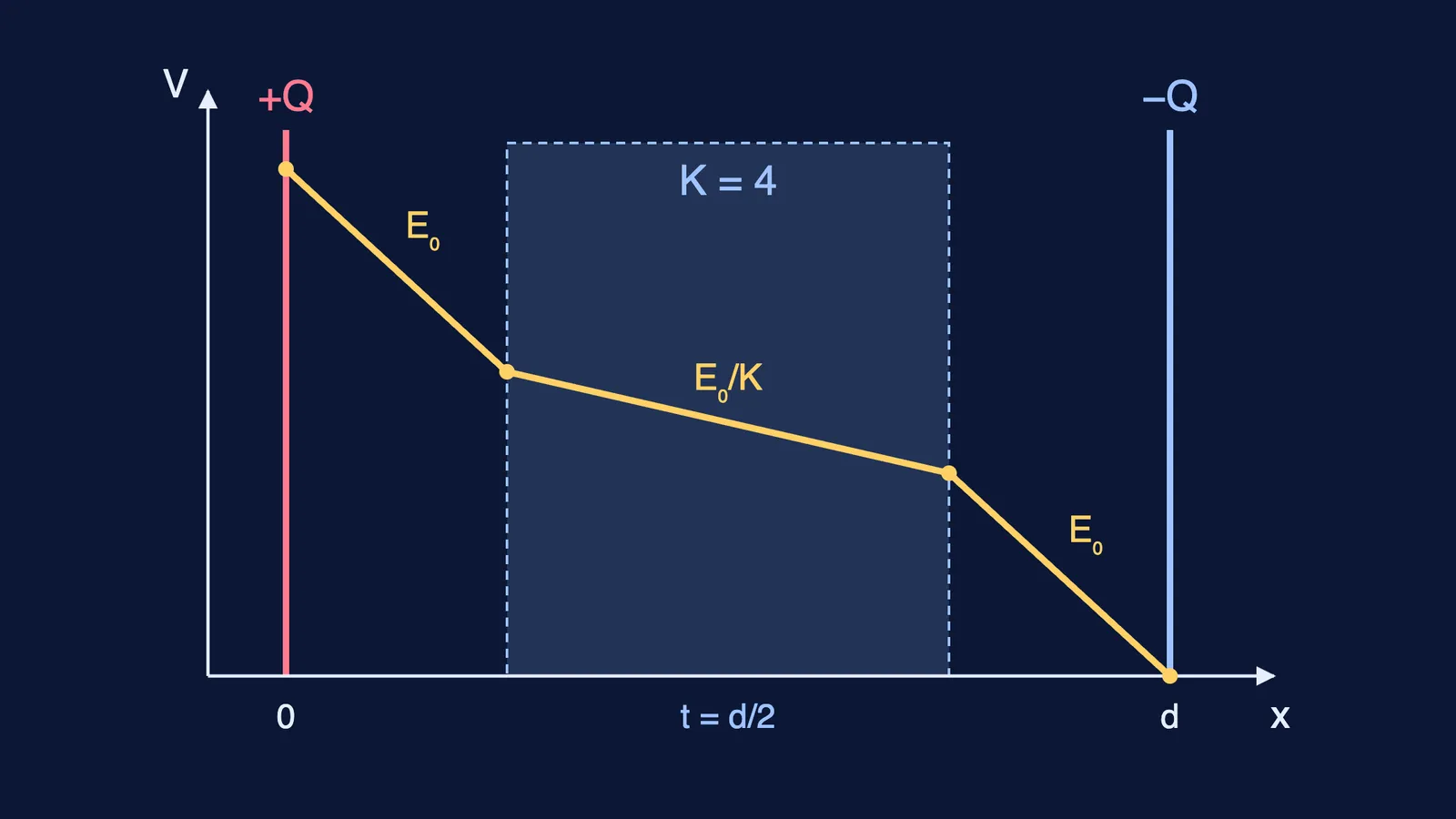
Slab of thickness t < d, same area as the plates: C = ε₀A/(d − t + t/K).
Series: 1/C = 1/C₁ + 1/C₂ + … + 1/Cₙ; each carries the same Q.
Parallel: C = C₁ + C₂ + … + Cₙ; each has the same V.
Worked example: plates of 0.020 m² sit 1.0 mm apart, so C₀ = 8.854 × 10⁻¹² × 0.020/10⁻³ ≈ 177 pF. Filling with K = 5 gives 885 pF; a 0.50 mm slab of K = 5 gives ε₀A/(0.60 mm) ≈ 295 pF. Then 2 μF and 3 μF in series across 12 V: C = 1.2 μF, Q = 14.4 μC, V₁ = 7.2 V, V₂ = 4.8 V.
Watch for: capacitor rules are the reverse of resistor rules, and the smaller capacitor in series takes the larger voltage.
How much energy does a capacitor store?
Energy stored: U = Q²/(2C) = ½CV² = ½QV.
Energy density in a field: u = ½ε₀E² (J m⁻³), for any field in vacuum.
Dielectric inserted, battery disconnected (Q fixed): C → KC, V → V/K, U → U/K.
Dielectric inserted, battery connected (V fixed): C → KC, Q → KQ, U → KU.
The syllabus asks for these formulae only, not their derivation.
Worked example: the 1.2 μF pair at 12 V stores ½ × 1.2 × 10⁻⁶ × 12² = 86.4 μJ. A field of 10⁶ V m⁻¹ stores u ≈ 4.43 J m⁻³.
Watch for: decide whether Q or V stays fixed before choosing the energy form.
If the field inside a dielectric is hard to picture, the Fermi Simulation Lab has interactive simulations for the ideas that are easier to see than to read.
How to revise this formula sheet
Write the powers side by side: point-charge V ∝ 1/r, E ∝ 1/r², U ∝ 1/r, dipole V ∝ 1/r².
In every capacitor problem, note "Q fixed" or "V fixed" before you start.
Check a slab answer at its limits: t = 0 gives C₀, t = d gives KC₀.
Revise Chapter 1 alongside, using our Electric charges and fields Class 12 board guide; σ/ε₀ and dipoles carry over.
For JEE, a non-uniform gap is worked through in capacitance of inclined plates.