On this page
Every formula below is from Chapter 3 of the rationalised NCERT Class 12 Physics textbook (2026-27 reprint), and the topics match Unit II of the CBSE Class XII Physics syllabus for 2026-27. For full board answers, see our Current Electricity Class 12 board exam guide.
Not included: the current NCERT chapter has no potentiometer or resistor colour code, and mentions the meter bridge in one line.
What are the formulas for current, drift velocity and mobility?
Current: I = q/t (steady current), where q is the net charge (C) crossing an area in time t (s); for a varying current, I = dq/dt. Unit: A.
Current density: j = I/A, for current spread evenly over an area A (m²) normal to the flow. Unit: A m⁻².
Current in terms of drift: I = n e A v_d, in A, where n is free electrons per unit volume (m⁻³), e = 1.6 × 10⁻¹⁹ C, A the cross-section (m²) and v_d the drift speed (m s⁻¹).
Drift speed: v_d = eEτ/m, where E is the field (V m⁻¹), τ the mean time between collisions (s) and m the electron mass (kg). Electrons drift opposite to E.
Mobility: μ = v_d/E = eτ/m, always positive. Unit: m² V⁻¹ s⁻¹.
Worked example: a copper wire of cross-section 1.0 mm² carries 2.0 A. With n = 8.5 × 10²⁸ m⁻³ (NCERT's Example 3.1 value for copper), v_d = I/(neA) = 2.0/(8.5 × 10²⁸ × 1.6 × 10⁻¹⁹ × 1.0 × 10⁻⁶) ≈ 1.5 × 10⁻⁴ m s⁻¹, about 0.15 mm/s.
Watch for: converting mm² to m². 1 mm² = 10⁻⁶ m², not 10⁻³ m².
Ohm's law, resistivity and temperature
Ohm's law: V = IR, where V is the potential difference (V) and R the resistance (Ω). Valid for ohmic conductors at fixed temperature.
Uniform wire: R = ρl/A, in Ω, where l is the length (m), A the cross-section (m²) and ρ the resistivity (Ω m).
Vector form: j = σE, where σ = 1/ρ is the conductivity (S m⁻¹).
Resistivity from the drift model: ρ = m/(n e² τ), in Ω m.
Temperature dependence (metals, over a limited range): ρ_T = ρ₀[1 + α(T − T₀)], where ρ₀ is the resistivity at the reference temperature T₀ and α the temperature coefficient of resistivity (K⁻¹ or °C⁻¹).
Worked example: a wire 2.0 m long, 0.50 mm² in cross-section, has ρ = 1.0 × 10⁻⁶ Ω m at 20 °C. R = ρl/A = (1.0 × 10⁻⁶ × 2.0)/(0.50 × 10⁻⁶) = 4.0 Ω. If α = 4.0 × 10⁻³ °C⁻¹, at 70 °C it becomes 4.0 × (1 + 4.0 × 10⁻³ × 50) = 4.8 Ω (ignoring thermal expansion).
Watch for: stretching a wire to n times its length (constant volume) cuts its area to A/n, so R rises n² times, not n.
How do you calculate electrical energy and power?
Energy delivered in time Δt: ΔW = IVΔt, in joules (J).
Power: P = IV = I²R = V²/R, in watts (W). The last two need V = IR; for other devices use P = IV.
Cable loss: P_c = I²R_c = P²R_c/V², in W, where R_c is the cable resistance (Ω) and P the power (W) delivered at voltage V (V).
Worked example: 10 kW is sent through 2.0 Ω cables. At 220 V, P_c = (10⁴)² × 2.0/220² ≈ 4.1 kW. At 2,200 V, the loss is about 41 W. Ten times the voltage, one-hundredth the loss.
Watch for: compare series resistors with I²R (same current), parallel ones with V²/R (same voltage).
What changes when a cell has internal resistance?
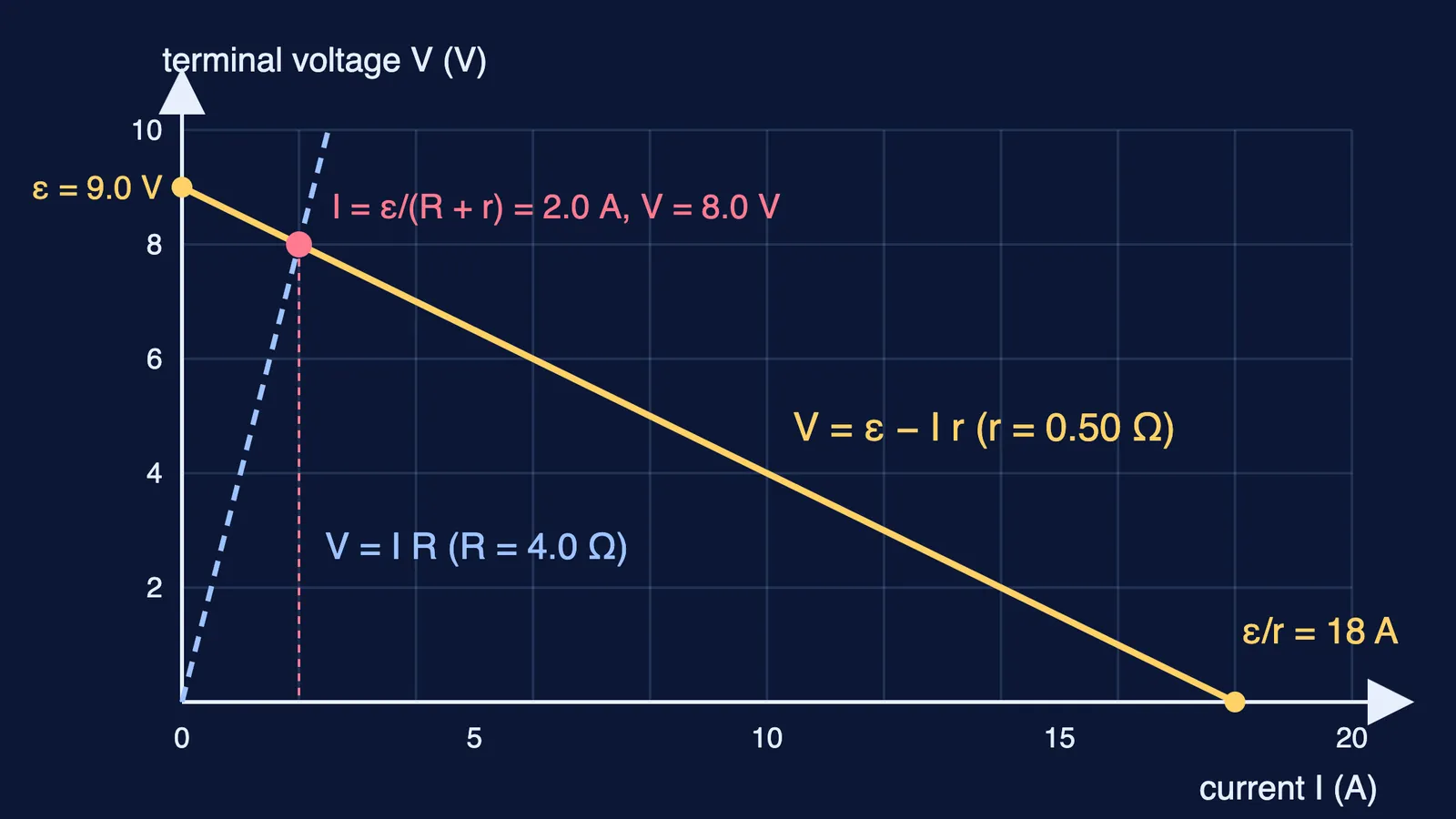
Terminal voltage: V = ε − Ir, where ε is the emf of the cell (V), r its internal resistance (Ω) and I the current drawn.
Current through an external resistor R (Ω): I = ε/(R + r), in A. The largest current, at R = 0, is I_max = ε/r.
Series (+ of one to − of the next): ε_eq = ε₁ + ε₂ (V), r_eq = r₁ + r₂ (Ω). One cell reversed: ε_eq = ε₁ − ε₂ (ε₁ > ε₂); r_eq still adds.
Parallel (like terminals joined): ε_eq = (ε₁r₂ + ε₂r₁)/(r₁ + r₂), in V, and 1/r_eq = 1/r₁ + 1/r₂, with r_eq in Ω. For n cells: ε_eq/r_eq = ε₁/r₁ + ... + εₙ/rₙ.
Worked example: cells of 2.0 V (r = 0.40 Ω) and 1.5 V (r = 0.60 Ω) are joined in parallel. ε_eq = (2.0 × 0.60 + 1.5 × 0.40)/1.00 = 1.8 V and r_eq = 0.40 × 0.60/1.00 = 0.24 Ω. Across a 3.36 Ω resistor, I = 1.8/(3.36 + 0.24) = 0.50 A and the terminal voltage is 1.8 − 0.50 × 0.24 = 1.68 V.
Watch for: in parallel, ε_eq is not the plain average; each emf is weighted by the other cell's internal resistance.
Kirchhoff's rules and the Wheatstone bridge
Junction rule: currents (A) entering a junction equal currents leaving it (charge conservation).
Loop rule: potential changes (V) around any closed loop add to zero. Across a resistor along the assumed current: −IR; through a cell from − to +: +ε.
Wheatstone bridge balance (no current through the galvanometer): R₂/R₁ = R₄/R₃ (NCERT Fig. 3.18 labelling). The unknown resistance is then R₄ = R₃R₂/R₁, in Ω.
Worked example: balance with R₁ = 100 Ω, R₂ = 150 Ω, R₃ = 40 Ω gives R₄ = 40 × 150/100 = 60 Ω.
Watch for: labels differ between books, so read the ratio off the figure. A negative current from Kirchhoff's rules just means the real direction is opposite; keep the sign.
How to revise this formula sheet
Write the chain on one page: v_d = eEτ/m, then I = neAv_d, then j = σE, then ρ = m/(ne²τ), deriving each from the one before.
Check units in every answer, especially mobility (m² V⁻¹ s⁻¹) and resistivity (Ω m).
Each week, solve one parallel-cell and one bridge question, writing every loop equation in full.
Try the assertion-reason questions on current electricity. Preparing for JEE too? See Current Electricity for JEE Main, with solved circuits.
If drift or the bridge balance is hard to picture, the Fermi Simulation Lab has interactive simulations for ideas easier to see than to read.