

On this page
Assertion-reason questions give you two statements and ask you to test the link between them. Most students can easily spot if a statement is factually wrong. The real trap lies in choosing between Option A (the reason explains the assertion) and Option B (both are true, but they are unrelated).
In the 2024–25 CBSE Class 12 Physics sample paper, assertion-reason items account for 4 of the 33 questions. Along with electrostatics, the current electricity unit carries 16 of the 70 marks in the theory paper. Mastering these logic pairs is essential for both board exams and competitive tests like NEET.
Here are the typical concepts examiners use to build these pairs, and how to unpick them.
How does drift velocity depend on the conductor?
A classic pair tests your understanding of electron drift when a wire's physical dimensions change.
Assertion: When a wire is stretched to double its length while keeping the potential difference across it constant, the drift velocity of electrons halves. Reason: Drift velocity is directly proportional to the electric field inside the conductor.
Both statements are true. But does the reason explain the assertion? The electric field is given by E = V/L. If the length (L) doubles and the voltage (V) remains constant, the electric field is halved. Since drift velocity (v_d = eEτ/m) is directly proportional to the electric field, it also halves.
Because the reason provides the exact physical principle needed to prove the assertion, this is a clear Option A. If you are ever unsure about the underlying physics behind these formulas, the Fermi Concept Library maps out every idea with its own lesson.
What happens when a cell discharges?
Examiners love to test the difference between electromotive force (EMF) and terminal voltage.
Assertion: The terminal potential difference of a cell is always less than its EMF. Reason: When current is drawn from a cell, there is a potential drop across its internal resistance.
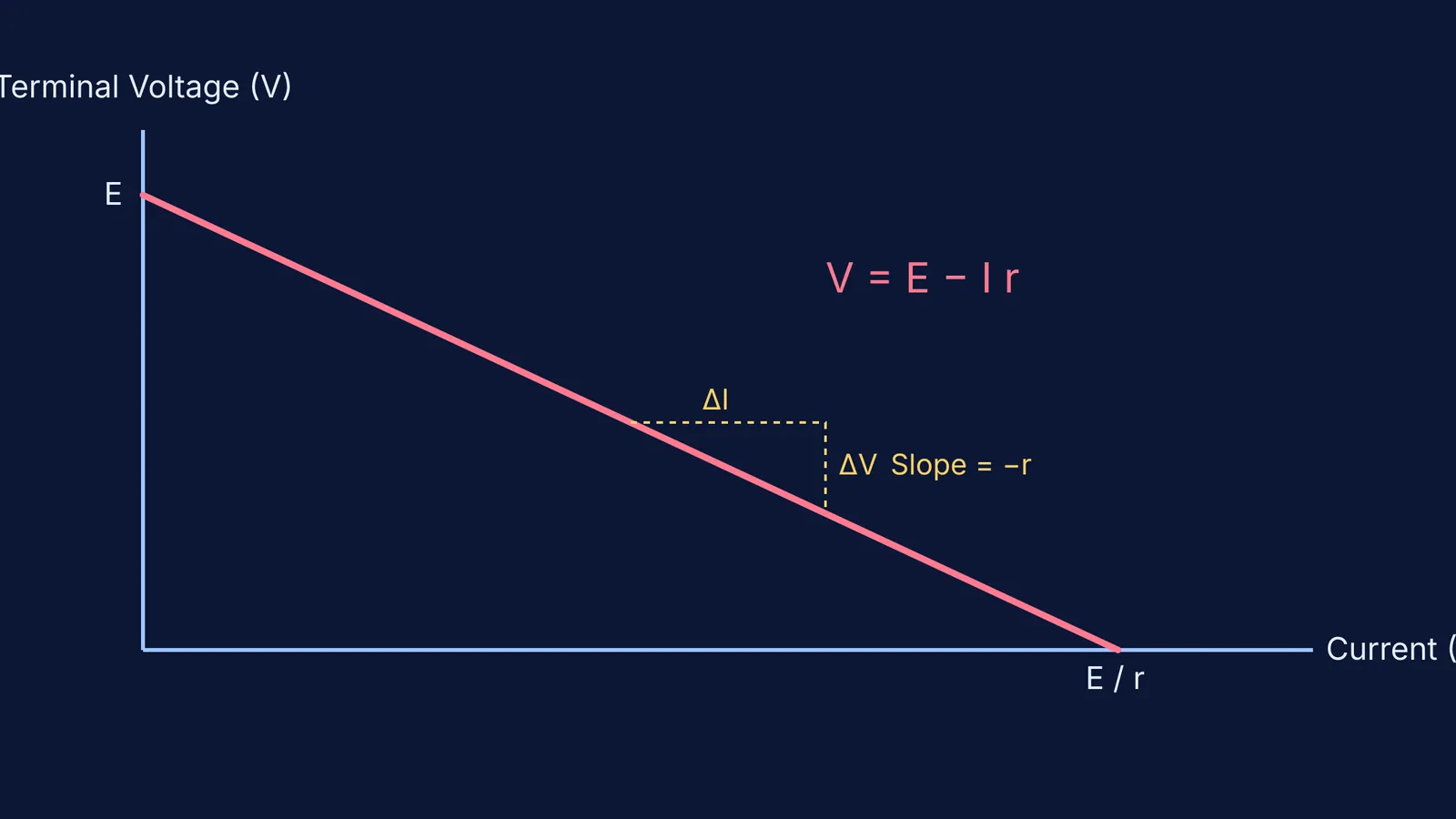
Read the assertion carefully. The word "always" is a massive red flag. While a discharging cell has a terminal voltage of V = E − Ir (which is less than E), a cell being charged has a terminal voltage of V = E + Ir (which is greater than E).
Because the assertion uses "always", it is false. The reason, however, is a true statement about discharging cells. This makes it Option D.
How to apply Kirchhoff's laws to assertion pairs?
Kirchhoff's laws are built on deep conservation principles, making them perfect candidates for assertion-reason questions.
Assertion: Kirchhoff's loop rule is a consequence of the conservation of energy. Reason: The electrostatic force is a conservative force, so the total work done in moving a charge around a closed loop is zero.
Both statements are true. The loop rule states that the sum of potential differences across all elements in a closed circuit loop is zero. Potential difference is work done per unit charge. The fact that the electrostatic force is conservative is the exact physical reason why the round-trip work (and thus the sum of voltage drops) must be zero. This is Option A.
If you struggle to apply these rules to complex grids, mastering the Node potential method: solving circuits by assigning voltages is a great next step. For interactive practice, the Fermi Problem Library offers worked problems with a step-by-step solver that explains the reasoning rather than printing an answer.
A framework for picking the right option
When you face a tough assertion-reason question, use this three-step test:
Hide the reason. Read the assertion on its own. Is it a universally true statement? Watch out for absolute words like "always", "never" or "must", which often make the statement false.
Hide the assertion. Read the reason in isolation. Is the physics correct on its own? Do not assume it is true just because it sounds like it matches the assertion.
The "Because" test. If both statements are true, join them with the word "because": "[Assertion] is true because [Reason]." If the resulting sentence makes logical sense and relies on a fundamental cause rather than just restating a formula, the answer is Option A. If the two ideas are true but parallel, it is Option B.
If you keep getting stuck between options A and B during your revision, Fermi's AI tutor can work out what you already know and build a plan for the session, stepping in to check your understanding as you go.


