On this page
This sheet collects the main formulas in Chapter 1 of the NCERT Class 12 Physics Part I textbook (Reprint 2026-27), which matches Chapter 1 of the CBSE Class XII Physics syllabus for 2026-27. For question types and answer-writing, see our Electric charges and fields Class 12 board exam guide.
Notation: k = 1/(4πε₀) ≈ 9 × 10⁹ N m² C⁻², and ε₀ = 8.854 × 10⁻¹² C² N⁻¹ m⁻² is the permittivity of free space, both as given in the NCERT chapter. SI units throughout. All formulas are for charges in vacuum (air is close enough). Potential and dipole potential energy are in Chapter 2.
Charge and Coulomb's law: what are the formulas?
Quantisation: q = ne, where n is an integer (positive, negative or zero) and e = 1.602 × 10⁻¹⁹ C is the magnitude of the charge on an electron or proton, as stated in the NCERT text.
Additivity and conservation: total charge = q₁ + q₂ + … + qₙ (algebraic sum), constant in an isolated system.
Coulomb's law (magnitude): F = k|q₁q₂|/r², for two point charges q₁ and q₂ separated by distance r.
Vector form: F₂₁ = k q₁q₂ r̂₂₁/r₂₁², the force on q₂ due to q₁, where r̂₂₁ is the unit vector from q₁ to q₂. Like charges (q₁q₂ > 0) repel; unlike charges attract.
Superposition: F₁ = F₁₂ + F₁₃ + … + F₁ₙ, a vector sum.
Worked example: q₁ = +4 μC and q₂ = −5 μC sit 0.40 m apart. F = (9 × 10⁹)(4 × 10⁻⁶)(5 × 10⁻⁶)/(0.40)² ≈ 1.1 N, attractive. The −5 μC charge is an excess of 5 × 10⁻⁶/1.602 × 10⁻¹⁹ ≈ 3.12 × 10¹³ electrons.
Watch for: use signs to decide direction; leave them out of the magnitude.
Electric field of point charges and charge distributions
Definition: E = F/q₀, force per unit charge on a small test charge q₀ that does not disturb the sources.
Point charge: E = kQ r̂/r², r̂ being the unit vector from Q to the field point, pointing away from a positive Q and towards a negative Q.
Force on charge q: F = qE (opposite to E if q < 0).
System of charges: E = Σ kqᵢ r̂ᵢP/rᵢP², a vector sum at point P (rᵢP: distance from qᵢ to P; r̂ᵢP: unit vector from qᵢ to P).
Charge densities: linear λ = ΔQ/Δl (C m⁻¹), surface σ = ΔQ/ΔS (C m⁻²), volume ρ = ΔQ/ΔV (C m⁻³).
Continuous distribution: E ≈ Σ k ρΔV r̂′/r′², r′ being the distance from each volume element to P; an integral as ΔV → 0.
Worked example: +5 nC at 0.30 m gives E = (9 × 10⁹)(5 × 10⁻⁹)/(0.30)² = 500 N C⁻¹, outward. An electron there feels eE = 8.0 × 10⁻¹⁷ N towards it.
Watch for: add components, not magnitudes.
Electric dipole: field and torque
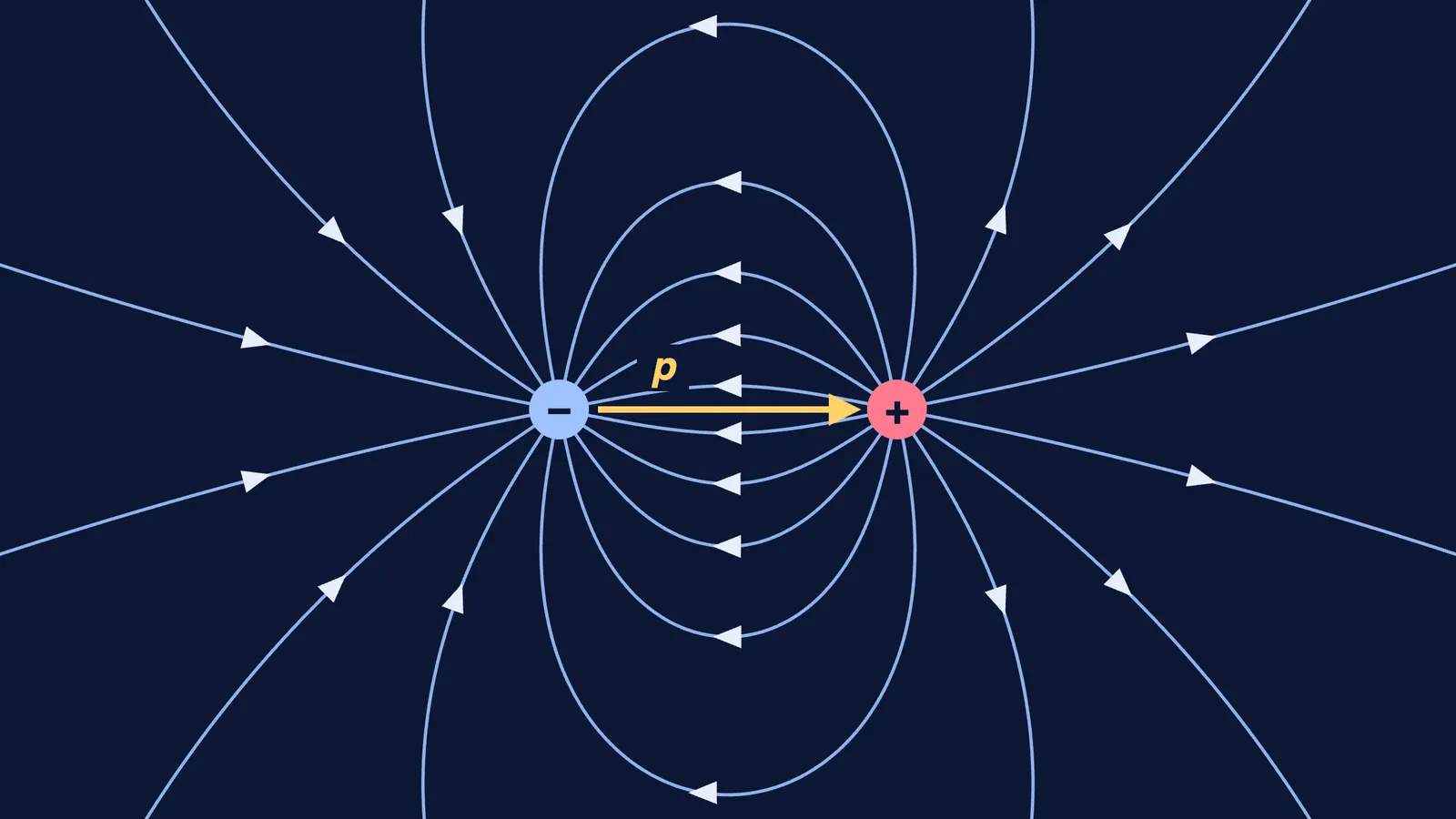
A dipole is charges +q and −q a distance 2a apart.
Dipole moment: p = q × 2a, directed from −q to +q. SI unit: C m.
On the axis, at distance r from the centre: E = k(4qar)/(r² − a²)², along p (r > a).
Axis, far away (r ≫ a): E = 2kp/r³, along p.
On the equatorial plane: E = k(2qa)/(r² + a²)^(3/2), opposite to p.
Equatorial, far away (r ≫ a): E = kp/r³, opposite to p.
Uniform external field: net force = 0; torque τ = p × E, magnitude pE sin θ, θ being the angle between p and E (zero at 0° and 180°).
Worked example: q = 2 nC, 2a = 4 mm, so p = 8 × 10⁻¹² C m. At r = 10 cm, the axial field is 2kp/r³ = 144 N C⁻¹ (exact: 144.1) and the equatorial field is 72 N C⁻¹. In a uniform field of 4 × 10⁴ N C⁻¹ at θ = 30°, τ = pE sin θ = 1.6 × 10⁻⁷ N m.
Watch for: the far field falls as 1/r³.
How do you use Gauss's law to find the field?
Flux through a small area: Δφ = E · ΔS = E ΔS cos θ, θ being the angle between E and the area vector ΔS, which points along the outward normal for a closed surface. Unit: N C⁻¹ m².
Gauss's law: φ = ∮ E · dS = q_enc/ε₀, q_enc being the net charge inside the closed surface; outside charges add zero net flux.
Infinitely long straight wire, linear charge density λ: E = λ/(2πε₀r) = 2kλ/r, radial, at distance r from the wire.
Infinite plane sheet, surface charge density σ: E = σ/(2ε₀), normal to the sheet and independent of distance.
Thin spherical shell, charge q, radius R: outside (r > R), E = kq/r², as if all charge were at the centre; inside (r < R), E = 0.
These need full symmetry; for a long wire or large finite sheet the NCERT chapter says they hold approximately away from the ends. Proofs are in our Electric charges and fields Class 12 derivations.
Worked example: 6 nC inside any closed surface gives φ ≈ 6.8 × 10² N m² C⁻¹. A wire with λ = 3 μC m⁻¹ gives 3.6 × 10⁵ N C⁻¹ at r = 0.15 m. A sheet with σ = 4 μC m⁻² gives 2.26 × 10⁵ N C⁻¹ at any distance. A 6 nC shell of radius 0.10 m gives 600 N C⁻¹ at r = 0.30 m and zero at r = 0.05 m.
Watch for: in the wire formula r is the perpendicular distance to the wire, and the sheet field has 2ε₀ in the denominator.
If dipole fields are hard to picture, the Fermi Simulation Lab has interactive simulations for ideas that are easier to see than to read.
How to revise this formula sheet
Rewrite each Gauss's-law result in k form; the shell outside matches a point charge.
Learn the dipole results as a pair: 2kp/r³ along p on the axis, kp/r³ against p on the equatorial plane.
For each Gauss's-law case, name the Gaussian surface and which faces carry flux.
Convert μC, nC and cm to SI before substituting.
Then move on with our Electrostatic potential and capacitance Class 12 board guide.