On this page
Chapter 1 of the NCERT Class 12 Physics textbook, Electric Charges and Fields (Reprint 2026-27), derives six results: the dipole field on the axis and on the equatorial line, the torque on a dipole, and three fields from Gauss's law. All six are in the chapter's topics in the CBSE Class XII Physics syllabus for 2026-27, which names the dipole field, the torque in a uniform field, and Gauss's theorem for a long wire, an infinite sheet and a thin shell.
Throughout, k = 1/(4πε₀) and the dipole moment p = q × 2a points from −q to +q. For the rest of the chapter, see our Electric charges and fields Class 12 board exam guide.
How do you derive the dipole field on the axis, E = 2kp/r³?
Setup: −q and +q a distance 2a apart; point P on the axis, r from the centre, on the +q side.
P is (r − a) from +q and (r + a) from −q.
Field of +q: kq/(r − a)², along p. Field of −q: kq/(r + a)², against p.
They lie on one line, so subtract: E = kq[1/(r − a)² − 1/(r + a)²].
Since (r + a)² − (r − a)² = 4ar, E = 4kqar/(r² − a²)².
For r ≫ a, drop a² beside r²: E = 4kqa/r³ = 2kp/r³.
Result: on the axis, E = 2kp/r³ for r ≫ a, along p.
Where students slip: adding the two fields instead of subtracting, or leaving out the direction.
How do you derive the dipole field on the equatorial line?
Setup: the same dipole; P on the perpendicular bisector, r from the centre.
P is √(r² + a²) from each charge, so both fields have magnitude kq/(r² + a²).
Components perpendicular to the axis cancel.
Components along the axis both point from +q towards −q and add; each is the magnitude times cos θ, with cos θ = a/√(r² + a²).
Total: E = 2kqa/(r² + a²)^(3/2) = kp/(r² + a²)^(3/2).
For r ≫ a: E = kp/r³.
Result: on the equatorial line, E = kp/r³ for r ≫ a, opposite to p.
Where students slip: taking cos θ as r/√(r² + a²), or losing the direction. At the same r, the axial result carries an extra factor of 2.
Why is the torque on a dipole in a uniform field τ = p × E?
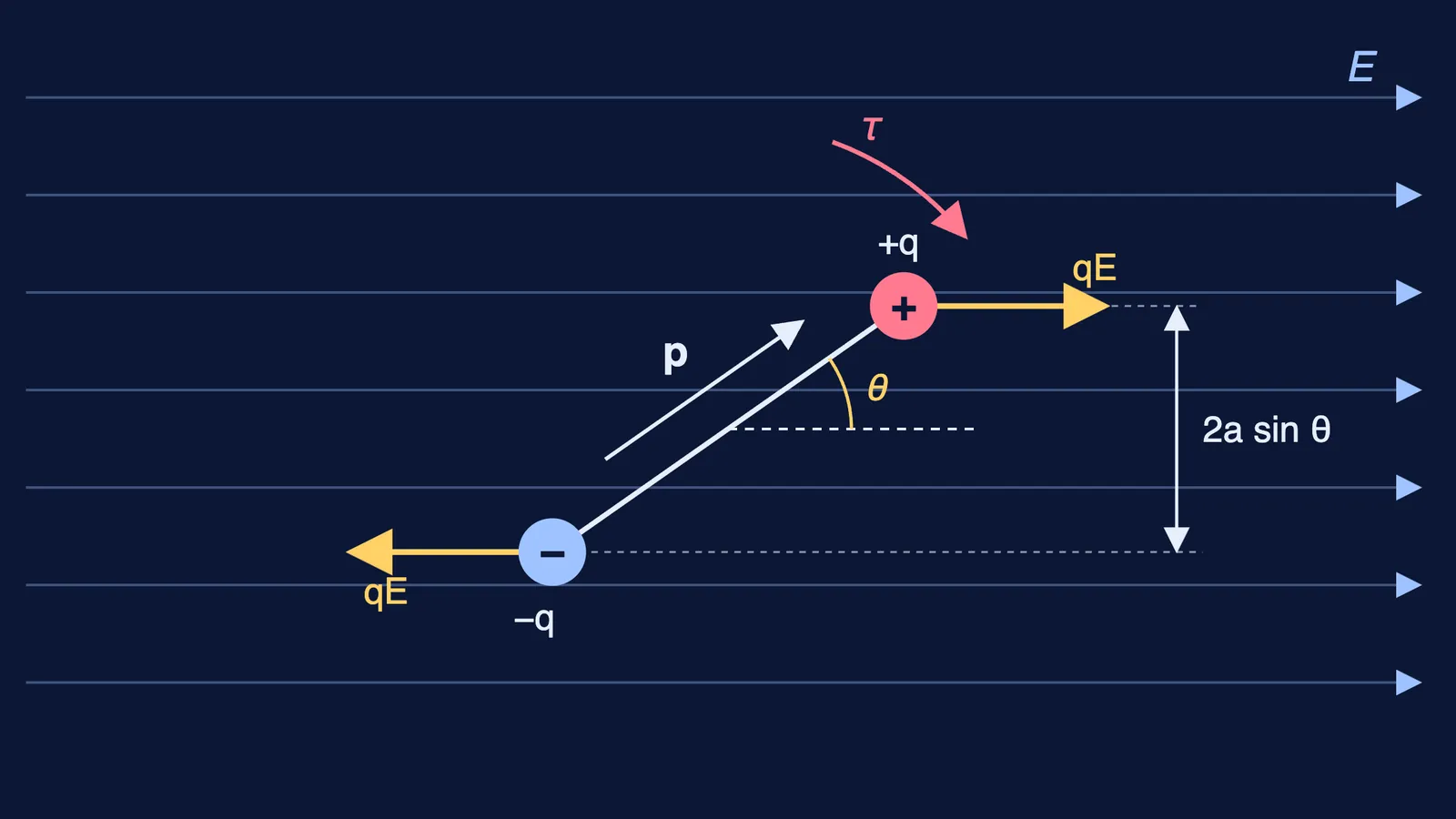
Setup: dipole p in a uniform field E, at angle θ to it (the figure at the top).
Force on +q is qE along E; force on −q is qE against E.
The forces cancel, so the net force is zero, but they act at different points and form a couple.
The perpendicular distance between their lines of action is 2a sin θ.
Torque = qE × 2a sin θ = (q × 2a)E sin θ = pE sin θ, the magnitude of p × E.
Result: τ = p × E, of magnitude pE sin θ; it turns p towards E and is zero when p is along E.
Where students slip: using 2a as the arm instead of 2a sin θ, or claiming a net force in a uniform field. For why θ = 0° is stable and 180° is not, read dipole potential energy at different orientations.
How does Gauss's law give the field of a long charged wire?
Setup: a straight wire with charge λ per metre; a coaxial Gaussian cylinder of radius r and length l.
By symmetry the field is radial and depends only on r.
On the flat end caps E lies along the surface, so their flux is zero.
On the curved surface E is normal and constant: flux = E × 2πrl.
Charge enclosed: λl. Gauss's law gives E × 2πrl = λl/ε₀.
Result: E = λ/(2πε₀r), radially outward for positive λ.
Where students slip: not saying why the end caps carry no flux, or using the wire's total charge instead of λl. There is a full worked version in the field of an infinite line charge using Gauss's law.
Why is the field of an infinite charged sheet σ/(2ε₀)?
Setup: a plane sheet with charge σ per square metre; a box of face area A crossing it, one face on each side.
By symmetry E is perpendicular to the sheet, pointing away from it on both sides when σ is positive.
The side walls are parallel to E and carry no flux.
Each face carries outward flux EA: total 2EA.
Charge enclosed: σA. Gauss's law gives 2EA = σA/ε₀.
Result: E = σ/(2ε₀), the same at every distance from the sheet.
Where students slip: writing EA instead of 2EA, which doubles the answer to σ/ε₀.
Why is the field inside a thin charged spherical shell zero?
Setup: a shell of radius R with charge σ per square metre, so q = 4πR²σ; a concentric Gaussian sphere of radius r.
By symmetry E is radial and the same size everywhere on the Gaussian sphere, so the flux is E × 4πr².
Outside (r > R): all of q is enclosed, so E × 4πr² = q/ε₀ and E = q/(4πε₀r²).
Inside (r < R): no charge is enclosed, so E × 4πr² = 0 and E = 0.
Result: outside, E = q/(4πε₀r²), as if all the charge sat at the centre; inside, E = 0.
Where students slip: writing R instead of r in the outside field, or saying the inside field is zero without the enclosed-charge step.
How should you practise these derivations?
Draw the figure first, with the charges, the point P, r and a labelled.
Write the axial and equatorial fields back to back, then compare them at the same r.
For each Gauss's law case, say why each part of the surface does or does not carry flux before writing an equation.
Test limits: put r ≫ a into the dipole results and r < R into the shell.
If the angle in the torque will not stick, try the Fermi Simulation Lab, interactive simulations for the ideas that are easier to see than to read.