On this page
Magnetism and Matter is Chapter 5 of the NCERT Class 12 Physics textbook (2026-27 reprint), and it is short. Here are the formulas it uses, grouped by topic, with SI units, conditions, one worked example and one pitfall per group. For answer layout and a revision plan, see our Magnetism and Matter Class 12 board exam guide.
The CBSE Class XII Physics curriculum for 2026-27 lists the equivalent solenoid, the dipole's field and its torque as "qualitative treatment only". The reprint has no section on Earth's magnetism, hysteresis or Curie's law, so those formulas are left out.
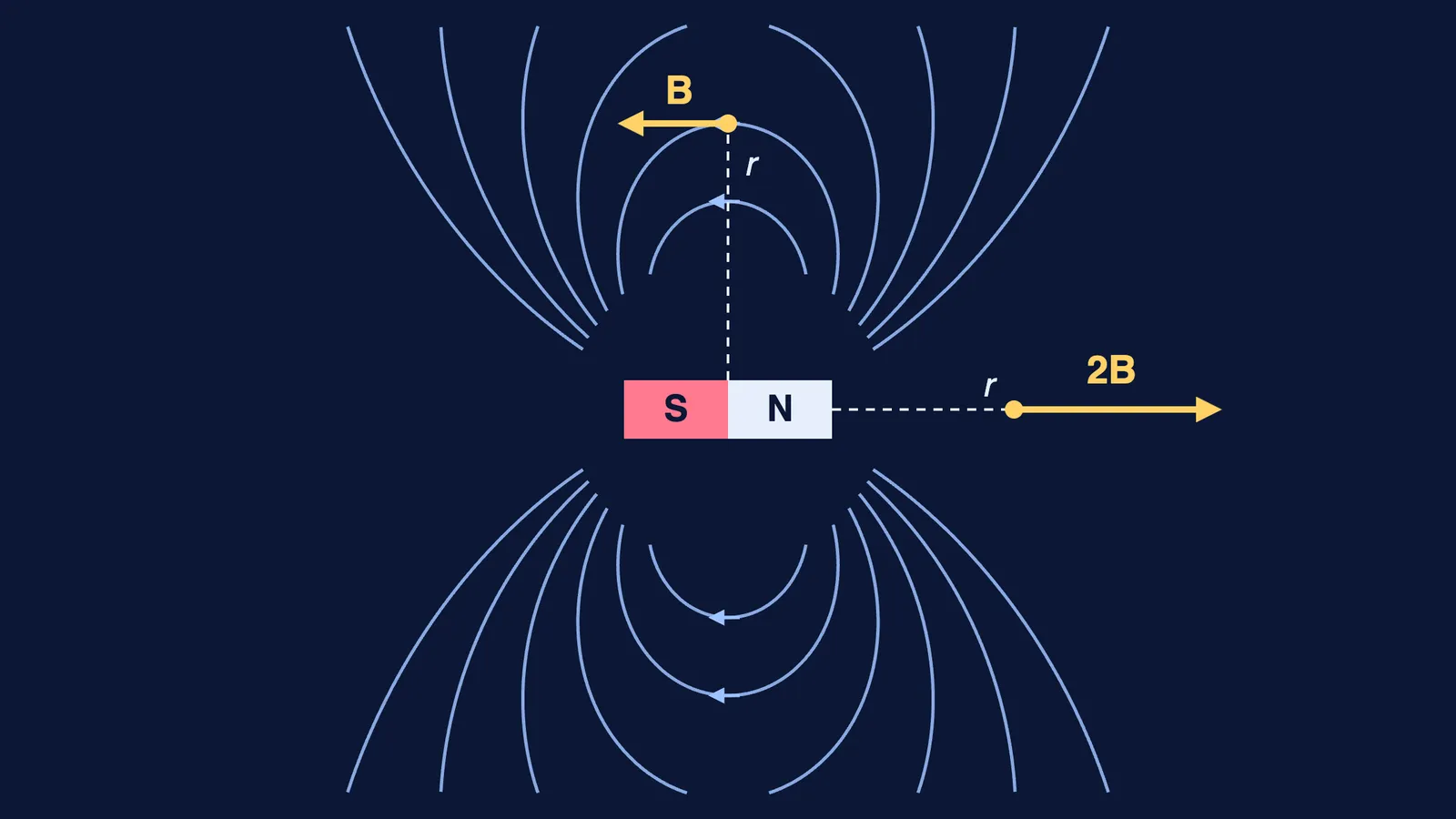
What is the field of a bar magnet on its axis and equator?
Symbols: m is the magnetic moment (A m², same as J T⁻¹), r the distance from the centre (m), l the magnet's length, μ₀ = 4π × 10⁻⁷ T m A⁻¹, B in tesla (1 T = 10⁴ gauss).
Equivalent solenoid: m = NIA (N turns, current I in A, area A in m²).
Axial field: B = μ₀ · 2m / (4π r³), along m. Condition: r ≫ l.
Equatorial field: B = −μ₀ m / (4π r³), opposite to m. Condition: r ≫ l.
At equal r, the axial field is twice the equatorial field.
Worked example: a short solenoid with 500 turns, 0.40 A and area 2.0 × 10⁻⁴ m² has m = 0.040 A m². At r = 0.10 m on its axis, B = 10⁻⁷ × 2 × 0.040 / 0.001 = 8.0 × 10⁻⁶ T; on its equator, 4.0 × 10⁻⁶ T.
Watch for: μ₀ · 2m / (4π r³) equals μ₀ m / (2π r³). Writing μ₀ · 2m / (2π r³) doubles the answer.
Torque and energy of a magnet in a uniform field
Symbols: θ is the angle between m and B, τ the torque (N m), U the potential energy (J).
Torque: τ = m × B, so τ = mB sin θ. Net force in a uniform field is zero.
Energy: U = −m · B = −mB cos θ, taking U = 0 at θ = 90°.
Stable at θ = 0° (U = −mB); unstable at θ = 180° (U = +mB).
Work to turn it from θ₁ to θ₂: W = mB (cos θ₁ − cos θ₂).
Worked example: m = 0.60 J T⁻¹ in B = 0.25 T. At 30°, τ = 0.60 × 0.25 × 0.5 = 0.075 N m and U ≈ −0.13 J. Turning it from 0° to 90° takes 0.15 J; from 0° to 180°, 0.30 J.
Watch for: work is the change in U, so 0° to 90° needs +mB even though the final U is zero.
What does Gauss's law for magnetism say?
Symbols: ΔS is a small area element of a closed surface, pointing outward (m²); φ_B is magnetic flux in weber (1 Wb = 1 T m²).
Flux through one element: Δφ_B = B · ΔS.
Gauss's law for magnetism: Σ B · ΔS = 0 over any closed surface.
Compare electrostatics, Σ E · ΔS = q/ε₀. The magnetic sum is zero because isolated poles (monopoles) are not known to exist.
Worked example: a closed box surrounds the N end of a magnet. If 3.0 × 10⁻⁵ Wb leaves through five faces, 3.0 × 10⁻⁵ Wb must enter through the sixth.
Watch for: only the net flux through a closed surface is zero; B itself, or the flux through one face, need not be.
How are M, H, χ and μ related?
Symbols: M is magnetisation and H magnetic intensity (both A m⁻¹), χ susceptibility and μᵣ relative permeability (no units), μ permeability (T m A⁻¹), n turns per metre, V volume (m³).
M = m_net / V.
Empty long solenoid: B₀ = μ₀ n I, and H = nI.
H = B/μ₀ − M, so B = μ₀ (H + M).
Linear material: M = χH.
B = μ₀ (1 + χ) H = μ₀ μᵣ H = μH, where μᵣ = 1 + χ and μ = μ₀ μᵣ.
Magnetising current: B = μ₀ n (I + I_M), so I_M = (μᵣ − 1) I.
Worked example: 800 turns per metre, 1.5 A, core μᵣ = 250. H = 1200 A m⁻¹; B = 250 × 4π × 10⁻⁷ × 1200 ≈ 0.38 T; χ = 249, so M ≈ 3.0 × 10⁵ A m⁻¹ and I_M ≈ 374 A.
Watch for: H and M are in A m⁻¹, not tesla. Dropping μ₀ from B = μ₀ μᵣ H gives a field nearly 800,000 times too big (1/μ₀ ≈ 7.96 × 10⁵).
Which values mean dia, para or ferro?
ε below is a small positive number (NCERT Table 5.2).
Diamagnetic: −1 ≤ χ < 0, 0 ≤ μᵣ < 1, μ < μ₀ (bismuth, copper, water).
Paramagnetic: 0 < χ < ε, 1 < μᵣ < 1 + ε, μ > μ₀ (aluminium, sodium, oxygen).
Ferromagnetic: χ ≫ 1, μᵣ ≫ 1, μ ≫ μ₀ (iron, cobalt, nickel).
Superconductor (perfect diamagnet): χ = −1, μᵣ = 0.
Temperature: a paramagnet's χ depends on temperature, and a ferromagnet turns paramagnetic when heated enough (stated in words, no formula).
Worked example: χ = 2.3 × 10⁻⁵ gives μᵣ = 1.000023, paramagnetic. χ = −1.6 × 10⁻⁵ gives μᵣ = 0.999984, diamagnetic.
Watch for: a diamagnet's μᵣ is below 1 but never negative; χ is the negative one.
How to revise this formula sheet
Learn the dipole results as swaps from electrostatics: p → m, 1/ε₀ → μ₀, E → B.
Sketch the magnet at 0°, 90° and 180° with U = −mB, 0 and +mB beside it.
Practise classifying a material from one χ or μᵣ value.
The 2026-27 CBSE sample paper offers "State Gauss's law of magnetism" as a choice in Question 20, so practise a two-line statement with the no-monopole reason.
For how these results are derived, see Magnetism and Matter Class 12 derivations, step by step. If field lines are hard to picture from a page, the Fermi Simulation Lab has interactive simulations for ideas that are easier to see than to read.