On this page
Wave Optics has fewer formulas than most Class 12 Physics chapters, but each one comes with a condition that decides whether you can use it. This sheet sets out the formulas behind the 2026-27 syllabus topics for the chapter, with symbols, SI units, conditions, one worked example per group and the slip to watch for.
The CBSE Class XII Physics syllabus 2026-27 covers Huygens' principle, proofs of reflection and refraction, coherent sources, Young's double-slit experiment with the fringe width as a "final expression only", and single-slit diffraction treated qualitatively. The formulas below follow NCERT Class 12 Physics, Chapter 10 (Reprint 2026-27). Polarisation and Malus' law (Section 10.7) are not in the 2026-27 syllabus, so they are left out.
What are the wavefront and refraction formulas in Wave Optics?
Symbols: c = speed of light in vacuum (3.0 × 10⁸ m/s); v = speed in a medium (m/s); n = refractive index (no unit); λ = wavelength (m); ν = frequency (Hz); i, r = angles of incidence and refraction, measured from the normal.
Refractive index: n = c/v
Law of reflection (Huygens' construction): angle of incidence = angle of reflection
Snell's law from Huygens' construction: sin i/sin r = v₁/v₂ = n₂/n₁, so n₁ sin i = n₂ sin r
Wavelength on refraction: v₁/λ₁ = v₂/λ₂ (frequency ν = v/λ stays the same)
Wavelength inside a medium, coming from vacuum (or air, taking n ≈ 1): λ = λ₀/n
Critical angle, going from denser medium 1 to rarer medium 2 (n₁ > n₂): sin i_c = n₂/n₁
Worked example: light of wavelength 640 nm in air enters glass with n = 1.6. Speed in glass v = (3.0 × 10⁸)/1.6 = 1.875 × 10⁸ m/s. Frequency ν = (3.0 × 10⁸)/(640 × 10⁻⁹) ≈ 4.69 × 10¹⁴ Hz, the same in air and glass. Wavelength in glass λ = 640/1.6 = 400 nm.
Watch for: changing the frequency on refraction. Only speed and wavelength change; ν is fixed by the source.
Superposition and coherent sources
Symbols: Δ = path difference S₁P ~ S₂P (m); φ = phase difference (rad); I₀ = intensity from each source alone (W/m²); n = 0, 1, 2, 3...
Phase difference from path difference: φ = (2π/λ) × Δ
Constructive interference (bright): Δ = nλ, that is φ = 0, ±2π, ±4π...
Destructive interference (dark): Δ = (n + ½)λ, that is φ = ±π, ±3π...
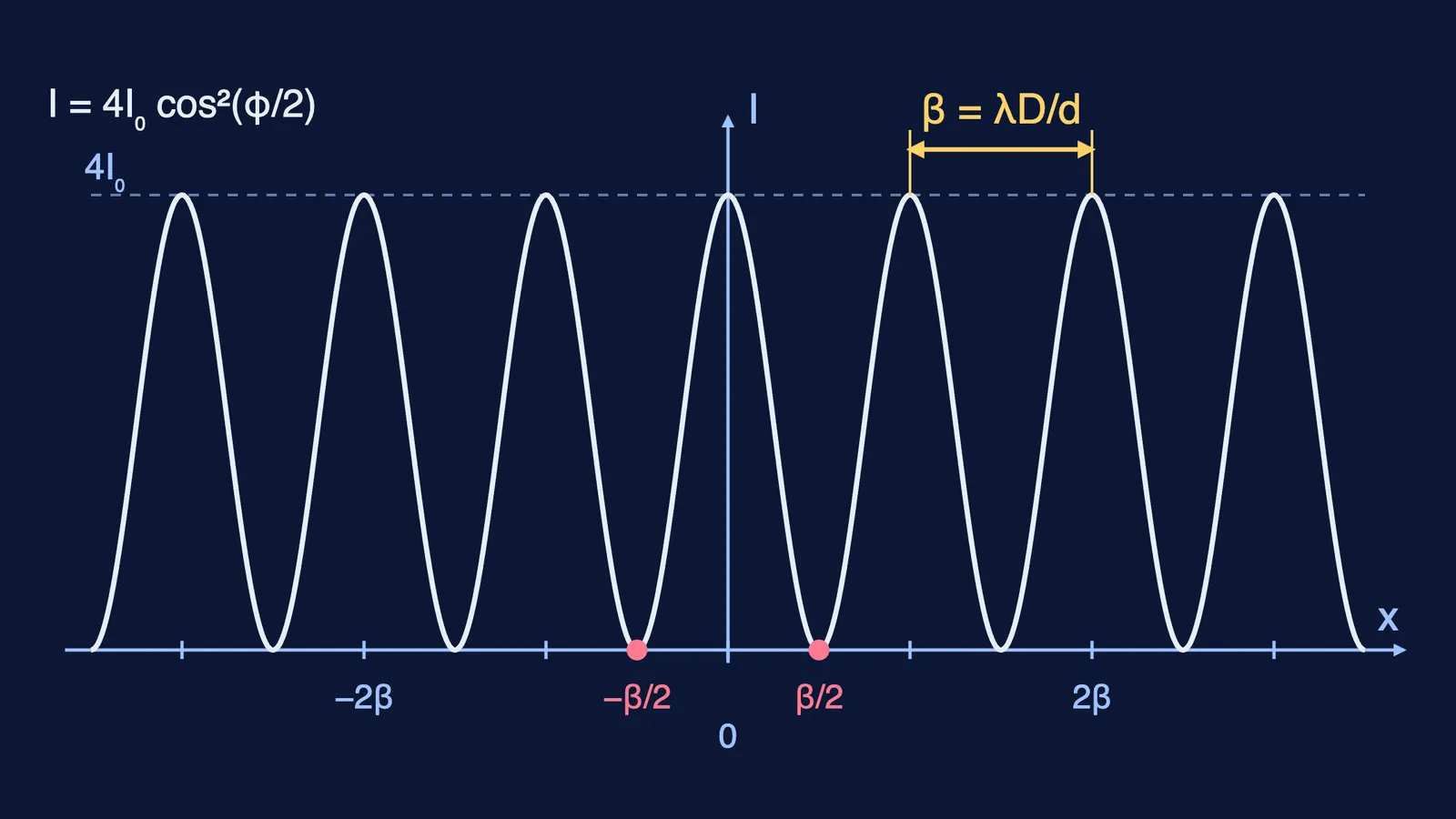
Two coherent sources of equal intensity I₀: I = 4I₀ cos²(φ/2), so the maximum is 4I₀ and the minimum is 0
Two incoherent sources (phase difference changing rapidly): I = 2I₀ at every point
Worked example: two coherent sources, each giving I₀ alone, meet at a point with path difference λ/4. Then φ = (2π/λ)(λ/4) = π/2, and I = 4I₀ cos²(π/4) = 4I₀ × ½ = 2I₀.
Watch for: writing 2I₀ as the maximum. Amplitudes add for coherent sources, so the peak is 4I₀; 2I₀ is the average, and the steady value for incoherent sources.
What is the fringe width formula in Young's double-slit experiment?
Symbols: d = slit separation (m); D = slit-to-screen distance (m); x = distance on the screen from the central bright fringe (m); β = fringe width (m). Conditions: D ≫ d and x small compared with D; monochromatic light; slits in phase.
Path difference at point x: Δ ≈ xd/D
Bright fringes: x_n = nλD/d, n = 0, ±1, ±2...
Dark fringes: x_n = (n + ½)λD/d, n = 0, ±1, ±2...
Fringe width (bright to bright, or dark to dark): β = λD/d, the spacing between successive positions in NCERT Eqs. 10.13 and 10.14
Worked example: λ = 550 nm, d = 0.25 mm, D = 1.2 m. β = (550 × 10⁻⁹ × 1.2)/(0.25 × 10⁻³) = 2.64 × 10⁻³ m = 2.64 mm. The third bright fringe is at 3β = 7.92 mm. The dark fringe for n = 1, the second dark fringe from the centre, is at 1.5β = 3.96 mm.
Watch for: counting dark fringes from n = 1. The first dark fringe is n = 0, at β/2, so the kth dark fringe sits at (k − ½)β. Also convert mm and nm to metres before dividing.
Single-slit diffraction (qualitative)
Symbols: a = slit width (m); θ = angle from the central line (rad). Conditions: a parallel beam falling normally on the slit, angles small, as in NCERT Fig. 10.14.
Minima (zero intensity): θ ≈ nλ/a, n = ±1, ±2, ±3... (n = 0 is the central maximum, not a minimum)
Secondary maxima, getting weaker: θ ≈ (n + ½)λ/a, n = 1, 2, 3... on each side
Central maximum, between the first minima on either side: angular width 2λ/a
Linear width of the central maximum on a screen at distance D: 2λD/a
Worked example: a = 0.20 mm, λ = 500 nm, D = 1.5 m. The first minimum is at θ = (500 × 10⁻⁹)/(0.20 × 10⁻³) = 2.5 × 10⁻³ rad, so the central maximum spans 5.0 × 10⁻³ rad, which is 2λD/a = 7.5 mm on the screen.
Watch for: mixing up the two patterns. In Young's experiment λ/d gives bright fringes; in a single slit λ/a gives dark ones, and the central maximum is twice as wide as the other fringes.
How to revise this formula sheet
Write the four groups from memory with their conditions, then compare. Missing "D ≫ d" or "n₁ > n₂" counts as a wrong line.
Sketch the I = 4I₀ cos²(φ/2) curve above this article and mark β, the first dark fringe at β/2 and the 4I₀ peak. One picture holds most of the Young's experiment results.
Practise the units drill: every λ in metres, every slit gap in metres, angles in radians.
If the fringe pattern is hard to picture, the Fermi Simulation Lab has interactive simulations for the ideas that are easier to see than to read.
Then test yourself with Wave Optics JEE Main practice questions with solutions, and use the Wave Optics Class 12 board exam guide to plan your answers. The Ray Optics Class 12 board exam guide covers the chapter before this one.