On this page
This sheet collects the main formulas of Chapter 6 of the NCERT Class 12 Physics Part I textbook (Reprint 2026-27), in the order the chapter teaches them.
The CBSE Physics curriculum for 2026-27 lists Faraday's laws, induced emf and current, Lenz's law, and self and mutual induction under Chapter 6, and the AC generator under Chapter 7 (NCERT teaches it in Section 6.8). Eddy currents are not in the 2026-27 NCERT chapter.
See also our electromagnetic induction Class 12 board exam guide and the chapter's step-by-step derivations.
What do magnetic flux and Faraday's law say?
Symbols: B is the magnetic field (tesla, T), A the area (m²), θ the angle between B and the normal to the surface, N the number of turns, t time (s), R the circuit resistance (Ω), ε the emf (volt, V).
Flux through a plane area in a uniform field: Φ = B · A = BA cos θ.
Non-uniform field or curved surface: Φ = Σ Bᵢ · dAᵢ over all area elements.
Unit of flux: weber, 1 Wb = 1 T m² (a scalar).
Faraday's law for one loop: ε = −dΦ/dt.
Closely wound coil of N turns: ε = −N dΦ/dt, where NΦ is the flux linkage.
Average emf over an interval: |ε| = N |ΔΦ|/Δt.
Induced current in a closed circuit: I = ε/R.
Lenz's law (the minus sign): the induced current opposes the change in flux that produced it.
Worked example: a coil of 150 turns and area 0.020 m² sits with its normal along a field that falls steadily from 0.50 T to 0.10 T in 0.040 s. ΔΦ per turn = 0.020 × 0.40 = 0.0080 Wb, so |ε| = 150 × 0.0080/0.040 = 30 V. With R = 12 Ω, I = 30/12 = 2.5 A. The flux is falling, so the induced current adds flux in the original direction.
Watch for: θ is measured from the normal, not from the plane of the coil. Flipping a coil through 180° from face-on (θ = 0) changes the flux by 2BA, not BA.
How do you find motional emf?
Symbols: l is rod length (m), v speed (m/s), ω angular speed (rad/s), ν rotation frequency (rev/s), R the length of a rotating rod (m, a length here, not a resistance).
Straight rod moving in a uniform, steady field, with l, v and B mutually perpendicular: ε = Blv.
Rod of length R rotating about one end in a plane perpendicular to B: ε = ½BωR².
Angular speed from rotation rate: ω = 2πν.
Worked example 1: a 0.50 m rod slides at 4.0 m/s on rails in a 0.30 T field perpendicular to them. ε = 0.30 × 0.50 × 4.0 = 0.60 V.
Worked example 2: a 0.80 m metal rod spins at 30 rev/s about one end in a 0.50 T field along the axis. ω = 2π × 30 ≈ 188.5 rad/s, so ε = ½ × 0.50 × 188.5 × 0.80² ≈ 30.2 V.
Watch for: convert rev/s to rad/s first. Wheel spokes are in parallel, so their number does not change the emf.
Self-inductance, mutual inductance and stored energy
Symbols: L and M are self- and mutual inductance (henry, H, dimensions [M L² T⁻² A⁻²]), I current (A), n turns per metre, l solenoid length (m), μ₀ = 4π × 10⁻⁷ T m A⁻¹, μᵣ the core's relative permeability (no unit), n₁ and n₂ the turns per metre of the inner and outer solenoids, N₁ the turns of coil 1, Φ₁ the flux through each of its turns, I₁ and I₂ the currents in coils 1 and 2, r₁ and r₂ the inner and outer radii (m).
Self-inductance: NΦ = LI, and ε = −L dI/dt.
Long solenoid (l ≫ radius, edge effects ignored): L = μ₀n²Al; with a core, L = μᵣμ₀n²Al.
Mutual inductance: N₁Φ₁ = M₁₂I₂, and ε₁ = −M dI₂/dt.
M₁₂ = M₂₁ = M.
Two long co-axial solenoids of the same length l: M = μ₀n₁n₂πr₁²l; with a medium, M = μᵣμ₀n₁n₂πr₁²l.
Two concentric co-axial single-turn circular coils with r₁ ≪ r₂: M = μ₀πr₁²/(2r₂).
Both effects together in coil 1: ε₁ = −L₁ dI₁/dt − M₁₂ dI₂/dt, where L₁ is coil 1's self-inductance (NCERT writes M₁₁).
Energy stored in an inductor: U = ½LI² (joule, J).
Magnetic energy density: u_B = B²/(2μ₀) (J/m³).
Worked example: an air-cored solenoid 0.50 m long has 1000 turns (n = 2000 m⁻¹) and cross-section 4.0 × 10⁻⁴ m², so L = μ₀n²Al ≈ 1.0 × 10⁻³ H. If the current rises steadily from 0 to 3.0 A in 0.010 s, the self-induced emf is 1.0 × 10⁻³ × 300 ≈ 0.30 V. The stored energy at 3.0 A is ½ × 1.0 × 10⁻³ × 3.0² ≈ 4.5 × 10⁻³ J.
Watch for: n is turns per metre, and 1 cm² = 10⁻⁴ m².
What formula gives the emf of an AC generator?
Symbols: N turns of area A rotate at constant ω in a uniform field B, with θ = ωt (θ = 0 at t = 0, coil plane perpendicular to B); ε₀ is the peak emf (V).
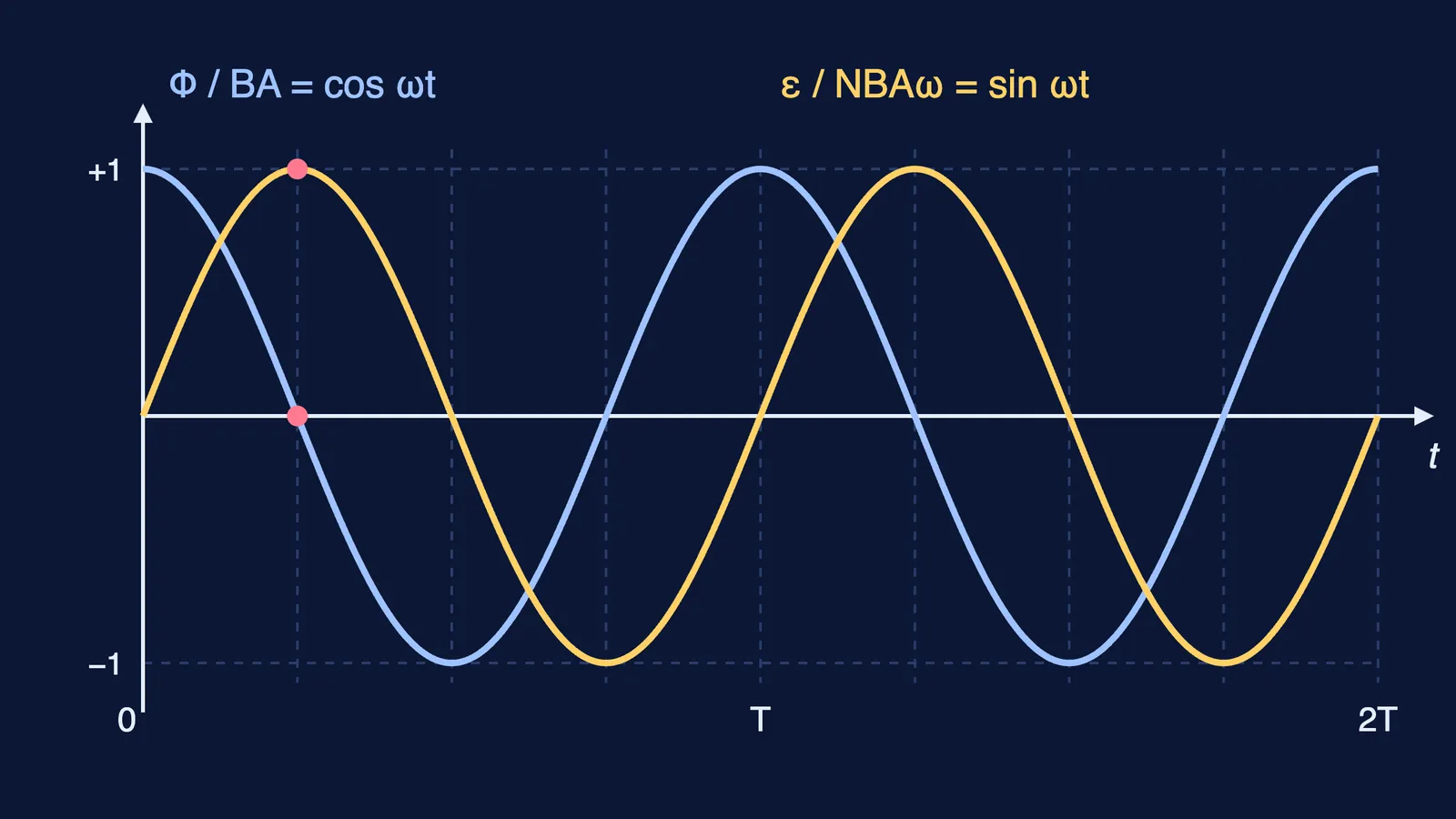
Flux at time t: Φ = BA cos ωt.
Instantaneous emf: ε = NBAω sin ωt.
Peak emf: ε₀ = NBAω, so ε = ε₀ sin ωt.
With ω = 2πν: ε = ε₀ sin 2πνt.
Worked example: a 50-turn coil of area 0.030 m² turns at 50 Hz in a 0.20 T field. ε₀ = 50 × 0.20 × 0.030 × 2π × 50 ≈ 94.2 V.
Watch for: ε peaks when the flux is zero (coil plane parallel to B), a quarter-turn offset shown in the graph at the top.
The Fermi Simulation Lab has interactive simulations for the ideas that are easier to see than to read.
How to revise this formula sheet
Start every flux question by drawing the coil's normal and marking θ from it.
For each emf formula, name what changes: B, area, angle or current.
Apply Lenz's law in words before writing a sign.
Rework the solenoid example from memory, checking units in henry and joule.
Test yourself on our electromagnetic induction case study questions.