On this page
Case-based questions give you a short passage and a run of linked sub-questions, so one misread line can cost every part. Here are three original cases on electromagnetic induction, easiest first, each with four graded parts and worked answers. They stay inside the CBSE Class XII Physics curriculum for 2026-27, which lists Faraday's laws, induced emf and current, Lenz's law, and self and mutual induction for this chapter, and every formula follows the NCERT Class 12 Physics Chapter 6, 2026-27 reprint.
Attempt all four parts before checking. For derivations and answer layout, see our electromagnetic induction board exam answer guide. For the question format itself, read how case-based questions work in board exams.
Case 1: How much charge flows when a magnet is switched off?
In a school lab in Bhopal, Ananya places a flat coil of 200 turns, each of area 25 cm², between the poles of an electromagnet. The plane of the coil is perpendicular to the field, which is uniform at 0.20 T. The coil is joined to a galvanometer, and the coil and galvanometer together have a resistance of 8.0 Ω. When her partner switches the electromagnet off, the field falls steadily to zero in 0.050 s and the galvanometer needle kicks, then returns to zero.
(i) The magnetic flux through one turn before switch-off is: (a) 5.0 × 10⁻⁴ Wb (b) 5.0 × 10⁻² Wb (c) 0.10 Wb (d) 1.0 × 10⁻³ Wb
(ii) What is the average emf induced in the coil?
(iii) Seen from the north pole of the electromagnet, is the induced current clockwise or anticlockwise as the field falls?
(iv) Find the charge that flows through the galvanometer and explain why a slower switch-off would give the same charge.
Answers.
(i) (a). Φ = BA = 0.20 × 25 × 10⁻⁴ = 5.0 × 10⁻⁴ Wb.
(ii) ε = NΔΦ/Δt = 200 × 5.0 × 10⁻⁴ / 0.050 = 2.0 V.
(iii) The field points away from the north pole and is falling. The induced current must add field in that direction, so seen from the north pole it is clockwise.
(iv) Q = IΔt = (NΔΦ/RΔt)Δt = NΔΦ/R = 0.10/8.0 = 0.0125 C. Δt cancels, so a slower switch-off gives a smaller current for longer but the same charge.
Case 2: Why does a ceiling fan blade carry an emf?
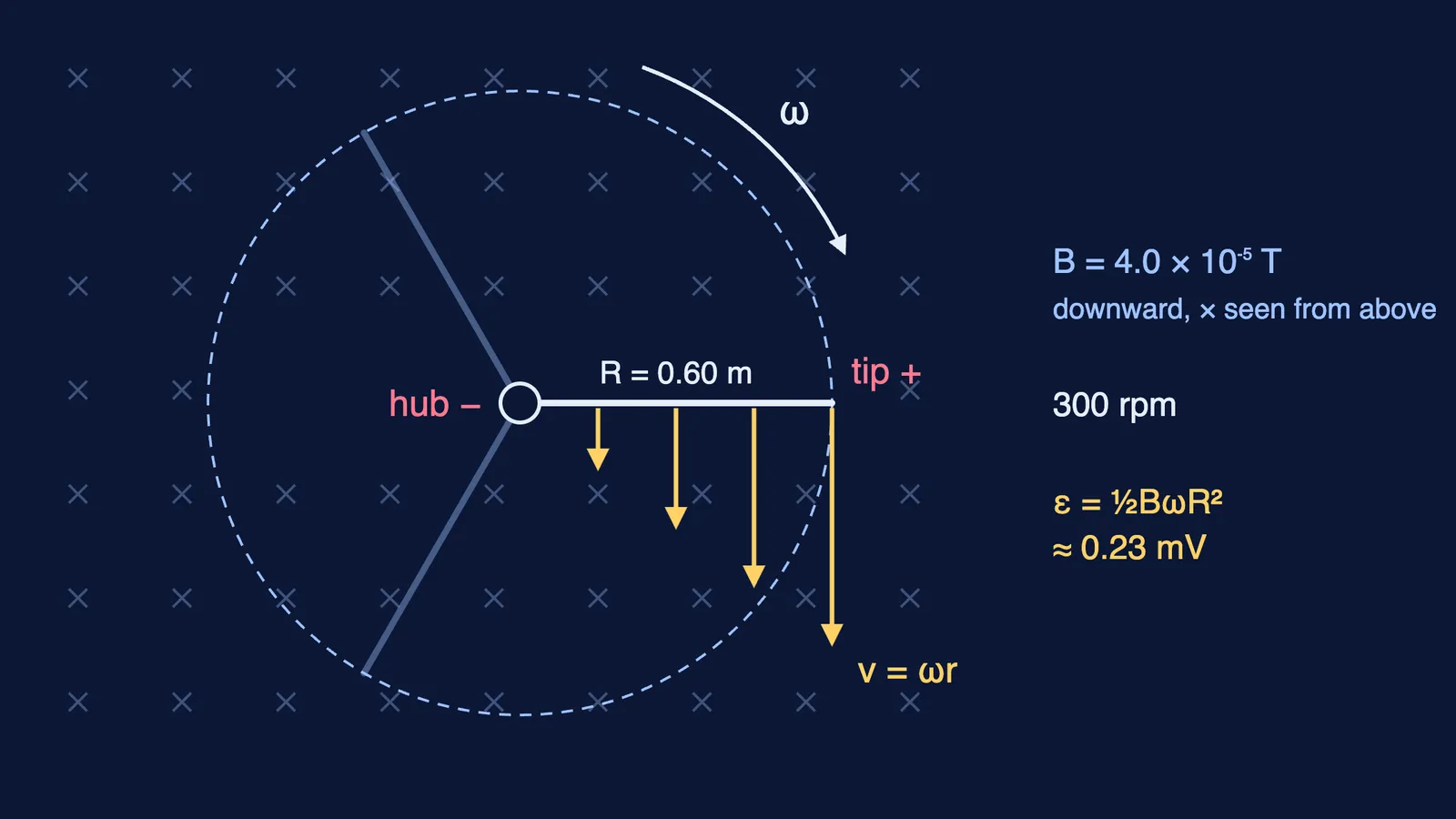
A ceiling fan in a Lucknow classroom has metal blades whose tips sit 0.60 m from the axis. It runs at 300 revolutions per minute and, seen from below, the blades turn anticlockwise. Take the vertical component of the Earth's magnetic field there as 4.0 × 10⁻⁵ T, pointing downwards, and ignore the horizontal component. Each blade behaves like a straight rod rotating about one end in a field perpendicular to its plane of rotation. A sensitive voltmeter joined between hub and tip through sliding contacts would show a small, steady reading.
(i) The emf between hub and tip depends on: (a) B only (b) ω only (c) B, ω and R² (d) the number of blades
(ii) Calculate the emf between the hub and the tip of one blade.
(iii) Which end of the blade is at the higher potential, the hub or the tip?
(iv) If the fan ran at twice the speed with blades twice as long, by what factor would the emf change? Show why.
Answers.
(i) (c). ε = ½BωR²; blade count does not matter because the blades are in parallel.
(ii) ω = 2π × 300/60 = 31.4 rad/s. ε = ½ × 4.0 × 10⁻⁵ × 31.4 × 0.60² = 2.3 × 10⁻⁴ V, about 0.23 mV.
(iii) Anticlockwise from below is clockwise from above. With B downwards, the force q(v × B) on a positive charge points outwards along the blade, so positive charge collects at the tip: the tip is at higher potential.
(iv) ε ∝ ωR², so the factor is 2 × 2² = 8.
Case 3: How strongly are two coaxial coils linked?
A student team in Kochi builds a mutual-induction demonstration for a science fair. They wind an outer solenoid of 1,000 turns, 50 cm long and 2.0 cm in radius. Inside it, on the same axis and of the same length, they place an inner solenoid of 500 turns and radius 1.0 cm. The outer coil carries a steady 2.0 A from a battery. When a switch opens, its current drops to zero in 5.0 ms, and a galvanometer across the inner coil kicks. Neglect edge effects and assume air cores throughout.
(i) While the outer current stays steady at 2.0 A, the emf in the inner coil is: (a) zero (b) maximum (c) equal to the battery voltage (d) negative
(ii) Calculate the mutual inductance of the pair.
(iii) Find the average emf induced in the inner coil when the switch opens.
(iv) Find the self-inductance of the outer solenoid and the energy stored in it at 2.0 A.
Answers.
(i) (a). Steady current, steady flux linkage, no emf.
(ii) n₁ = 500/0.50 = 1,000 per m and n₂ = 1,000/0.50 = 2,000 per m. M = μ₀n₁n₂πr₁²l = 4π × 10⁻⁷ × 1,000 × 2,000 × π × (0.010)² × 0.50 = 3.95 × 10⁻⁴ H, about 0.39 mH.
(iii) ε = M ΔI/Δt = 3.95 × 10⁻⁴ × 2.0/(5.0 × 10⁻³) = 0.16 V.
(iv) L = μ₀n₂²πr₂²l = 4π × 10⁻⁷ × (2,000)² × π × (0.020)² × 0.50 = 3.2 × 10⁻³ H. Energy U = ½LI² = ½ × 3.16 × 10⁻³ × 2.0² = 6.3 × 10⁻³ J.
How do you attack case-study questions on induction?
First write what is changing: B, area, angle or current. That tells you whether to use NΔΦ/Δt, Blv, ½BωR² or M dI/dt.
For every direction question, say whether flux is rising or falling, then make the induced current oppose that change. Name the side you are looking from.
A steady field, a steady current or a loop sliding (not rotating) wholly inside a uniform field gives zero emf.
For charge, use Q = NΔΦ/R; time cancels.
In mutual inductance, use the inner coil's radius: only its area links both fields.
If Lenz's-law directions are hard to picture, the Fermi Simulation Lab has interactive simulations for ideas easier to see than to read. When you are done here, try the assertion-reason questions on electromagnetic induction and AC.