

On this page
Three original cases, easy to hard, with worked answers. If a rule feels shaky, start with our Units and Measurements Class 11 guide with worked examples.
What do these Units and Measurements case studies cover?
Every case stays inside Chapter 1 of the CBSE 2026-27 Class XI Physics curriculum: SI units, significant figures, the uncertainty in a result, and dimensional analysis. The rules used come from the rationalised NCERT Class 11 Physics Chapter 1, Units and Measurement (Reprint 2026-27), including its convention for rounding a dropped 5. Class 11 exams are set by your school, so treat these as practice in the case-based style, not a copy of any paper.
Case 1: A carpenter's tabletop in Mysuru
A carpenter in Mysuru is making a teak dining table. He measures the top with a steel tape that reads to the nearest millimetre: length 152.4 cm and width 76.0 cm. Vernier callipers give the plank's thickness as 1.85 cm. His nephew, a Class 11 student, types the numbers into a phone calculator to order polish and edging. He reports the area as 11582.4 cm² and the volume of wood as 21427.44 cm³. The carpenter asks whether all those digits mean anything.
(i) How many significant figures does the width 76.0 cm have? (a) 1 (b) 2 (c) 3 (d) 4
(ii) Write the length in metres. Does the number of significant figures change?
(iii) Find the perimeter of the top, for the edging strip, to the correct precision.
(iv) Rewrite the nephew's area and volume to the correct number of significant figures, and give the volume in m³.
Answers.
(i) (c). The trailing zero after a decimal point is significant.
(ii) 1.524 m, still four significant figures. Changing units only moves the decimal point.
(iii) 2 × (152.4 + 76.0) = 456.8 cm. Addition keeps one decimal place, and the factor 2 is exact.
(iv) The least precise readings, 76.0 cm and 1.85 cm, have three significant figures, so the area is 1.16 × 10⁴ cm² and the volume is 2.14 × 10⁴ cm³, or 0.0214 m³.
Case 2: Timing a toy car in a Guwahati lab
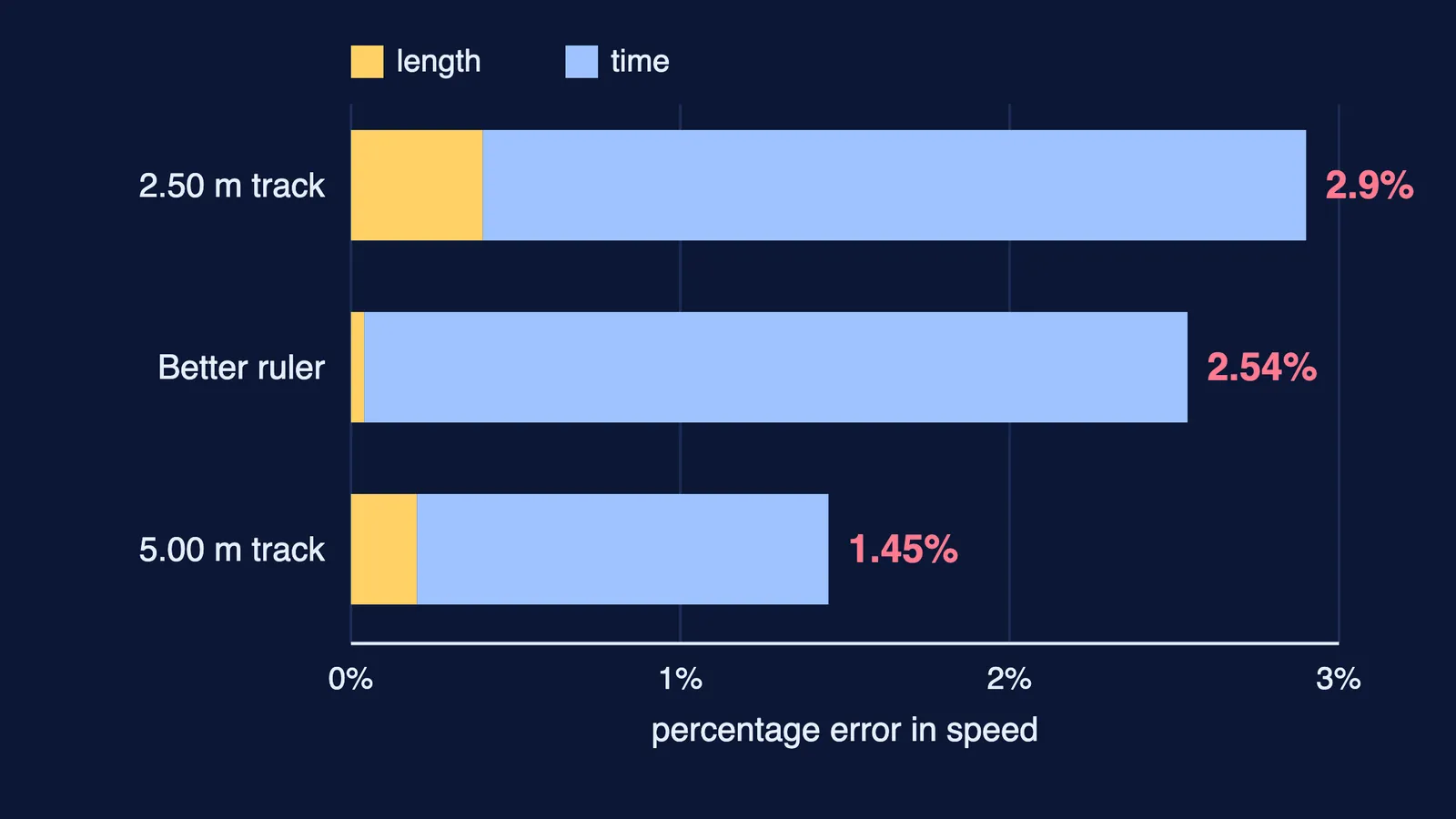
A Class 11 group in Guwahati measures the speed of a battery-powered toy car. They mark a straight track 2.50 m long, measured to ± 0.01 m. Riya starts a phone stopwatch as the car crosses the start line and stops it at the finish. The time is 4.0 s, and the group agrees that hand timing is good only to ± 0.1 s. Their teacher asks for the speed with its uncertainty. Riya then wants to buy a better ruler, reading to ± 0.001 m. Arjun instead wants to double the track to 5.00 m (± 0.01 m), over which the car takes 8.0 s (± 0.1 s).
(i) The percentage error in the track length is: (a) 0.01% (b) 0.4% (c) 2.5% (d) 4%
(ii) Find the speed to the correct number of significant figures.
(iii) Find the percentage and absolute uncertainty in the speed.
(iv) Whose suggestion reduces the percentage error in the speed more, Riya's or Arjun's? Show the numbers.
Answers.
(i) (b). 0.01 / 2.50 × 100 = 0.4%.
(ii) 2.50 / 4.0 = 0.625 m s⁻¹. The time has two significant figures, so keep two. The dropped digit is 5 and the digit before it (2) is even, so by NCERT's convention it stays: 0.62 m s⁻¹.
(iii) For a quotient, add the relative errors: 0.4% + (0.1 / 4.0 × 100 = 2.5%) = 2.9%. Absolute error = 0.625 × 0.029 ≈ 0.018, so v = 0.62 ± 0.02 m s⁻¹.
(iv) Riya: 0.04% + 2.5% = 2.54%. Arjun: 0.2% + 1.25% = 1.45%. Arjun's idea wins, because the timing error was the bigger share.
Case 3: Wave speed in coastal water, from dimensions
An intern at an ocean-science lab in Chennai studies long waves moving towards the coast. She guesses that the speed v of such a wave depends only on the depth of water d, the acceleration due to gravity g and the density of sea water ρ. She uses the method of dimensions, writing v = k gˣ dʸ ρᶻ, where k is a dimensionless constant. A colleague suggests the simpler formula v = gd. Her lab wants to compare the speed of such a wave over the open ocean, 4000 m deep, with that over a continental shelf 40 m deep.
(i) The dimensional formula of density is: (a) [M L³] (b) [M L⁻³] (c) [M L⁻² T⁰] (d) [M⁰ L⁻³]
(ii) Is the colleague's formula v = gd dimensionally correct? Give one line of reasoning.
(iii) Find x, y and z, and write the relation.
(iv) Without knowing k, find how many times faster the wave travels at 4000 m than at 40 m. Name one thing this method cannot tell her.
Answers.
(i) (b). Density is mass per unit volume.
(ii) No. [gd] = [L T⁻²][L] = [L² T⁻²], but [v] = [L T⁻¹].
(iii) [L T⁻¹] = [L T⁻²]ˣ [L]ʸ [M L⁻³]ᶻ. M: z = 0. T: −2x = −1, so x = 1/2. L: x + y − 3z = 1, so y = 1/2. So v = k√(gd), and density drops out.
(iv) v₁ / v₂ = √(4000 / 40) = √100 = 10 times faster; k cancels in the ratio. The method cannot give the value of k, and it cannot show that the wave depends only on these three quantities.
How do you attack case-study questions in this chapter?
Underline every measured value and count its significant figures before you calculate (Case 1).
Ask which operation you are doing: multiply or divide means fewest significant figures; add or subtract means fewest decimal places.
When the digit you drop is exactly 5, apply NCERT's even-odd rule instead of always rounding up (Case 2).
For a product or quotient, convert each error to a percentage first, then add.
In dimensional analysis, write one equation per base dimension, and use ratios when the constant is unknown (Case 3).
For the strategy behind these questions, read our guide to case-based questions in board exams. If one step keeps slipping, the Fermi Problem Library has worked problems with a step-by-step solver that explains the reasoning rather than printing an answer.


