

On this page
Case-based questions give you a short real-life situation and several linked questions about it, testing whether you can spot the counting idea hidden in the story. Below are three original cases on Chapter 6 of the NCERT Class 11 Mathematics textbook (Reprint 2026-27), set inside the topics the CBSE 2026-27 Class XI Mathematics syllabus lists: the fundamental principle of counting, factorial notation, permutations, combinations and simple applications. Class 11 exams are set by your school, so treat these as case-style practice, not a prediction of your paper. Theory first? Read our Permutations and Combinations Class 11 guide with examples.
Case 1: How many lunch combos can a Kochi canteen offer?
A college canteen in Kochi sells a lunch combo. You pick one main from five (sambar rice, curd rice, veg biryani, appam with stew, chapati with kurma), one side from three (papad, salad, pickle) and one dessert from two (payasam, banana). Anjali, a first-year student, eats lunch there every weekday, Monday to Friday. She has decided two things: she will have a different main on each of the five days, but she does not mind repeating a side. The manager wants a menu card showing how many combos exist.
(i) How many different combos can be made with one main, one side and one dessert? (a) 10 (b) 15 (c) 30 (d) 60
(ii) The canteen adds the option "no dessert". How many combos are possible now?
(iii) Ignoring sides and desserts, in how many orders can Anjali eat the five mains across the week?
(iv) Counting only her main and her side for each day, how many different weekly lunch plans can Anjali make?
Answers.
(i) (c) 30. By the multiplication principle, 5 × 3 × 2 = 30.
(ii) The dessert choice now has 3 options (payasam, banana, none), so 5 × 3 × 3 = 45.
(iii) The five different mains fill five days with no repetition, so 5! = 120.
(iv) Mains: 5! = 120. Sides may repeat: 3⁵ = 243. Total = 120 × 243 = 29,160.
Case 2: How many different trains can Kavya build for a science fair?
For her school science fair in Mysuru, Kavya builds a model train with 8 coaches behind the engine: 4 sleeper coaches (S), 2 AC three-tier coaches (B), 1 pantry car (P) and 1 general coach (G). Coaches of the same type are painted identically, so two sleeper coaches swapped look the same. Her friend Rohan claims there are 8! = 40,320 different-looking trains. Kavya thinks the true number is much smaller, and wants to check it before she labels her display board.
(i) How many different-looking trains can be made using all 8 coaches? (a) 40,320 (b) 1,680 (c) 840 (d) 420
(ii) In how many of these are the two AC coaches next to each other?
(iii) In how many are the two AC coaches never next to each other?
(iv) Kavya now paints a number on every coach (S1 to S4, B1, B2, P, G), so all 8 are different. In how many arrangements are all four sleeper coaches together and both AC coaches together?
Answers.
(i) (c) 840. With repeated objects, 8!/(4! 2!) = 40,320/48 = 840.
(ii) Glue the two B coaches into one block, then arrange 7 units with 4 identical S: 7!/4! = 210.
(iii) Complement: 840 − 210 = 630.
(iv) Arrange 4 units (S-block, B-block, P, G) in 4! = 24 ways, then the blocks internally in 4! and 2! ways: 24 × 24 × 2 = 1,152.
Case 3: How many robotics teams can a Bhopal school pick?
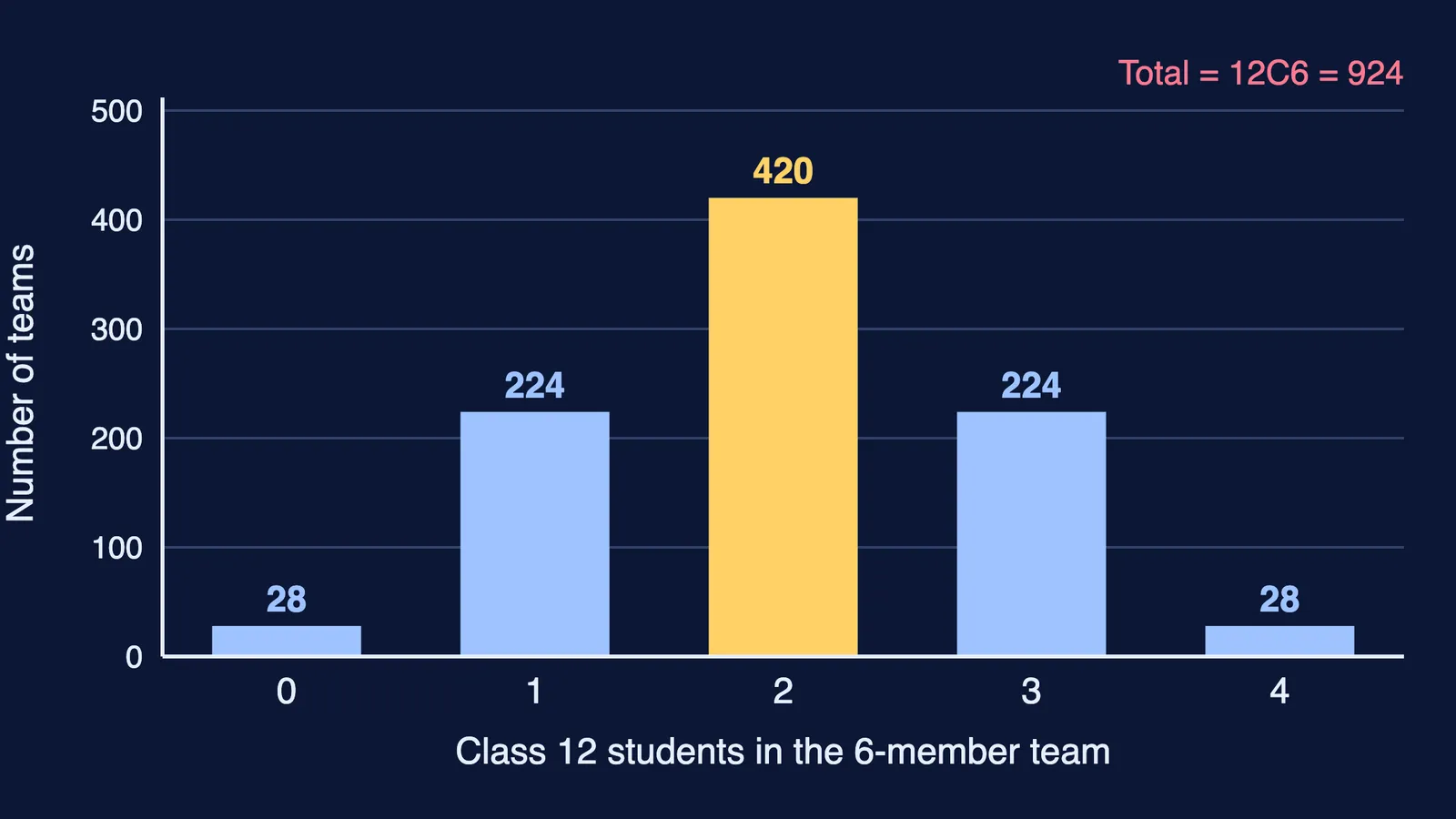
A school in Bhopal must send a 6-member team to a district robotics contest. Twelve students have applied after a selection test: 8 from Class 11 and 4 from Class 12. Two applicants, Aarav (Class 11) and Meher (Class 12), have said they will not work on the same team. The teacher wants a mix of Class 11 and Class 12 experience on the team. Once a team is fixed, its members will choose a captain and a vice-captain from among themselves.
(i) How many 6-member teams can be chosen with no conditions? (a) 210 (b) 495 (c) 924 (d) 665,280
(ii) How many teams have exactly 2 Class 12 students?
(iii) How many teams have at least one Class 12 student?
(iv) Aarav and Meher must not both be on the team. How many teams are possible, and in how many ways can such a team be formed together with a captain and a vice-captain?
Answers.
(i) (c) 924. Order does not matter, so ¹²C₆ = 12!/(6! 6!) = 924.
(ii) Choose 4 from Class 11 and 2 from Class 12: ⁸C₄ × ⁴C₂ = 70 × 6 = 420.
(iii) Complement of "no Class 12 student": 924 − ⁸C₆ = 924 − 28 = 896.
(iv) Teams with both Aarav and Meher: fix them and choose 4 more from the other 10, ¹⁰C₄ = 210. Allowed teams = 924 − 210 = 714. Captain and vice-captain are an ordered pair from 6: ⁶P₂ = 30. Total = 714 × 30 = 21,420.
How to attack case-study questions on permutations and combinations?
Ask "does order matter?" for every part. In Case 3 the team ignores order but the captain and vice-captain do not.
Mark identical objects. If the passage says items look the same, divide by the factorial of each repeated group, as in Case 2.
Use the complement for "at least one" and "never together". Counting the opposite and subtracting is usually one line.
Treat "together" as a block. Count it as one unit, then multiply by its internal arrangements.
Reuse earlier parts. Part (iii) of Case 2 subtracts the answer to part (ii), and part (iii) of Case 3 starts from the total in part (i).
For more practice beyond the case format, try our Permutations and Combinations JEE Main practice questions with solutions, and see how case-based questions work in board exams. If you get a count wrong and cannot see why, the Fermi Problem Library has worked problems with a step-by-step solver that explains the reasoning rather than printing an answer.


