On this page
Formulas first? See our Sequences and Series Class 11 guide.
Which topics do these Class 11 case-study questions cover?
The CBSE Class XI Mathematics curriculum for 2026-27 lists sequences and series, the arithmetic mean (A.M.), the G.P. and its sum, the geometric mean (G.M.) and the A.M.-G.M. relation. It marks the special sums of k, k² and k³ as assessed only formatively, so we leave them out. Class 11 exams are set by schools, so treat these as practice.
The cases use results from the NCERT Class 11 chapter on sequences and series (Reprint 2026-27): a G.P. has nth term arⁿ⁻¹, its first n terms sum to a(1 − rⁿ)/(1 − r) when r ≠ 1, and for positive a and b, A = (a + b)/2 ≥ G = √(ab).
Case 1: Dot patterns for a school display
Kavya, in Class 11 in Chennai, is making kolam-style dot patterns for a school display. Pattern 1 is a row of 2 dots, pattern 2 is 2 rows of 3, and pattern n has n rows with n + 1 dots in each row. Each dot is a round sticker, and her teacher wants every pattern complete. She has one pack of 250 stickers and makes the patterns in order from pattern 1, stopping when she cannot finish the next.
(i) How many dots does pattern 7 have? (a) 49 (b) 56 (c) 63 (d) 42
(ii) Which pattern has 182 dots?
(iii) Show that pattern n + 1 has 2(n + 1) more dots than pattern n, and use this to find pattern 8 from pattern 7.
(iv) How many complete patterns can Kavya make with one pack, and how many stickers are left over?
Answers.
(i) (b). aₙ = n(n + 1), so a₇ = 7 × 8 = 56.
(ii) n(n + 1) = 182 = 13 × 14, so pattern 13.
(iii) aₙ₊₁ − aₙ = (n + 1)(n + 2) − n(n + 1) = 2(n + 1). So a₈ = 56 + 2 × 8 = 72.
(iv) Add the terms directly: running totals of 2 + 6 + 12 + 20 + 30 + 42 + 56 + 72 + 90 reach 168 after seven patterns, 240 after eight and 330 after nine. So 8 patterns, with 10 stickers left.
Case 2: A filter train at a village water plant
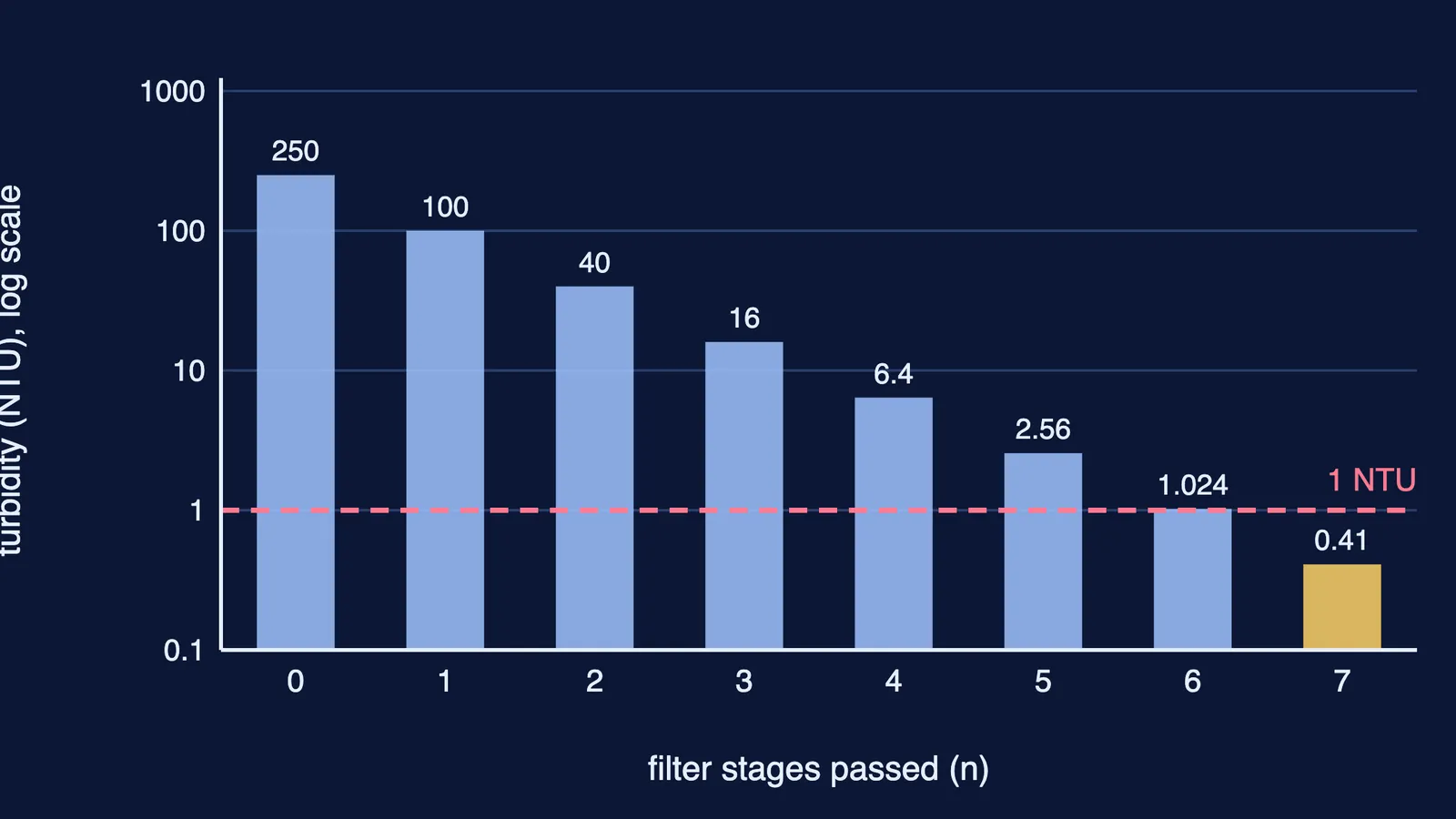
A village water plant in Odisha runs river water through identical filter stages. Each stage passes the same fraction of the turbidity (cloudiness, in NTU) entering it. Water flows through the stages one after another, and a sensor after each stage logs the reading. One morning the inlet reads 250 NTU and the sensor after stage 3 reads 16 NTU; the sensors after stages 1 and 2 are broken. The engineer wants the outlet below 1 NTU and asks a trainee to fill the gaps and plan more stages.
(i) The fraction of turbidity each stage lets through is: (a) 0.6 (b) 0.4 (c) 0.064 (d) 0.16
(ii) Find the two missing readings.
(iii) Using a G.P. sum, how much turbidity do the first four stages remove altogether?
(iv) What is the least number of stages that brings the outlet below 1 NTU?
Answers.
(i) (b). 250, x, y, 16 form a G.P., so 250r³ = 16, r³ = 0.064 and r = 0.4.
(ii) 250 × 0.4 = 100 NTU and 100 × 0.4 = 40 NTU: the two geometric means between 250 and 16.
(iii) Stage k removes 60% of what enters, so the amounts removed are 150, 60, 24, 9.6: a G.P. with a = 150 and r = 0.4. S₄ = 150(1 − 0.4⁴)/(1 − 0.4) = 150 × 0.9744/0.6 = 243.6 NTU. Check: 250 − 250 × 0.4⁴ = 250 − 6.4.
(iv) Keep multiplying by 0.4: 6.4, 2.56, 1.024, 0.4096. Six stages leave 1.024 NTU, so 7 are needed.
Case 3: Fencing a fish pond
A fish farmer near Kolkata is digging a rectangular pond with a fixed water area of 3600 m². It must be fenced on all four sides, and fencing is sold by the metre. Her son, in Class 11, notes that if the sides are l and b metres, the perimeter 2(l + b) is four times the A.M. of l and b, and the area is the square of their G.M. He uses this to find the least fencing needed.
(i) The G.M. of l and b is: (a) 1800 m (b) 60 m (c) 120 m (d) 900 m
(ii) If the pond is 90 m long, find its breadth and the A.M. of l and b, and check that A ≥ G.
(iii) Use A ≥ G to show that at least 240 m of fencing is needed. Which shape needs exactly 240 m?
(iv) The farmer already owns 250 m of fencing and wants to use all of it. Find the length and breadth.
Answers.
(i) (b). G = √(lb) = √3600 = 60 m.
(ii) b = 3600/90 = 40 m. A = (90 + 40)/2 = 65 m, more than G = 60 m.
(iii) Perimeter = 2(l + b) = 4A ≥ 4G = 4 × 60 = 240 m. Equality needs l = b: a 60 m square.
(iv) l + b = 125 and lb = 3600. Then (l − b)² = (l + b)² − 4lb = 15625 − 14400 = 1225, so l − b = 35. Solving gives l = 80 m and b = 45 m. Check: 80 × 45 = 3600.
How should you attack case-study questions on sequences and series?
Write a, r and n first, and decide which term the first reading is.
Given two G.P. terms, divide them to get a power of r; keep the root that fits.
"In all" or "total" asks for Sₙ; check a short sum by hand.
When a target is crossed, not hit, check the values on both sides.
In A.M.-G.M. parts, a fixed product means a fixed G.M. and a fixed sum a fixed A.M.
See our guide to case-based questions. If a step keeps slipping, the Fermi Problem Library has worked problems with a step-by-step solver that explains the reasoning rather than printing an answer.