On this page
For chapter notes and formulas, read our Statistics Class 11 Maths guide to mean deviation, variance and SD.
What do these Statistics case study questions cover?
Class 11 exams are set by your school, so the pattern varies. Treat these as practice in the case-based style.
Every method follows Chapter 13 of NCERT Class 11 Mathematics (Reprint 2026-27) and the CBSE 2026-27 Class XI Mathematics curriculum, which lists range, mean deviation, variance and standard deviation of ungrouped and grouped data. NCERT names quartile deviation as a measure of dispersion but does not teach it, so it is left out here.
Case 1: Two school bus routes in Pune
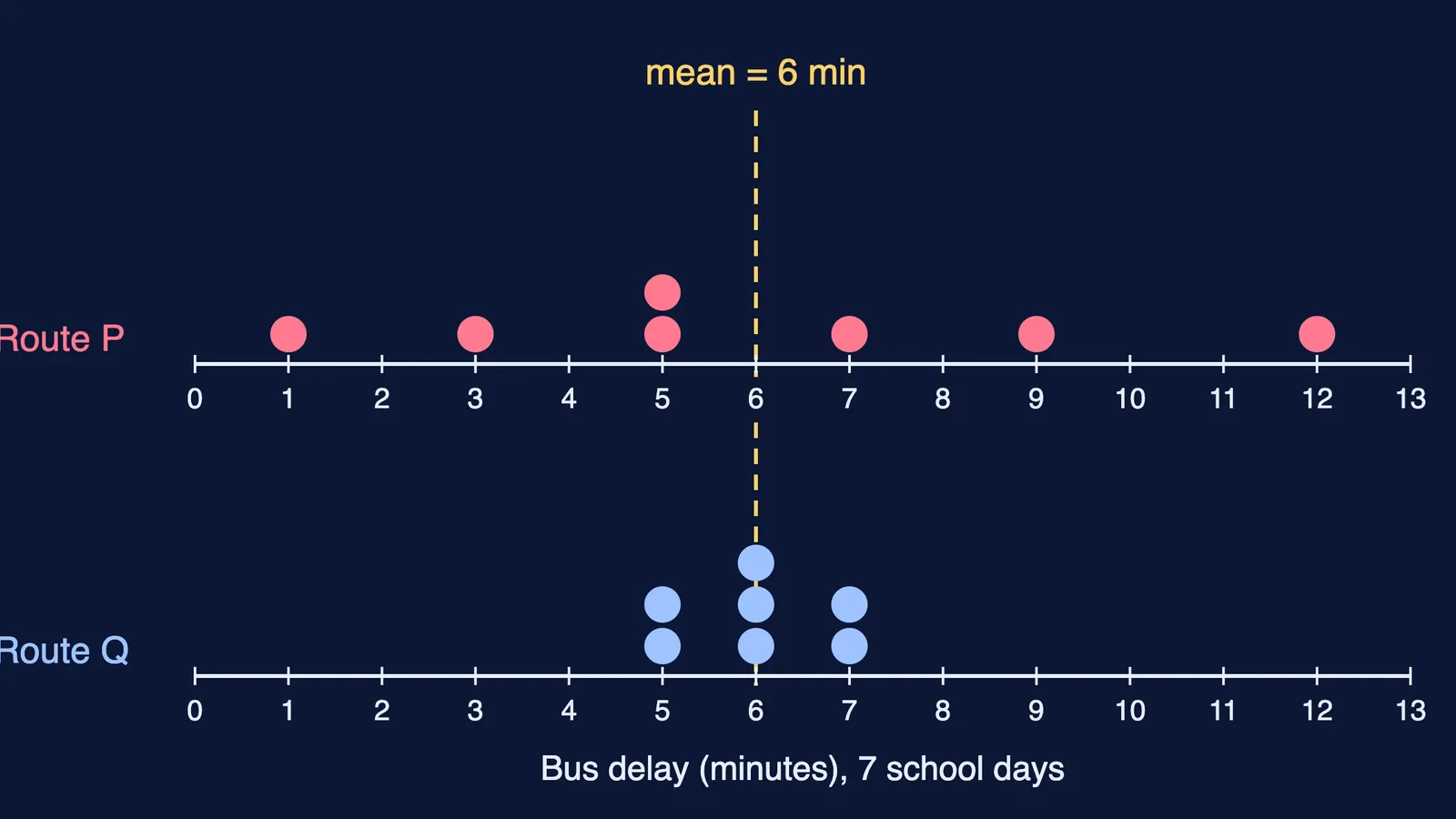
A parents' group in Pune keeps a simple log of how late two school buses arrive at the gate, in minutes, over seven school days. Route P: 3, 9, 1, 12, 5, 7, 5. Route Q: 6, 7, 5, 6, 7, 6, 5. Both routes have the same mean delay of 6 minutes, so one parent says the two buses are equally reliable. Another parent plots the delays as dots on a number line, sees one cluster tight and one scattered, and is not convinced.
(i) The range of Route P's delays is: (a) 6 min (b) 11 min (c) 12 min (d) 7 min
(ii) Find the median of Route P and its mean deviation about the median.
(iii) Find the mean deviation about the mean for both routes.
(iv) Find the standard deviation of each route and decide which bus is more reliable.
Answers.
(i) (b) Range = 12 − 1 = 11 min.
(ii) Sorted: 1, 3, 5, 5, 7, 9, 12, so M = 5 (the 4th value). |xᵢ − 5| = 2, 4, 4, 7, 0, 2, 0, sum 19. M.D.(M) = 19/7 ≈ 2.71 min.
(iii) Route P: |xᵢ − 6| = 3, 3, 5, 6, 1, 1, 1, sum 20, so M.D. = 20/7 ≈ 2.86 min. Route Q: 0, 1, 1, 0, 1, 0, 1, sum 4, so M.D. = 4/7 ≈ 0.57 min.
(iv) Route P: Σ(xᵢ − 6)² = 82, σ² = 82/7 ≈ 11.71, σ ≈ 3.42 min. Route Q: Σ(xᵢ − 6)² = 4, σ² = 4/7 ≈ 0.57, σ ≈ 0.76 min. Equal means hide different spreads; Route Q is more reliable.
Case 2: Defective bangles in a Jaipur workshop
A glass-bangle workshop in Jaipur picks 50 boxes from a wholesale order and checks them before dispatch, counting the defective bangles in each. Defects per box (frequency): 0 (7), 1 (12), 2 (14), 3 (10), 4 (5), 5 (2). The buyer deducts a fixed handling fee of ₹15 from every box plus ₹4 for each defective bangle in it. The owner wants to know the typical number of defects per box and how much the buyer's deduction varies from one box to the next.
(i) The mean number of defective bangles per box is: (a) 1.5 (b) 2 (c) 2.5 (d) 3
(ii) Find the variance of the number of defects.
(iii) Find the standard deviation and state its unit.
(iv) Find the mean and standard deviation of the deduction per box.
Answers.
(i) (b) N = 50 and Σfᵢxᵢ = 0 + 12 + 28 + 30 + 20 + 10 = 100, so x̄ = 100/50 = 2.
(ii) fᵢ(xᵢ − 2)² = 28, 12, 0, 10, 20, 18, sum 88. σ² = 88/50 = 1.76.
(iii) σ = √1.76 ≈ 1.33 defective bangles per box. The variance is in squared units; the standard deviation is back in the units of the data.
(iv) Deduction D = 15 + 4x. Mean: 15 + 4 × 2 = ₹23. With x = A + hy, NCERT shows x̄ = A + hȳ and σₓ² = h²σᵧ²; the fixed ₹15 shifts the mean but not the spread. So the variance of D is 16 × 1.76 = 28.16 and σ_D = 4 × √1.76 = √28.16 ≈ ₹5.31.
Case 3: Water use in a Bengaluru apartment block
During a summer shortage, a Bengaluru apartment association reads the meters of 40 flats and records daily water use in litres. Classes (number of flats): 100–120 (6), 120–140 (8), 140–160 (13), 160–180 (11), 180–200 (2). The mid-points are large, so the treasurer uses the step-deviation (shortcut) method with assumed mean A = 150 and class width h = 20 to save time. The committee wants a typical figure per flat and a measure of how unevenly the flats use water before it sets a daily limit for each household.
(i) For the class 160–180, the step deviation yᵢ = (xᵢ − A)/h is: (a) −1 (b) 0 (c) 1 (d) 2
(ii) Find the mean daily water use.
(iii) Find the variance and standard deviation by the shortcut method.
(iv) Find the mean deviation about the mean.
Answers.
(i) (c) Mid-point 170, so y = (170 − 150)/20 = 1.
(ii) Mid-points 110, 130, 150, 170, 190 give y = −2, −1, 0, 1, 2. fᵢyᵢ = −12, −8, 0, 11, 4, so Σfᵢyᵢ = −5. x̄ = 150 + 20 × (−5/40) = 147.5 litres.
(iii) fᵢyᵢ² = 24, 8, 0, 11, 8, so Σfᵢyᵢ² = 51. σ² = (h²/N²)[NΣfᵢyᵢ² − (Σfᵢyᵢ)²] = (400/1600)(40 × 51 − 25) = 0.25 × 2015 = 503.75 litres². σ ≈ 22.44 litres.
(iv) |xᵢ − 147.5| = 37.5, 17.5, 2.5, 22.5, 42.5. fᵢ|xᵢ − 147.5| = 225, 140, 32.5, 247.5, 85, sum 730. M.D.(x̄) = 730/40 = 18.25 litres.
How do you solve Statistics case-study questions?
Sort raw data first; the median and range then come straight off the list.
Decide what kind of data you have: raw values, a discrete table or class intervals. For classes, use mid-points.
Build columns (xᵢ, fᵢ, deviation, square) and total each before dividing by N.
When the same mean appears twice, the question is about spread. Answer with a measure of dispersion, not the mean.
Check units: variance is squared; SD and mean deviation use the data's units.
For a refresher on averages, see our guide to mean, median and mode, or read how to handle case-based questions. If a table keeps giving you the wrong answer, the Fermi Problem Library has worked problems with a step-by-step solver that explains the reasoning rather than printing an answer.