On this page
What are thermodynamics case-study questions in Class 11?
Class 11 exams are set by your school, not the board, so treat these three cases, easiest first, as practice in the case-based style: a short real-world passage, then four linked questions with worked answers. Every idea comes from Chapter 11, Thermodynamics, of NCERT Physics Part II (Reprint 2026-27), which sits in Unit VIII of the CBSE 2026-27 Physics curriculum. Scenarios and numbers are ours. NCERT's sign convention applies throughout: ∆Q = ∆U + ∆W, with ∆Q the heat supplied to the gas and ∆W the work done by the gas. Use R = 8.314 J mol⁻¹ K⁻¹.
Case 1: Where does the heat go when a gas expands?
Ishaan traps 0.20 mol of air in a vertical cylinder under a light, frictionless piston that is free to move, so the gas stays at atmospheric pressure, 1.0 × 10⁵ Pa. A water bath warms it from 300 K to 350 K and the piston rises. Treat air as an ideal gas with Cp = 29.1 J mol⁻¹ K⁻¹.
(i) The process is: (a) isothermal (b) adiabatic (c) isobaric (d) isochoric
(ii) How much work does the gas do on the piston?
(iii) How much heat does the gas absorb, and what is ∆U?
(iv) Would the same 50 K rise need more or less heat if the piston were clamped? Explain.
Answers.
(i) (c). The free piston keeps the pressure fixed.
(ii) ∆W = P(V₂ − V₁) = µR(T₂ − T₁) = 0.20 × 8.314 × 50 = +83.1 J.
(iii) ∆Q = µCp∆T = 0.20 × 29.1 × 50 = +291 J. ∆U = ∆Q − ∆W = 291 − 83.1 = +208 J.
(iv) Less. With the piston clamped, ∆W = 0, so ∆Q = ∆U = 208 J (∆U depends only on temperature for an ideal gas). At constant pressure, extra heat goes into work, which is why Cp − Cv = R.
Case 2: Why does a pump barrel get hot?
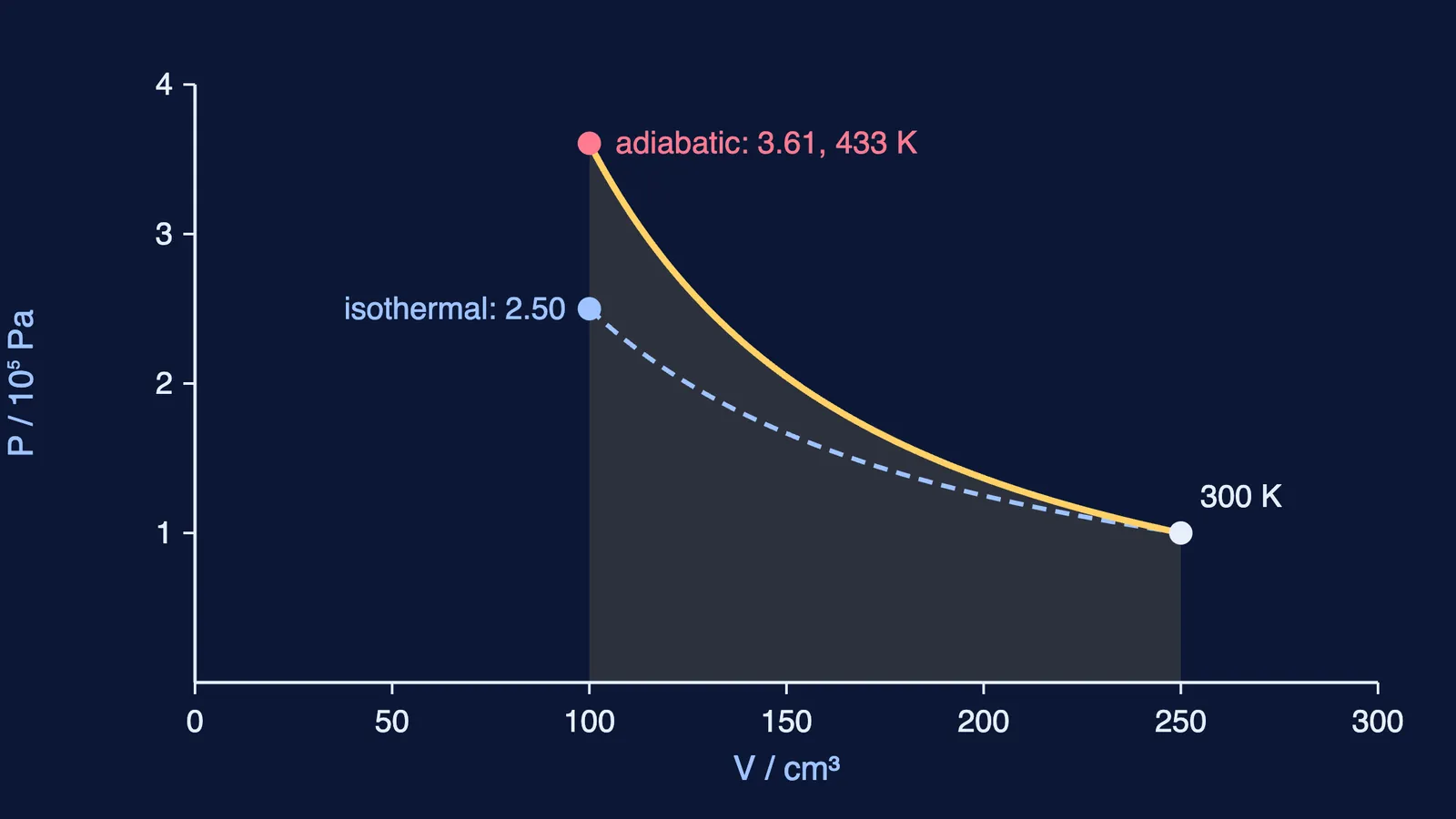
Pumping her cycle tyre in Pune, Meera notices the pump barrel turns warm. To model one stroke, her physics teacher takes 250 cm³ of air at 1.0 × 10⁵ Pa and 300 K, pushed so quickly to 100 cm³ that no heat escapes. Take γ = 1.4 for air and use 2.5⁰·⁴ = 1.443. They compare it with a very slow push to 100 cm³ at a steady 300 K.
(i) For the quick stroke: (a) ∆U = 0 (b) ∆Q = 0 (c) ∆W = 0 (d) ∆T = 0
(ii) Use the first law to explain why the air warms up.
(iii) Find the final pressure and temperature after the quick stroke, and the pressure after the slow push.
(iv) Calculate the work done by the gas and ∆U for the quick stroke.
Answers.
(i) (b). The stroke is treated as adiabatic: no heat flows in or out.
(ii) With ∆Q = 0, ∆U = −∆W. Compression means ∆W is negative, so ∆U is positive and the temperature of the ideal gas rises.
(iii) PV^γ = constant gives P₂ = 1.0 × 10⁵ × 2.5¹·⁴ = 1.0 × 10⁵ × 2.5 × 1.443 = 3.61 × 10⁵ Pa. TV^(γ−1) = constant gives T₂ = 300 × 2.5⁰·⁴ = 300 × 1.443 = 433 K, about 160 °C. The slow (isothermal) push gives P₁V₁ = P₂V₂, so P₂ = 2.50 × 10⁵ Pa.
(iv) ∆W = (P₁V₁ − P₂V₂) ÷ (γ − 1) = (25.0 − 36.07) ÷ 0.4 = −27.7 J (P₁V₁ = 1.0 × 10⁵ × 250 × 10⁻⁶ = 25.0 J). So ∆U = −∆W = +27.7 J.
Case 3: Can this engine really be 40% efficient?
A Coimbatore startup pitches an engine to a textile mill. It takes heat from waste steam at 480 K and rejects heat to cooling water at 300 K. The brochure says that in each cycle it absorbs 5.0 kJ from the steam and delivers 2.0 kJ of work. Should the mill's engineer believe it?
(i) The law that rules out an engine turning all the heat it absorbs from one reservoir into work, with no other effect, is: (a) the zeroth law (b) the first law (c) the Kelvin-Planck statement (d) the Clausius statement
(ii) What is the highest efficiency any engine can reach between these two temperatures?
(iii) Is the brochure's claim possible? Give a reason.
(iv) For a Carnot engine absorbing 5.0 kJ here, find W and Q₂. What cold-water temperature would the brochure's figures need?
Answers.
(i) (c). Kelvin-Planck forbids a perfect engine; Clausius (d) concerns heat flowing from cold to hot.
(ii) Carnot efficiency: η = 1 − T₂/T₁ = 1 − 300/480 = 0.375, or 37.5%.
(iii) No. The claimed efficiency is W/Q₁ = 2.0/5.0 = 0.40, which is more than the Carnot value. No engine working between two given temperatures can beat the Carnot engine, whatever its working substance.
(iv) W = 0.375 × 5.0 = 1.875 kJ and Q₂ = 5.0 − 1.875 = 3.125 kJ (check: Q₁/Q₂ = 1.6 = 480/300). For η = 0.40, even an ideal engine would need T₂ = 480 × (1 − 0.40) = 288 K or colder, below the 300 K water they have.
How to attack case-study questions
Name the process first. Free piston: isobaric. Clamped or rigid: isochoric. Too fast for heat to flow, or insulated: adiabatic. Slow, in contact with a large bath: isothermal.
Write NCERT's signs before numbers. Heat into the gas is positive; work done by the gas is positive; compression work is negative.
Use temperatures in kelvin. Carnot efficiency and PV = µRT both fail with °C.
Check with the first law. ∆Q − ∆W should equal ∆U in every step, and ∆U = 0 over a full cycle.
End with meaning. Say whether the gas warms or a claim breaks the second law.
If the gap between the adiabat and the isotherm in Case 2 is hard to picture, the Fermi Simulation Lab has interactive simulations for the ideas that are easier to see than to read. For the full chapter, read our Thermodynamics Class 11 physics guide, then see how to answer case-based questions and try first-law problems with a gas under a spring-loaded piston.