

On this page
What do these straight lines case studies cover?
Straight Lines is Chapter 9 of the NCERT Class 11 Mathematics textbook, Reprint 2026-27. The CBSE 2026-27 Mathematics curriculum lists slope of a line and angle between two lines, the forms of a line's equation (parallel to an axis, point-slope, slope-intercept, two-point and intercept) and distance of a point from a line. Every case stays inside that list.
Class 11 papers are set by your school, not by the board, so treat these as case-based practice, not a forecast of your paper. The scenarios and numbers are our own. New to the chapter? Start with our Straight Lines Class 11 guide with formulas and worked examples. For technique, read how to handle case-based questions in board exams.
Case 1: Chalk lines on a school ground
Before sports day, the PT teacher at a school in Bhopal maps the ground on a grid in metres, with the flagpole at the origin O(0, 0). The relay lane is a straight chalk line from cone A(1, 2) to cone B(9, 6). The teacher wants a third cone C(17, 10) further along, so runners can see the lane from the far end. A finish line will pass through a peg D(7, 1) and must be perpendicular to the lane.
(i) The slope of lane AB is: (a) 2 (b) 1/2 (c) −1/2 (d) −2
(ii) Using slopes, show that cone C lies on the lane.
(iii) Write the equation of the lane and find where it meets the y-axis.
(iv) Find the equation of the finish line through D.
Answers.
(i) (b). m = (6 − 2)/(9 − 1) = 4/8 = 1/2.
(ii) Slope of BC = (10 − 6)/(17 − 9) = 1/2, the same as AB, and B is common to both, so A, B and C are collinear.
(iii) Point-slope form: y − 2 = (1/2)(x − 1), so x − 2y + 3 = 0. Putting x = 0 gives y = 3/2: the lane meets the y-axis at (0, 1.5), 1.5 m from the flagpole.
(iv) The perpendicular slope is −2, since (1/2)(−2) = −1. So y − 1 = −2(x − 7), which gives 2x + y − 15 = 0.
Case 2: A highway, a link road and a service road
A district planning office near Nashik draws its road map on a grid where 1 unit is 1 km. A state highway runs straight through a toll plaza P(0, 2) and a fuel station Q(12, 7). A new link road to an industrial estate will join two villages, R(2, 1) and S(9, 18). The planners want the link road to cross the highway at an acute angle of at least 40°, so that loaded trucks can turn without swinging wide. A service road for local traffic is drawn along the line 5x − 12y − 15 = 0.
(i) The slope of the highway is: (a) 12/5 (b) 5/12 (c) −5/12 (d) 7/12
(ii) Write the equation of the highway in slope-intercept form.
(iii) Find the acute angle between the highway and the link road. Does it meet the planners' condition?
(iv) Show that the service road is parallel to the highway and find the distance between them.
Answers.
(i) (b). m₁ = (7 − 2)/(12 − 0) = 5/12.
(ii) P lies on the y-axis, so c = 2 and y = (5/12)x + 2, which is 5x − 12y + 24 = 0.
(iii) m₂ = (18 − 1)/(9 − 2) = 17/7. tan θ = |(17/7 − 5/12)/(1 + (5/12)(17/7))| = (169/84)/(169/84) = 1, so θ = 45°. That exceeds 40°, so the condition is met.
(iv) The service road has slope 5/12 too, so the lines are parallel. Distance = |24 − (−15)|/√(5² + 12²) = 39/13 = 3 km.
Case 3: The shortest pipe from a farm to a canal
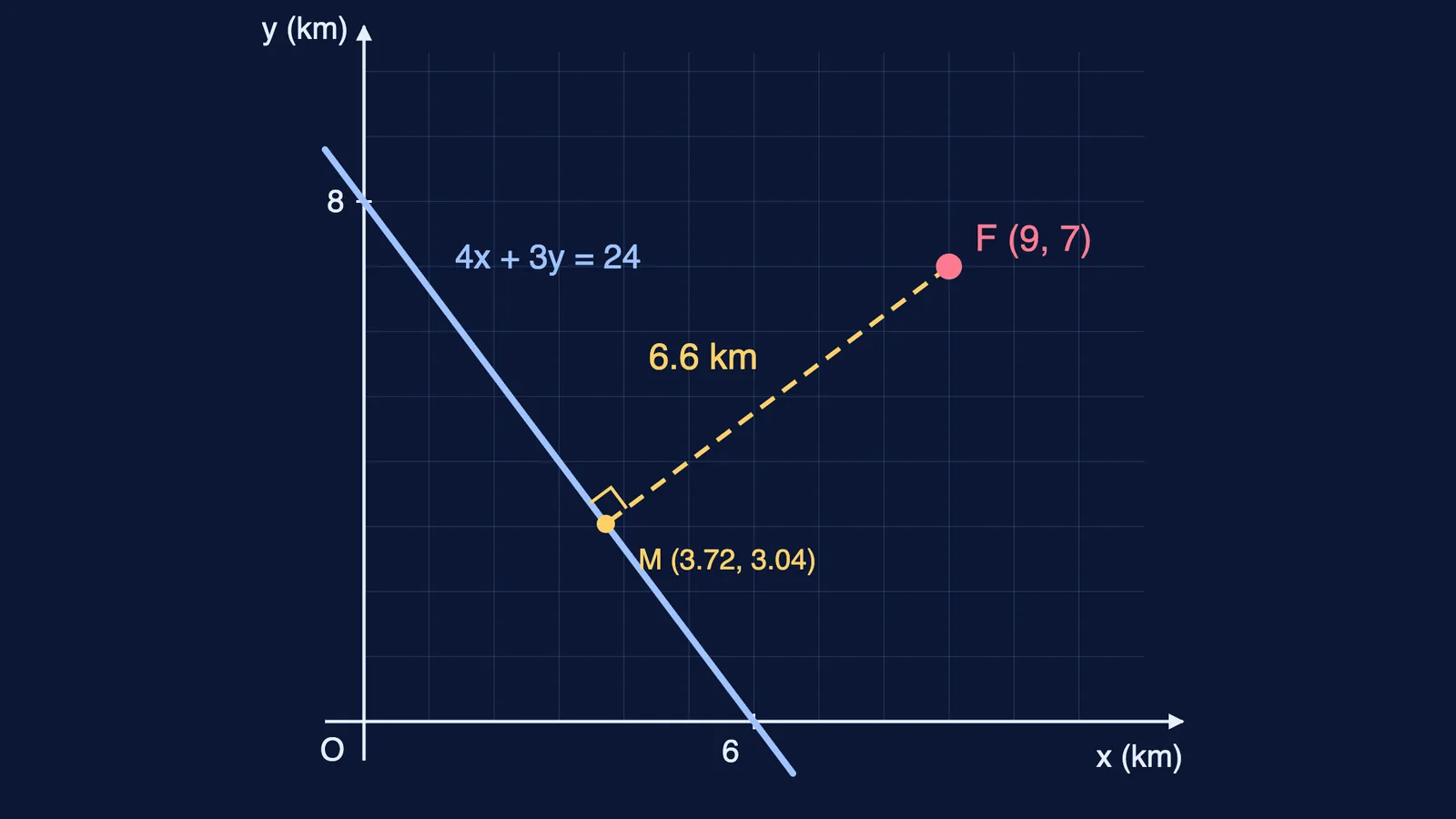
In a village in Rajasthan, a straight irrigation canal crosses the east road (the x-axis) 6 km from a crossroads O and the north road (the y-axis) 8 km from O. All distances are in kilometres. A farmer's pump house F stands at (9, 7). Pipe is expensive, so the farmer wants the shortest straight pipe from F to the canal. The panchayat separately wants a small pumping station on the north road, exactly 3 km from the canal measured perpendicularly, and asks where it could go.
(i) The equation of the canal is: (a) 3x + 4y = 24 (b) 4x + 3y = 24 (c) x/8 + y/6 = 1 (d) 4x − 3y = 24
(ii) Find the length of the shortest pipe.
(iii) Find the equation of the line along which the pipe runs and the point M where it meets the canal.
(iv) Find every possible position of the pumping station.
Answers.
(i) (b). Intercept form x/6 + y/8 = 1; multiplying by 24 gives 4x + 3y = 24.
(ii) The shortest pipe is the perpendicular from F. d = |4(9) + 3(7) − 24|/√(4² + 3²) = 33/5 = 6.6 km.
(iii) The canal's slope is −4/3, so the pipe's slope is 3/4: y − 7 = (3/4)(x − 9), or 3x − 4y + 1 = 0. Solving this with 4x + 3y = 24 gives M(93/25, 76/25) = (3.72, 3.04). Check: FM = √(5.28² + 3.96²) = 6.6 km.
(iv) Take the station at (0, k). Then |3k − 24|/5 = 3, so 3k − 24 = 15 or −15, giving k = 13 or k = 3. It can be at (0, 3) or (0, 13), one on each side of the canal.
How do you solve straight lines case-study questions?
Turn the story into coordinates first: list every point, line and unit.
Find the slope early. Parallel, perpendicular, angle and most equations follow from it.
Keep the modulus. A "distance equals" part, like Case 3 (iv), usually has two answers.
Substitute the given points back into your equation, and give distances in the passage's units.
Sketch roughly. A downhill line with a positive slope is a sign error.
If a method step keeps going wrong, the Fermi Problem Library has worked problems with a step-by-step solver that explains the reasoning rather than printing an answer.


