On this page
In a case-based question, one early sign error can follow you through all four parts. Below are three original cases on motion in a straight line, easiest first, each with four parts of rising difficulty and worked answers. They stay within the CBSE Physics syllabus for 2026-27 and follow NCERT Class 11 Physics Chapter 2 (Reprint 2026-27). Class 11 exams are set by schools, so treat these as practice, not a forecast.
Formulas and graphs are in our Class 11 guide to motion in a straight line, and the format itself is explained in how case-based questions work.
Case 1: How far apart are the two metro stations?
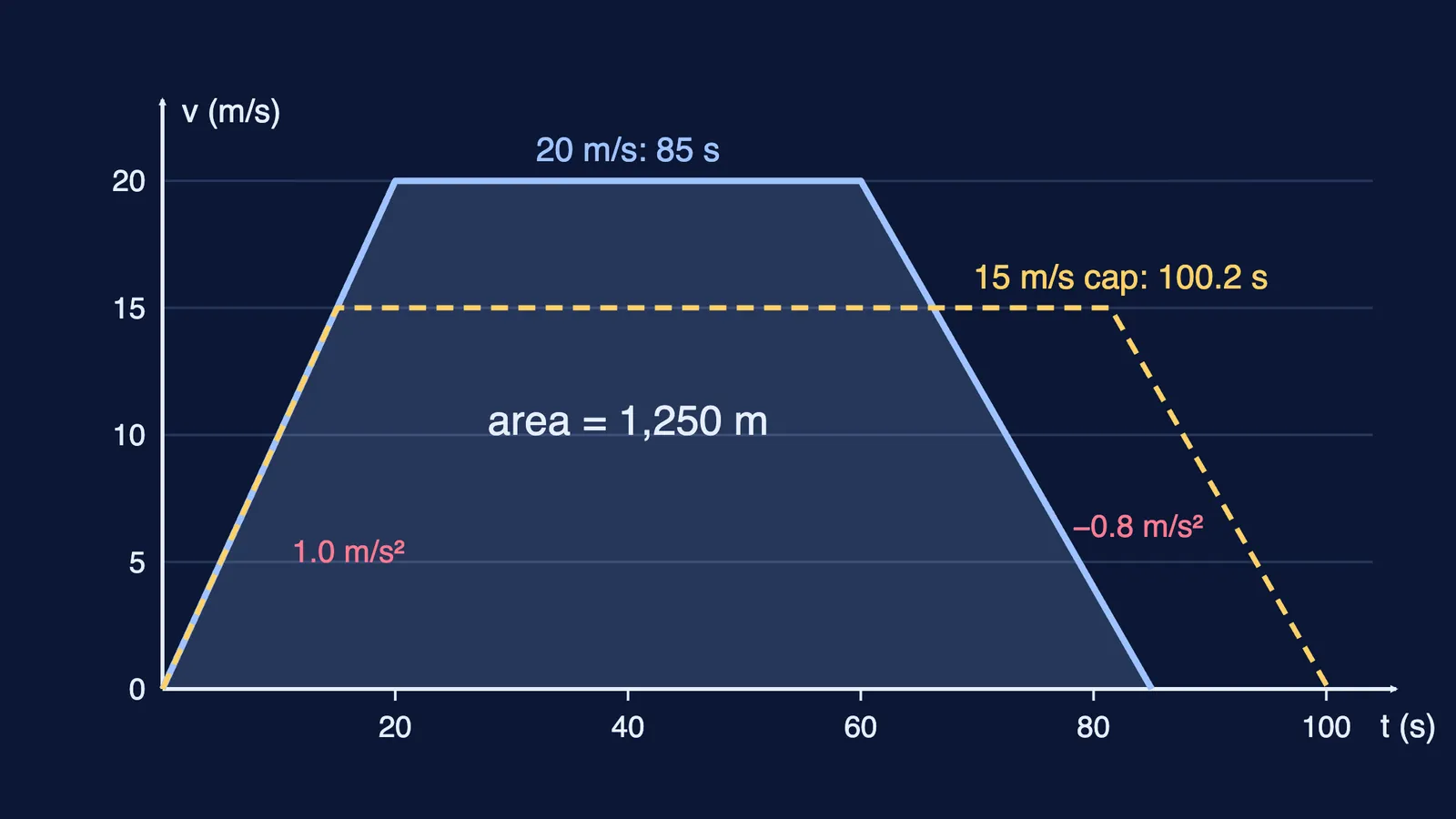
Suppose a metro train leaves one station from rest and speeds up uniformly at 1.0 m/s² until it reaches 20 m/s (72 km/h). It then runs at this steady speed for 40 s. Finally the driver brakes, and the train slows uniformly to rest at the next station in 25 s. The track is straight and level. An engineer sketches the velocity-time graph of the run, a trapezium, and uses it to answer a commuter group's questions about the trip.
(i) On a velocity-time graph, the area under the curve gives: (a) acceleration (b) displacement (c) average speed (d) velocity
(ii) How long does the train take to reach 20 m/s, and what is its acceleration while braking?
(iii) Find the distance between the stations and the average speed for the run.
(iv) If top speed is capped at 15 m/s, with the same acceleration and braking, how much longer is the trip?
Answers.
(i) (b). The area under a v-t graph between two instants equals the displacement in that interval.
(ii) t = v/a = 20/1.0 = 20 s. Braking: a = (0 − 20)/25 = −0.8 m/s², a deceleration of 0.8 m/s².
(iii) Area = ½ × 20 × 20 + 20 × 40 + ½ × 25 × 20 = 200 + 800 + 250 = 1,250 m. Average speed = 1,250/(20 + 40 + 25) = 1,250/85 = 14.7 m/s.
(iv) Speeding up to 15 m/s takes 15 s (112.5 m); braking from 15 m/s at 0.8 m/s² takes 18.75 s (140.6 m). The remaining 996.9 m at 15 m/s takes 66.5 s. New total = 15 + 18.75 + 66.5 = 100.2 s, about 15.2 s longer.
Case 2: Can the car stop before the school crossing?
A family car is moving at a steady 54 km/h on a straight road near a school in Kochi. A child steps onto a crossing ahead. The driver takes 0.75 s to notice and press the brake; during this reaction time the car keeps its speed. After that, the brakes slow it uniformly at 6.0 m/s². Later, at a road-safety talk, a teacher asks the class what would happen at 108 km/h if the reaction time and braking stayed the same.
(i) During the driver's reaction time, the car moves with: (a) uniform velocity (b) uniform deceleration (c) increasing speed (d) zero velocity
(ii) Convert 54 km/h to m/s and find the reaction distance.
(iii) Find the braking distance and the braking time. What is the total stopping distance?
(iv) At 108 km/h, find the total stopping distance. By what factor has it grown, and why is that factor not 2?
Answers.
(i) (a). The brakes are not yet applied.
(ii) 54 km/h = 54 × 1000/3600 = 15 m/s. Reaction distance = 15 × 0.75 = 11.25 m.
(iii) From v² = v₀² + 2ax with v = 0: braking distance = 15²/(2 × 6.0) = 18.75 m. Braking time = 15/6.0 = 2.5 s. Total = 11.25 + 18.75 = 30.0 m.
(iv) 108 km/h = 30 m/s. Reaction distance = 22.5 m; braking distance = 30²/12 = 75 m; total 97.5 m, which is 3.25 times 30.0 m. The reaction part doubles, but braking distance depends on v₀², so it grows four times.
Case 3: What does the motion sensor say about the trolley?
In a school lab in Lucknow, a student gives a trolley a push up a long, straight inclined track and lets it roll. A motion sensor at the foot of the track records its position along the track as x = 2.0 + 6.0t − 1.5t², with x in metres and t in seconds, for the first 4.0 s. Up the slope is taken as positive. The class must describe the motion using differentiation, then compare distance with displacement.
(i) At the instant the trolley is momentarily at rest, its acceleration is: (a) zero (b) down the slope and non-zero (c) up the slope (d) undefined
(ii) Differentiate to find the velocity v(t) and the acceleration of the trolley.
(iii) When and where does the trolley momentarily stop?
(iv) For 0 to 4.0 s, find the displacement, distance, average velocity and average speed. What is v at t = 4.0 s?
Answers.
(i) (b). Zero velocity does not mean zero acceleration; a stays −3.0 m/s², down the slope.
(ii) v = dx/dt = 6.0 − 3.0t m/s; a = dv/dt = −3.0 m/s², a constant.
(iii) v = 0 when 6.0 − 3.0t = 0, so t = 2.0 s. Then x = 2.0 + 12.0 − 6.0 = 8.0 m from the sensor.
(iv) x(0) = x(4.0) = 2.0 m, so displacement = 0. It goes up 6.0 m and back 6.0 m: distance = 12.0 m. Average velocity = 0; average speed = 12.0/4.0 = 3.0 m/s. At t = 4.0 s, v = −6.0 m/s, that is 6.0 m/s down the slope.
How do you attack case-study questions on motion in a straight line?
Fix the origin and positive direction first; NCERT's Points to Ponder note that signs depend on this choice.
Convert km/h to m/s first: multiply by 5/18.
For multi-stage motion, sketch the v-t graph and take areas stage by stage; the equations hold only while acceleration is constant.
Check whether a part asks for distance or displacement, average speed or average velocity. Our explainer on average speed versus average velocity shows where these get mixed up.
When x is given as a function of t, differentiate, then find where v = 0 before computing distance.
If you lose marks on method, not arithmetic, the Fermi Problem Library has worked problems with a step-by-step solver that explains the reasoning rather than printing an answer.