On this page
Three original Kinetic Theory cases, easy to hard. Try each on paper before reading the answers.
What do these kinetic theory cases cover?
Kinetic Theory is Chapter 12, under Unit IX, of the CBSE 2026-27 Class XI Physics curriculum. It covers the perfect-gas equation, kinetic interpretation of temperature, rms speed, equipartition and specific heats, and mean free path. Class 11 papers are set by schools, so treat these as practice in the case-based style, not as a prediction of any paper.
Every case uses the constants in the rationalised NCERT Chapter 12, Reprint 2026-27: R = 8.314 J mol⁻¹ K⁻¹, kB = 1.38 × 10⁻²³ J K⁻¹ and NA = 6.02 × 10²³ mol⁻¹. For the derivation and theory, read our Kinetic Theory Class 11 physics guide.
Case 1: Why does tyre pressure rise after a drive?
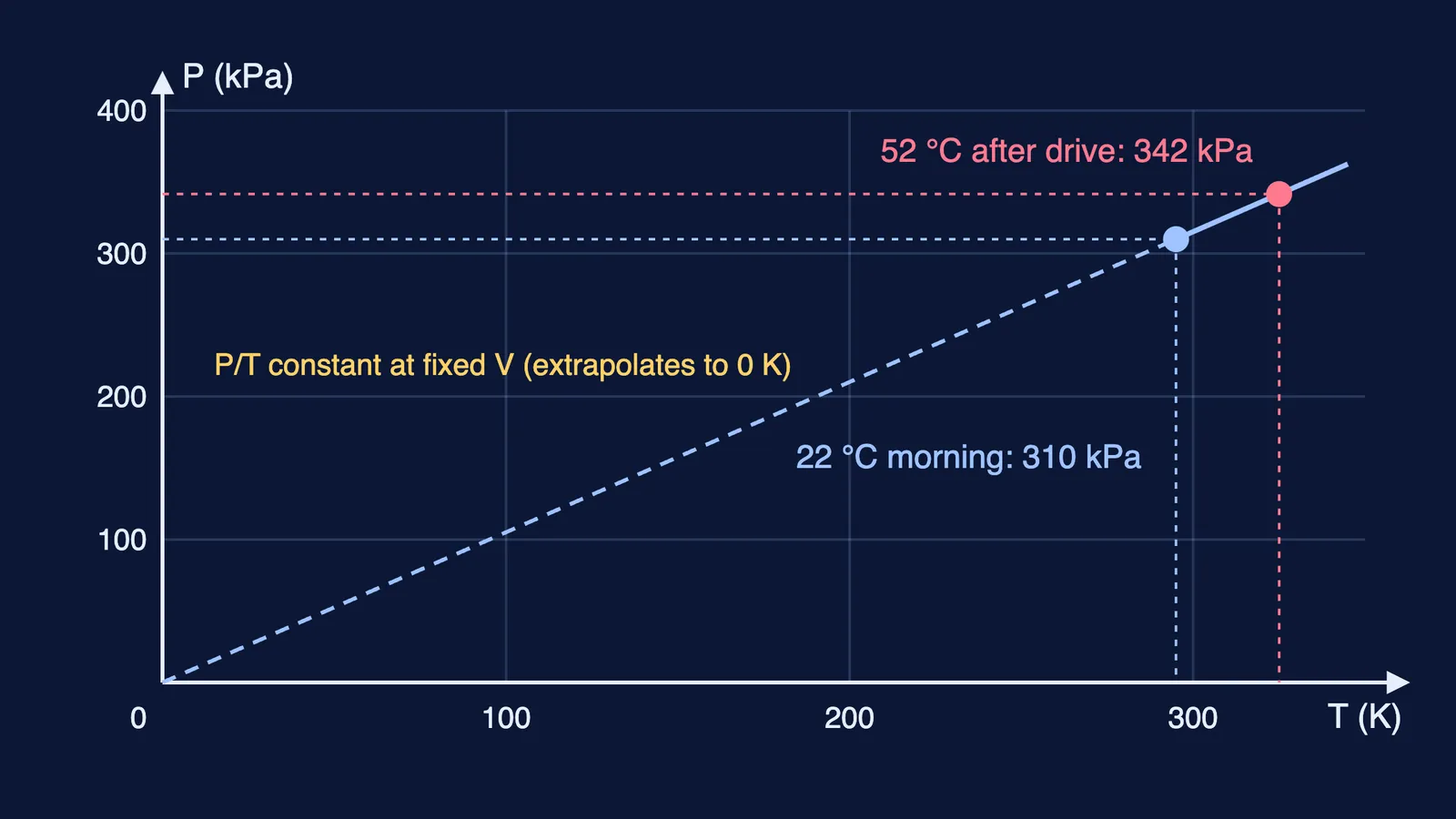
Rohan checks his car's tyres at a Nagpur petrol pump at 7 a.m., when the air inside is at 22 °C. The absolute pressure in the front-left tyre is 310 kPa, and its inside volume is 30 L. He then drives for two hours on a hot highway. When he stops, a thermometer probe shows the tyre air is at 52 °C. Treat the air as an ideal gas, assume no air leaks, and take the tyre volume as fixed.
(i) At fixed volume and fixed amount of gas, pressure is proportional to: (a) temperature in °C (b) absolute temperature (c) 1/T (d) T²
(ii) Find the absolute pressure in the tyre after the drive.
(iii) How many moles, and how many molecules, of air are in the tyre?
(iv) Using P = (1/3) n m ⟨v²⟩, explain in molecular terms why the pressure rose.
Answers.
(i) (b). From PV = μRT with V and μ fixed, P/T is constant only when T is in kelvin.
(ii) T₁ = 295 K, T₂ = 325 K. P₂ = 310 × 325/295 = 341.5 kPa, about 342 kPa (the red point above).
(iii) μ = PV/RT = (310 × 10³ × 0.030)/(8.314 × 295) = 3.79 mol. N = 3.79 × 6.02 × 10²³ ≈ 2.28 × 10²⁴ molecules.
(iv) No air leaked and V is fixed, so the number density n is unchanged. Since ½m⟨v²⟩ = (3/2)kBT, ⟨v²⟩ rises with T: molecules hit the walls harder and more often.
Case 2: Do helium and oxygen molecules share energy equally?
A gas supplier in Visakhapatnam fills a 10.0 L steel test cylinder with 8.0 g of helium (molar mass 4.0 g mol⁻¹) and 16.0 g of oxygen (molar mass 32.0 g mol⁻¹). The mixture settles at 27 °C. Treat both gases as ideal and ignore any reaction between them.
(i) The ratio of average translational kinetic energy per molecule, helium : oxygen, is: (a) 1 : 8 (b) 8 : 1 (c) 1 : 1 (d) 2√2 : 1
(ii) Find the partial pressure of each gas and the total pressure.
(iii) Find vrms of helium and the ratio vrms(He)/vrms(O₂).
(iv) Find the total translational kinetic energy of the mixture and show that it equals (3/2)PV.
Answers.
(i) (c). Average translational KE per molecule is (3/2)kBT = 1.5 × 1.38 × 10⁻²³ × 300 = 6.21 × 10⁻²¹ J for both, since it depends only on temperature.
(ii) μ(He) = 2.0 mol, μ(O₂) = 0.50 mol. p(He) = 2.0 × 8.314 × 300/0.010 = 4.99 × 10⁵ Pa; p(O₂) = 1.25 × 10⁵ Pa. By Dalton's law, P = 6.24 × 10⁵ Pa.
(iii) vrms(He) = √(3RT/M) = √(3 × 8.314 × 300/0.0040) ≈ 1368 m s⁻¹. Ratio = √(32/4) = √8 ≈ 2.83, so oxygen's vrms is about 484 m s⁻¹.
(iv) E = (3/2)(μ total)RT = 1.5 × 2.5 × 8.314 × 300 ≈ 9353 J. (3/2)PV = 1.5 × 6.235 × 10⁵ × 0.010 ≈ 9353 J. They match, as NCERT's PV = (2/3)E says.
Case 3: How does equipartition decide the heat a gas needs?
A food-packaging plant in Pune keeps 2.0 mol of nitrogen in a sealed rigid steel vessel. During a test, heaters raise the gas from 300 K to 380 K. The engineer models N₂ as a rigid diatomic molecule, like a dumbbell, and uses the law of equipartition of energy. A trainee asks what would change if the molecules also vibrated, since NCERT notes the rigid model is not always valid.
(i) A rigid diatomic molecule has how many degrees of freedom? (a) 3 (b) 5 (c) 6 (d) 7
(ii) Write Cv and γ for rigid N₂.
(iii) Find the heat supplied in the test.
(iv) If each molecule also had one vibrational mode, find the new Cv and the heat for the same 80 K rise.
Answers.
(i) (b) 5: three translational and two rotational, about the two axes perpendicular to the bond.
(ii) Each degree of freedom carries ½kBT, so U = (5/2)RT per mole, Cv = (5/2)R ≈ 20.8 J mol⁻¹ K⁻¹, Cp = (7/2)R, γ = 7/5 = 1.4.
(iii) Rigid vessel, so constant volume: Q = μCvΔT = 2.0 × 20.785 × 80 ≈ 3326 J, about 3.33 kJ.
(iv) A vibrational mode has kinetic and potential energy, so it adds kBT, not ½kBT. Cv = (7/2)R ≈ 29.1 J mol⁻¹ K⁻¹ and Q = 2.0 × 29.099 × 80 ≈ 4656 J, about 4.66 kJ.
How to attack case-study questions
Convert to kelvin first. In Case 1, using 22 and 52 would give a 136% rise instead of about 10%.
Hunt for the fixed quantity. A rigid tank means fixed V, so use Cv; a sealed tyre means fixed μ.
Separate energy from speed. Temperature fixes average KE per molecule; speed then depends on mass.
Count degrees of freedom before any formula. Monatomic 3, rigid diatomic 5, and each vibrational mode adds 2 squared terms, as NCERT section 12.5 explains.
Keep molar mass in kg mol⁻¹. Helium is 0.0040, not 4, inside √(3RT/M).
For the strategy behind the format, read our guide to case-based questions in board exams, and for the next chapter's cycles and signs, our Thermodynamics Class 11 physics guide. If molecules hitting walls still feels abstract, the Fermi Simulation Lab has interactive simulations for the ideas that are easier to see than to read.