On this page
Three original case studies on Class 11 Probability, from a Venn diagram to counting with combinations, with every answer worked out. For the full chapter, read our Probability Class 11 maths guide.
What do Class 11 Probability case studies test?
The CBSE Mathematics curriculum for 2026-27 lists the Class XI Probability topics as events, 'not', 'and' and 'or' events, exhaustive and mutually exclusive events, axiomatic (set theoretic) probability, and the probability of 'not', 'and' and 'or' events. The same document says random experiments, outcomes and sample space are assessed only formatively, so these cases use sample spaces as a tool rather than asking about them.
The source text is Chapter 14 of the NCERT Class 11 Mathematics textbook (Reprint 2026-27), which covers events and the axiomatic approach. Your school sets the Class 11 paper, so treat these as practice in the case-based style. For the format in general, see our guide to case-based questions in board exams.
Case 1: Rain and power cuts in a Mumbai June
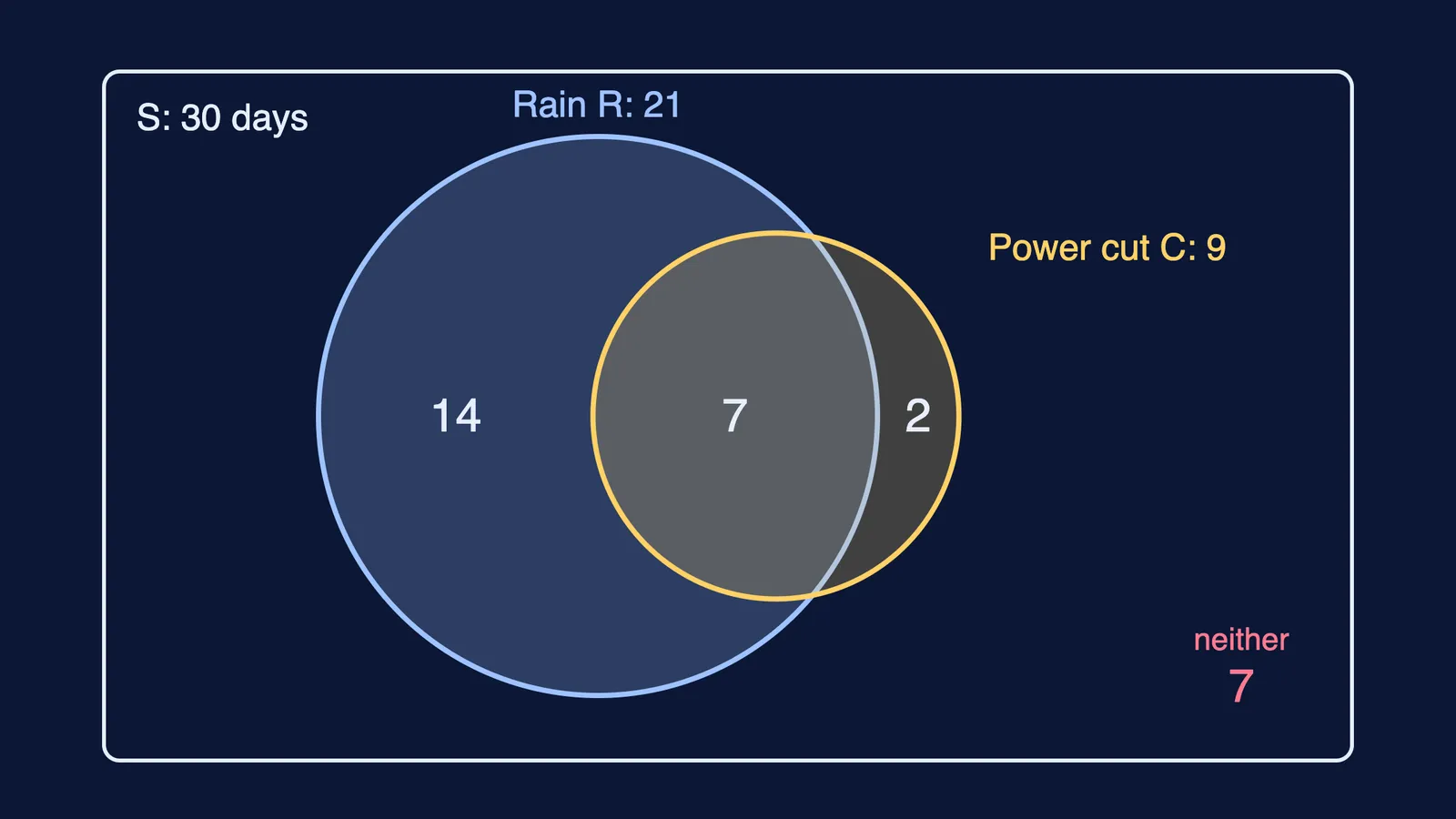
Riya, a Class 11 student in Mumbai, kept a weather and electricity diary for the 30 days of June. It rained on 21 days. Her building had a power cut on 9 days. On 7 days there was both rain and a power cut. Her teacher picks one day of June at random from the diary, each day equally likely. Let R be the event "it rained that day" and C the event "there was a power cut that day".
(i) P(R) equals: (A) 3/10 (B) 7/10 (C) 7/30 (D) 23/30
(ii) Find P(R or C).
(iii) Find the probability that the day had neither rain nor a power cut.
(iv) Find P(C but not R). Are the events C and "not R" mutually exclusive? Give a reason.
Answers.
(i) (B). P(R) = 21/30 = 7/10.
(ii) P(R ∪ C) = P(R) + P(C) − P(R ∩ C) = 21/30 + 9/30 − 7/30 = 23/30.
(iii) "Neither" is the complement of "R or C", so P = 1 − 23/30 = 7/30.
(iv) C − R has 9 − 7 = 2 days, so P(C but not R) = 2/30 = 1/15. Since C ∩ R′ has 2 days, it is not empty, so C and "not R" are not mutually exclusive.
Case 2: A bowler's delivery record
A district cricket coach in Indore studies one bowler's legal deliveries over a season. Each delivery ends in exactly one of six outcomes, with these probabilities: dot ball 0.40, one run 0.30, two runs 0.10, four 0.12, six 0.05 and wicket k. Treat this list as the full sample space for one delivery.
(i) The value of k is: (A) 0.03 (B) 0.05 (C) 0.13 (D) 0.30
(ii) Find the probability that a delivery gives at least two runs.
(iii) Let A be "the batter scores runs" and B be "the delivery is not a boundary" (a boundary is a four or a six). Find P(A or B).
(iv) Show that the events "boundary", "dot or wicket" and "one or two runs" are mutually exclusive and exhaustive.
Answers.
(i) (A). The probabilities of all outcomes must add to 1, so k = 1 − (0.40 + 0.30 + 0.10 + 0.12 + 0.05) = 0.03.
(ii) "At least two runs" = {two, four, six}, so P = 0.10 + 0.12 + 0.05 = 0.27.
(iii) P(A) = 0.30 + 0.10 + 0.12 + 0.05 = 0.57. P(B) = 1 − 0.17 = 0.83. A ∩ B = {one, two}, so P(A ∩ B) = 0.40. Then P(A ∪ B) = 0.57 + 0.83 − 0.40 = 1. Every delivery either scores runs or is not a boundary, so A ∪ B = S.
(iv) The three sets {four, six}, {dot, wicket} and {one, two} share no outcome, so they are pairwise disjoint. Together they contain all six outcomes, and their probabilities 0.17 + 0.43 + 0.40 add to 1.
Case 3: Bruised mangoes in a crate
A fruit seller in Ratnagiri has a small crate of 15 mangoes, of which 4 are bruised and 11 are sound. A customer takes 3 mangoes from the crate at random without looking, so every group of 3 is equally likely. The seller has a rule: if two or more of the three mangoes are bruised, the customer gets a refund.
(i) The number of equally likely outcomes is: (A) 45 (B) 165 (C) 455 (D) 2730
(ii) Find the probability that none of the three mangoes is bruised.
(iii) Find the probability that at least one mango is bruised.
(iv) Find the probability that the customer gets a refund.
Answers.
(i) (C). Order does not matter, so n(S) = ¹⁵C₃ = 455. The figure 2730 counts ordered picks.
(ii) All three must come from the 11 sound mangoes: ¹¹C₃ = 165, so P = 165/455 = 33/91.
(iii) This is the complement of (ii): P = 1 − 33/91 = 58/91.
(iv) Exactly two bruised: ⁴C₂ × ¹¹C₁ = 6 × 11 = 66. All three bruised: ⁴C₃ = 4. These events are mutually exclusive, so P(refund) = (66 + 4)/455 = 70/455 = 2/13. Check: 165 + 220 + 66 + 4 = 455, where 220 = 4 × ¹¹C₂ is "exactly one bruised".
How do you solve Probability case study questions?
Translate every phrase into sets first: "neither" is (A ∪ B)′, "A but not B" is A − B, "at least one" is the complement of "none".
Draw a quick Venn diagram for two overlapping events and fill in the overlap before the single-event regions, as in Case 1. Our Sets Class 11 guide revises the set operations.
When the case gives probabilities instead of counts, check the axioms first: each value between 0 and 1, all values adding to 1.
Use the 'or' rule only after you know the overlap; add without subtracting only when the events are mutually exclusive.
For "at least" questions, the complement is usually one step shorter, and a full split of n(S) is a free check on your counting.
If a step keeps going wrong, the Fermi Problem Library has worked problems with a step-by-step solver that explains the reasoning rather than printing an answer.