On this page
What do case-study questions on Trigonometric Functions test?
A case-study question gives you a short real situation and four linked questions; here, stories about rotating or looking up become radians, quadrants and identities.
The CBSE Mathematics curriculum for 2026-27 covers degree and radian measure, the unit-circle definition, signs, domain and range, the sum and difference formulas, and identities for 2x and 3x. It lists general solutions of trigonometric equations among Class XI topics assessed only formatively, so no case below uses them.
Class 11 exams are set by your school, so treat these as practice, not a board pattern. Every fact matches the NCERT chapter Trigonometric Functions (Reprint 2026-27); the scenarios and numbers are our own. For theory and proofs, see our Trigonometric Functions Class 11 guide.
Case 1: The giant wheel at a Mysuru mela
A giant wheel at a Dasara mela in Mysuru has a radius of 12 m, and its hub is 14 m above the ground. Sixteen cabins hang at equal spacing around the rim. Seen from the ticket counter, the wheel turns anticlockwise at a steady speed, one revolution every 4 minutes. Riya's cabin starts level with the hub, on the right. Her brother, waiting at the counter with a stopwatch, wants to know how far she has travelled and how high she is after 100 seconds.
(i) What angle do two neighbouring cabins make at the hub? (a) π/16 (b) π/8 (c) π/4 (d) 22.5 radians
(ii) Through what angle, in degrees and in radians, does the wheel turn in 100 seconds?
(iii) How far along the rim does her cabin travel in that time? (Use π = 3.14.)
(iv) Taking the hub as origin, find her cabin's coordinates then, and her height above the ground.
Answers.
(i) (b) π/8. A full turn, 2π radian, is shared by 16 equal gaps.
(ii) 100/240 × 360° = 150°, which is 150 × π/180 = 5π/6 radian.
(iii) l = rθ = 12 × 5π/6 = 10π ≈ 10 × 3.14 = 31.4 m.
(iv) Scaling the unit circle to radius 12, the cabin is at (12 cos 150°, 12 sin 150°) = (−6√3, 6), about (−10.39 m, 6 m). Her height is 14 + 6 = 20 m.
Case 2: A robot arm on a Pune assembly line
A welding robot in a busy Pune car-parts factory has a 0.5 m arm that pivots about a fixed point. The controller measures its angle from a horizontal line pointing right: anticlockwise positive, clockwise negative, and the counter keeps adding across full turns. At the end of one shift the counter reads 2,310°. After a reset, a test command turns the arm through −1,020° from the reference line. A second, smaller arm in the same cell is 29 cm long.
(i) In which quadrant does the 0.5 m arm point when the counter reads 2,310°? (a) I (b) II (c) III (d) IV
(ii) Taking the pivot as origin, find the tip's exact coordinates for 2,310°.
(iii) After the −1,020° command, is the tip above or below the pivot? Give its coordinates.
(iv) A sensor finds the smaller arm's tip 20 cm to the left of its pivot and below it. Find sin x, tan x and sec x for the arm's angle x.
Answers.
(i) (b) II. Sine and cosine repeat every 360°, and 2,310° − 6 × 360° = 150°.
(ii) (0.5 cos 150°, 0.5 sin 150°) = (−√3/4, 1/4) m, about (−0.433 m, 0.25 m).
(iii) −1,020° + 3 × 360° = 60°, so the tip is at (0.5 cos 60°, 0.5 sin 60°) = (1/4, √3/4) m: above the pivot.
(iv) cos x = −20/29, so sin² x = 1 − 400/841 = 441/841. Left of and below the pivot is the third quadrant, so sin x = −21/29, tan x = 21/20 and sec x = −29/20.
Case 3: Where should the second camera stand?
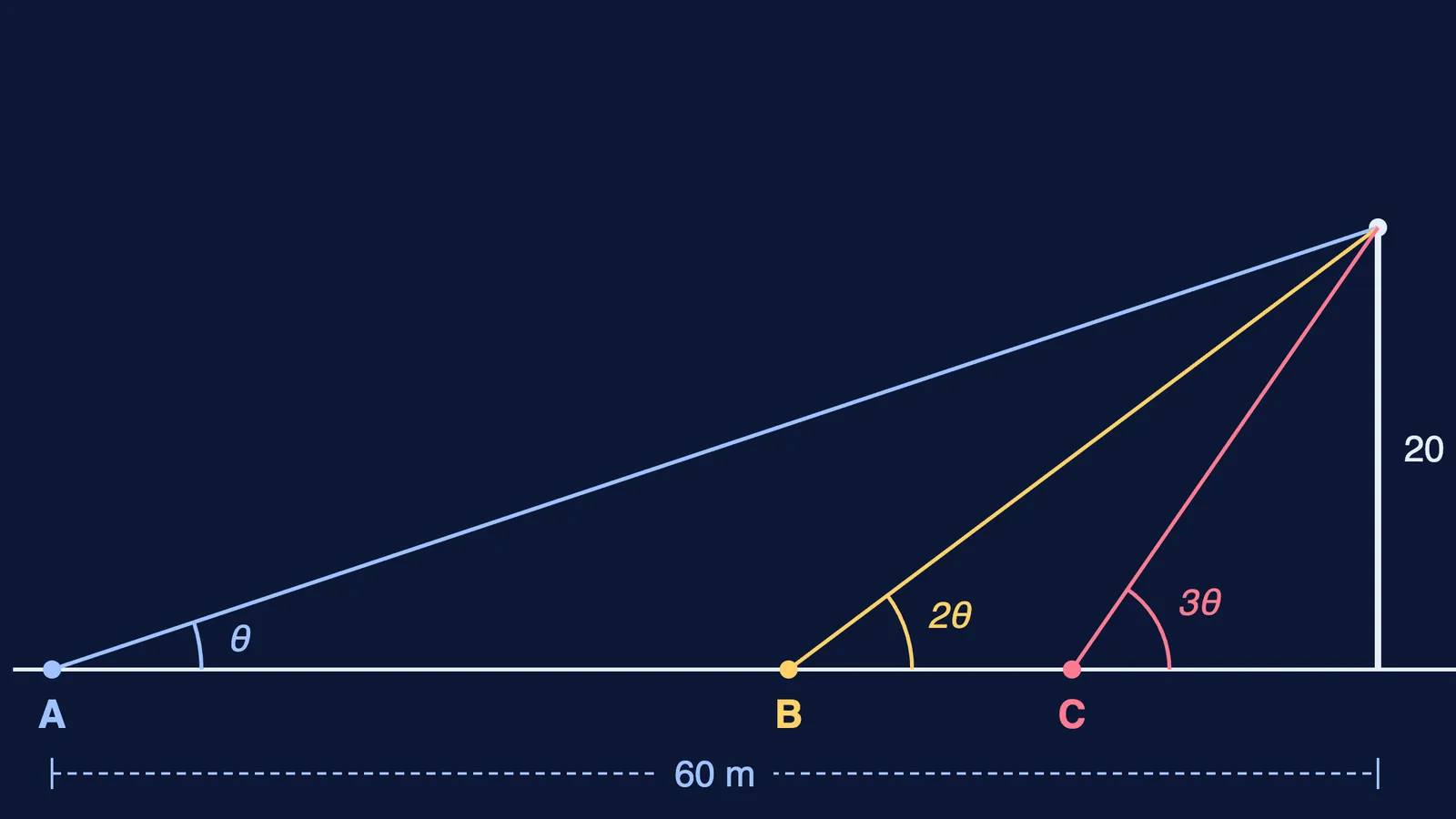
A crew is filming a 20 m mobile tower on flat ground near Nagpur. From point A, 60 m from the foot of the tower, a ground-level camera tilts up through an angle θ to see the top, so tan θ = 1/3. The director wants a second shot from B, on the same line and closer, where the angle of elevation is 2θ, and a third from C at 3θ. With no angle meter, every distance must come from identities.
(i) Which value checks the height from point A? (a) 60 × 3 m (b) 60 ÷ 1/3 m (c) 60 × 1/3 m (d) 60 + 3 m
(ii) Find tan 2θ.
(iii) How far is B from the foot of the tower, and how far must the crew walk from A to B?
(iv) Find cos 2θ, and the distance of C from the foot of the tower.
Answers.
(i) (c). Height = 60 × tan θ = 20 m, matching the tower.
(ii) tan 2θ = 2 tan θ/(1 − tan² θ) = (2/3)/(8/9) = 3/4.
(iii) 20 ÷ tan 2θ = 80/3 ≈ 26.7 m from the foot. The crew walks 60 − 80/3 = 100/3 ≈ 33.3 m.
(iv) cos 2θ = (1 − tan² θ)/(1 + tan² θ) = (8/9)/(10/9) = 4/5. Next, tan 3θ = (3 tan θ − tan³ θ)/(1 − 3 tan² θ) = (1 − 1/27)/(1 − 1/3) = 13/9. So C is 20 ÷ 13/9 = 180/13 ≈ 13.8 m from the foot. Since tan θ = 1/3 < 1/√3, θ < 30°, so 3θ is acute and the answer makes sense.
How to attack case-study questions
Convert first: l = rθ only works with θ in radians.
Reduce large or negative angles by multiples of 360° first.
Take the sign from the quadrant the story gives ("left of and below the pivot"), then the size from the identity.
When only tan is given, use the tan forms of the 2x and 3x identities.
End with units and the story: "B is about 26.7 m from the tower."
Our guide to case-based questions in board exams covers timing, and trigonometric ratios of allied angles in Class 11 gives more practice with results like cos 150° = −cos 30°. If the identity steps in Case 3 tripped you up, the Fermi Problem Library has worked problems with a step-by-step solver that explains the reasoning rather than printing an answer.