On this page
What do case-study questions on this chapter test?
The CBSE Class XI Mathematics syllabus for 2026-27 covers ordered pairs, Cartesian products, relations, functions, real functions with their graphs, and the sum, difference, product and quotient of functions. Composition of functions is assessed only formatively, so no case below uses it.
Class 11 exams are set by your school, so treat these as case-based practice. Every definition matches the NCERT chapter Relations and Functions (Reprint 2026-27); the scenarios and numbers are our own. For the theory, start with our Relations and Functions Class 11 guide.
Case 1: Which snack and drink combos fit ₹40?
A tiffin stall outside a college in Pune sells three snacks, S = {samosa, vada pav, dhokla}, priced ₹15, ₹20 and ₹30. It sells four drinks, D = {chai, lassi, nimbu pani, coffee}, priced ₹10, ₹30, ₹15 and ₹25. The owner writes each combo as an ordered pair (snack, drink). For "student combos" costing at most ₹40 he defines the relation R = {(s, d) : price of s + price of d ≤ 40, s ∈ S, d ∈ D}.
(i) How many ordered pairs are there in S × D? (a) 7 (b) 12 (c) 64 (d) 4096
(ii) How many relations can be defined from S to D?
(iii) Write R in roster form and state its domain and range.
(iv) Is R a function from S to D? If the rule is changed to "total exactly ₹40", is the new relation a function from S to D? Give a reason each time.
Answers.
(i) (b) 12. n(S × D) = n(S) × n(D) = 3 × 4.
(ii) Every subset of S × D is a relation: 2^12 = 4,096 relations.
(iii) R = {(samosa, chai), (samosa, nimbu pani), (samosa, coffee), (vada pav, chai), (vada pav, nimbu pani), (dhokla, chai)}. Domain = {samosa, vada pav, dhokla}. Range = {chai, nimbu pani, coffee}; lassi is in the codomain D but not in the range.
(iv) No: samosa has three images. With "exactly ₹40" the relation is {(samosa, coffee), (dhokla, chai)}, and it is still not a function, because vada pav has no image (no drink costs ₹20).
Case 2: Which cycle-rental stand is cheaper?
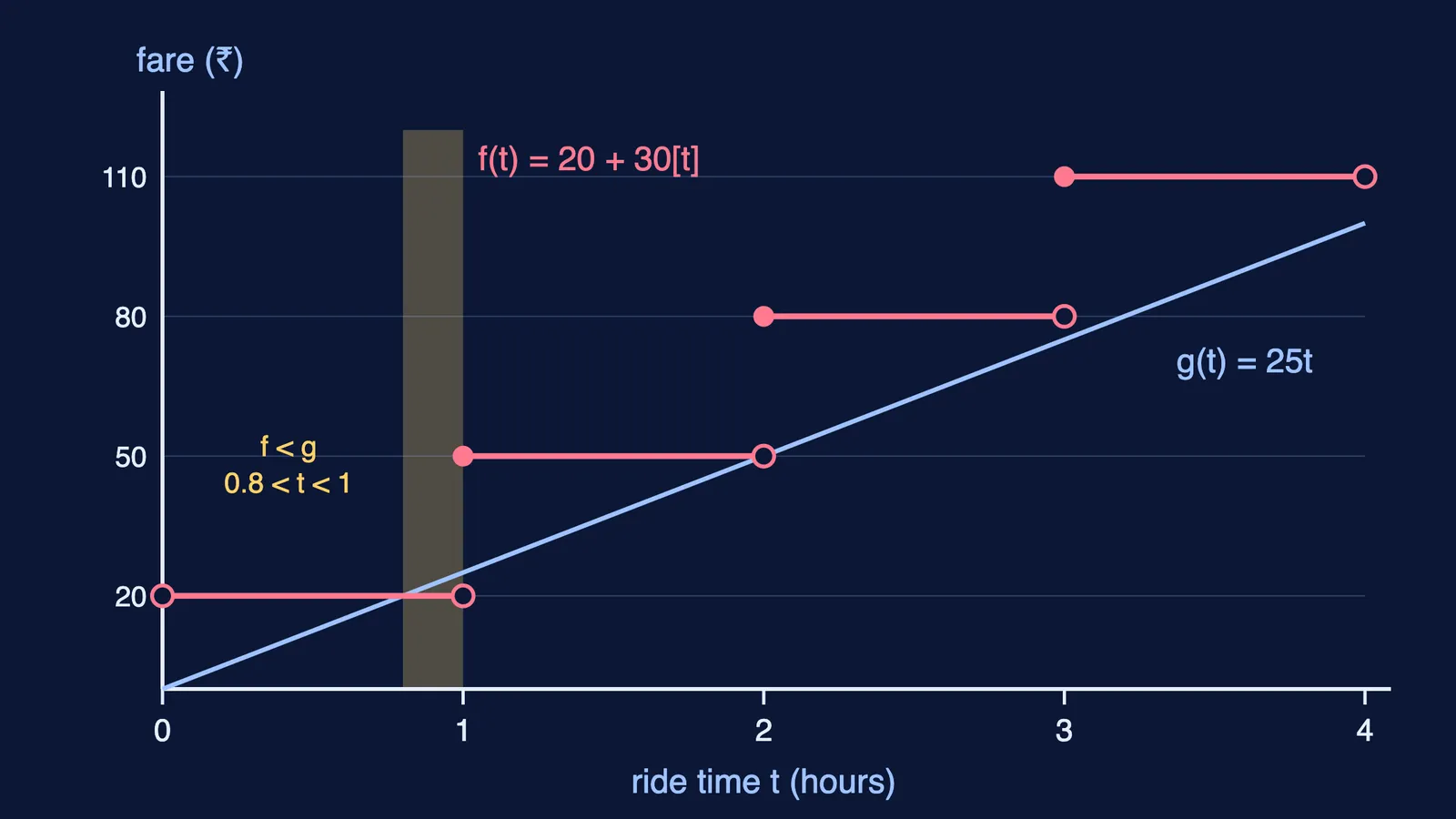
Two cycle-rental stands near a lake in Mysuru rent bikes for less than 4 hours. Stand P charges a ₹20 base fee plus ₹30 for every complete hour, so a ride of t hours costs f(t) = 20 + 30[t], where [t] is the greatest integer function and 0 < t < 4. Stand Q charges ₹25 per hour in exact proportion to ride time, so g(t) = 25t on the same domain. Ravi plans a short morning ride and wants to know which stand to pick.
(i) What does a 2.5-hour ride cost at Stand P? (a) ₹75 (b) ₹80 (c) ₹95 (d) ₹50
(ii) Write the range of f.
(iii) For which ride times does a rider pay exactly ₹80 at Stand P?
(iv) Find (f − g)(0.9) and (f − g)(1.5). For which values of t is Stand P cheaper?
Answers.
(i) (b) ₹80. [2.5] = 2, so f(2.5) = 20 + 30 × 2 = 80.
(ii) [t] takes only the values 0, 1, 2 and 3 when 0 < t < 4, so the range is {20, 50, 80, 110}.
(iii) 20 + 30[t] = 80 gives [t] = 2, which holds for 2 ≤ t < 3.
(iv) (f − g)(0.9) = 20 − 22.5 = −2.5, so P is ₹2.50 cheaper. (f − g)(1.5) = 50 − 37.5 = 12.5, so Q is ₹12.50 cheaper. On each interval n ≤ t < n + 1, P is cheaper when 20 + 30n < 25t, that is t > 0.8 + 1.2n. For n = 0 this gives 0.8 < t < 1. For n = 1, 2, 3 the bound is not below n + 1, so P is cheaper only for 0.8 < t < 1.
Case 3: Can average cost ever reach ₹2?
A small printing press in Sivakasi prints exam answer sheets. Each day it has a fixed cost of ₹6,000 for rent, power and wages, and each sheet costs ₹2 in paper and ink. So the daily cost for x sheets is C(x) = 6000 + 2x. The manager divides by the identity function I(x) = x to get the average cost per sheet, A(x) = (C/I)(x) = (6000 + 2x)/x. A school asks for a quote of ₹2.50 per sheet, and the manager needs a reply.
(i) What is A(1000)? (a) ₹6 (b) ₹8 (c) ₹2 (d) ₹6.002
(ii) As a real function, what is the domain of A, and why?
(iii) How many sheets bring the average cost down to ₹5? To ₹2.50?
(iv) Treating A as a real function, find its range. What does this say about an average cost of ₹2?
Answers.
(i) (b) ₹8. A(1000) = (6000 + 2000)/1000 = 8.
(ii) R − {0}. A quotient f/g is defined only where g(x) ≠ 0, and here g is I(x) = x.
(iii) (6000 + 2x)/x = 5 gives 6000 = 3x, so x = 2,000 sheets. (6000 + 2x)/x = 2.5 gives 6000 = 0.5x, so x = 12,000 sheets.
(iv) Write y = 2 + 6000/x, so x = 6000/(y − 2). This works for every y except 2. Range = R − {2}. Average cost nears ₹2 as x grows but never equals it: the fixed ₹6,000 is always shared.
How to attack case-study questions
Turn the story into symbols first: the sets and the rule.
For "is it a function?", check each element of the first set: exactly one image, no more and no fewer.
With [x], fix the integer part first, then turn it into an interval with ≤ on the left and < on the right.
For a quotient, write the condition (denominator ≠ 0) before simplifying; it decides the domain.
For a range, solve y = f(x) for x and see which y values break the formula.
Our guide to case-based questions in board exams covers how to pace these. If the interval step in Case 2 tripped you up, the Fermi Problem Library has worked problems with a step-by-step solver that explains the reasoning rather than printing an answer.