

On this page
What do solids case-study questions test?
A case-study question gives a short real-life passage and asks linked questions on it. Class 11 exams are set by your school, not the board, so treat these as case-based practice, not a paper pattern.
The CBSE Physics curriculum 2026-27 lists the chapter's content: elasticity, the stress-strain relationship, Hooke's law, Young's modulus, bulk modulus, shear modulus (qualitative idea only), Poisson's ratio and elastic energy. Every case stays inside that list and NCERT Class 11 Physics Chapter 8 (Reprint 2026-27). For definitions, see our Mechanical Properties of Solids Class 11 guide.
Take g = 9.8 m s⁻² and these values from NCERT's Tables 8.1 and 8.3: Young's modulus 200 GPa for steel and 110 GPa for copper; yield strength 250 MPa for steel and 200 MPa for copper; bulk modulus 160 GPa for steel and 2.2 GPa for water.
Case 1: A signboard outside a Lucknow sweet shop
A sweet shop in Lucknow hangs its 25 kg signboard from a single vertical steel wire, 2.0 m long and 2.0 mm in diameter. The owner's daughter, a Class 11 student, wonders how much the wire has stretched. A hardware dealer offers a copper wire of exactly the same length and diameter, saying copper is "more elastic because it stretches more". Ignore the wire's mass.
(i) Longitudinal strain has: (a) the unit N m⁻² (b) the unit m (c) no unit (d) the unit N
(ii) Find the tensile stress in the wire.
(iii) Find the extension of the steel wire.
(iv) How much would the copper wire stretch? Is the dealer right?
Answers.
(i) (c). Strain is a ratio of two lengths, ΔL/L.
(ii) A = π(1.0 × 10⁻³)² = 3.14 × 10⁻⁶ m² and F = 25 × 9.8 = 245 N, so σ = 245/(3.14 × 10⁻⁶) ≈ 7.8 × 10⁷ N m⁻².
(iii) ΔL = σL/Y = (7.8 × 10⁷ × 2.0)/(2.0 × 10¹¹) ≈ 7.8 × 10⁻⁴ m, or 0.78 mm.
(iv) The stress is the same, so ΔL ∝ 1/Y: 0.78 × 200/110 ≈ 1.42 mm. The dealer is wrong: the material that stretches less under the same load is more elastic, so steel beats copper.
Case 2: Pressure-testing a steel ball in a Chennai lab
A Chennai ocean-engineering lab tests deep-sea parts. A solid steel sphere of radius 10.0 cm is placed in a sealed chamber full of water, and the water pressure is raised by 60 MPa. An intern notices that more water has to be pumped into the rigid chamber as the pressure rises, and asks why.
(i) Under this uniform squeeze, the sphere: (a) changes shape but not volume (b) changes volume but not shape (c) changes both (d) changes neither
(ii) Find the volume strain of the sphere.
(iii) By how many cubic centimetres does the sphere shrink?
(iv) Find the volume strain of the water at the same pressure. Answer the intern, and explain why solids are harder to compress.
Answers.
(i) (b). Hydraulic stress acts normal to every point of the surface, so only the volume changes.
(ii) |ΔV|/V = p/B = (60 × 10⁶)/(160 × 10⁹) = 3.75 × 10⁻⁴.
(iii) V = (4/3)π(0.100)³ = 4.19 × 10⁻³ m³, so |ΔV| = 3.75 × 10⁻⁴ × 4.19 × 10⁻³ ≈ 1.57 × 10⁻⁶ m³, about 1.6 cm³.
(iv) |ΔV|/V = (60 × 10⁶)/(2.2 × 10⁹) ≈ 2.7 × 10⁻², or 2.7%, about 73 times the steel's strain. The water shrinks by 2.7% of its volume, so more must be pumped in. Atoms in a solid are tightly coupled to their neighbours; molecules in a liquid are bound less strongly, giving a much smaller bulk modulus.
Case 3: A tensile test at a Jamshedpur steel plant
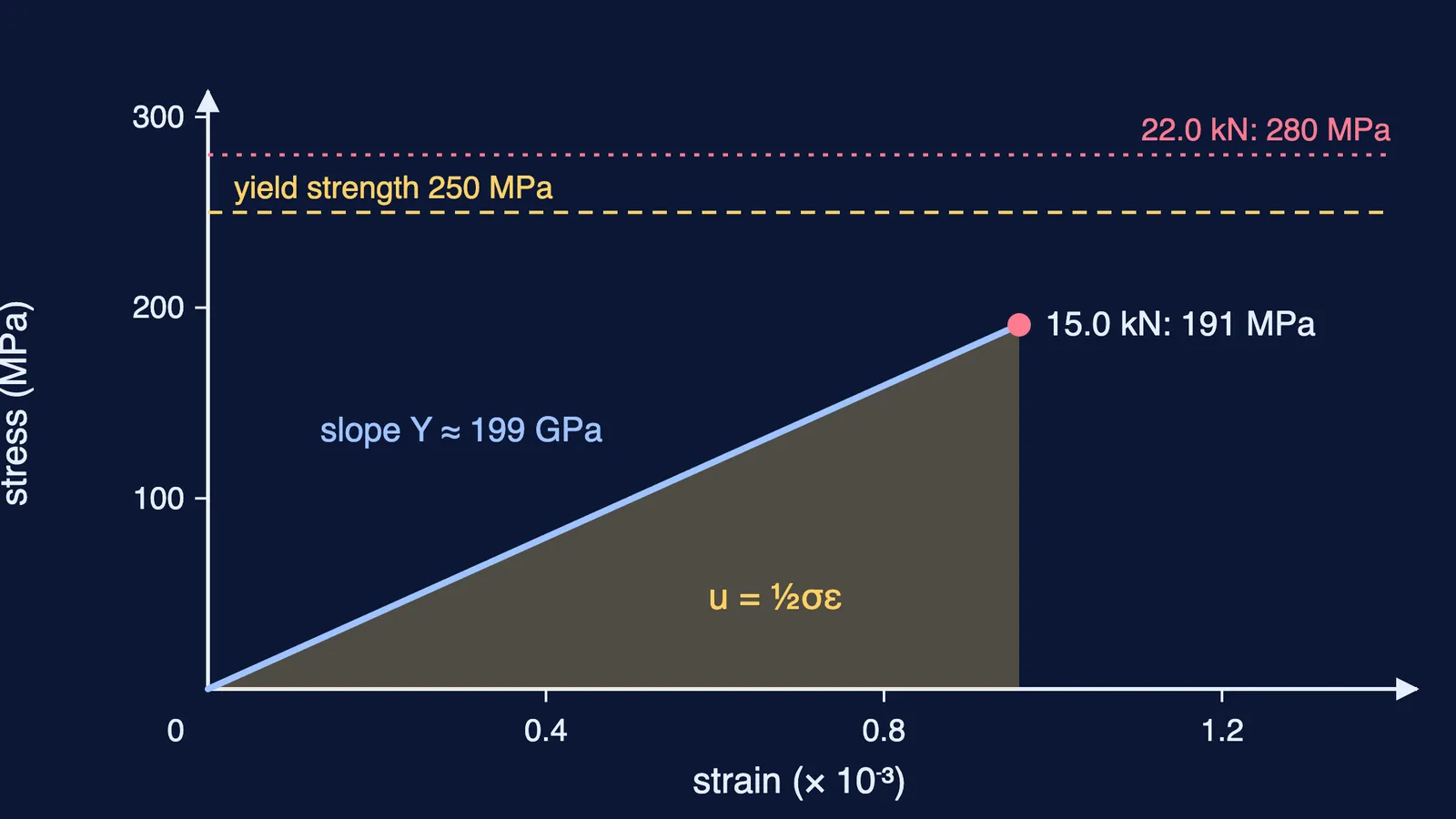
A Jamshedpur steel plant's lab checks a new batch of rods. A test piece 10.0 mm in diameter carries two gauge marks 50.0 cm apart. Under a pull of 15.0 kN, the gauge length grows by 0.48 mm and the diameter shrinks by 2.8 µm. When the load is removed, the rod returns exactly to its original length. Next, the technician will raise the load to 22.0 kN. The yield strength of this steel is 250 MPa.
(i) The full recovery after the 15.0 kN pull shows the rod stayed: (a) beyond its ultimate strength (b) in the plastic region (c) within the elastic limit (d) at the fracture point
(ii) Find Young's modulus of the steel.
(iii) Find Poisson's ratio of the steel.
(iv) Find the elastic energy stored at 15.0 kN. What will happen to the rod after the 22.0 kN pull?
Answers.
(i) (c). Below the yield point, the body regains its original dimensions when the load is removed.
(ii) A = π(5.0 × 10⁻³)² = 7.85 × 10⁻⁵ m², σ = (15.0 × 10³)/(7.85 × 10⁻⁵) ≈ 1.91 × 10⁸ N m⁻² and ε = 0.48/500 = 9.6 × 10⁻⁴. So Y = σ/ε ≈ 1.99 × 10¹¹ N m⁻², close to NCERT's 2.0 × 10¹¹ for steel.
(iii) Lateral strain = (2.8 × 10⁻⁶)/(10.0 × 10⁻³) = 2.8 × 10⁻⁴, so Poisson's ratio = (2.8 × 10⁻⁴)/(9.6 × 10⁻⁴) ≈ 0.29, inside NCERT's range of 0.28 to 0.30 for steels.
(iv) U = ½FΔL = ½ × 15.0 × 10³ × 0.48 × 10⁻³ = 3.6 J. At 22.0 kN, σ = (22.0 × 10³)/(7.85 × 10⁻⁵) ≈ 2.80 × 10⁸ N m⁻², above the 250 MPa yield strength. The rod will keep a permanent set.
How do you attack solids case-study questions?
Convert first. Change mm to m, kN to N and MPa to N m⁻².
Name the stress before the formula. Pull along the length means Y; an even squeeze from a fluid means B; shear needs only a qualitative answer.
Use ratios. At equal stress, ΔL ∝ L/Y; for one wire, ΔL ∝ F.
Check the yield strength. Above σy, the body keeps a permanent set.
Read "elastic" carefully. More elastic means it stretches less for the same load.
For the general method, read our guide to case-based questions in board exams, then try harder JEE Advanced fluids and elasticity practice questions. If a step goes wrong, the Fermi Problem Library has worked problems with a step-by-step solver that explains the reasoning rather than printing an answer.


