On this page
The 10 original questions below stay inside NCERT Class 12 Physics Chapter 6, Electromagnetic Induction, Chapter 7, Alternating Current, and Unit 14 of the NMC syllabus for NEET (UG)-2026. Most hinge on a statement that is true but is not the reason.
How do you answer assertion-reason questions?
Judge each statement on its own. If both are true, ask whether R is the direct cause of A as the textbook gives it. Our step-by-step strategy for assertion-reason questions covers the method.
Use these keys for questions 1 to 6:
(A) Both A and R are true and R is the correct explanation of A.
(B) Both A and R are true but R is NOT the correct explanation of A.
(C) A is true but R is false.
(D) A is false but R is true.
Use these keys for questions 7 to 10:
(A) Both statements are correct.
(B) Both statements are incorrect.
(C) Statement I is correct, Statement II is incorrect.
(D) Statement I is incorrect, Statement II is correct.
Assertion-reason questions on EMI and AC
Q1 (easy). Assertion (A): A bar magnet resting inside a closed coil, with neither moving, induces no current in the coil. Reason (R): An emf is induced in a coil only while the magnetic flux linked with it is changing.
Answer: (A). Both true, and R is the cause of A: constant flux means zero emf.
Trap: thinking a strong field alone drives a current.
Q2 (easy). Assertion (A): When the north pole of a magnet is pushed towards a closed coil, the face of the coil nearest the magnet acts as a north pole. Reason (R): Lenz's law follows from the conservation of electric charge.
Answer: (C). A is true: the induced current opposes the rising flux, so it repels the approaching north pole. R is false: NCERT ties Lenz's law to conservation of energy, since the opposite direction would make a perpetual-motion machine.
Trap: picking the wrong conservation law.
Q3 (medium). Assertion (A): The rms value of a sinusoidal current is about 0.707 times its peak value. Reason (R): The average of a sinusoidal current over one full cycle is zero.
Answer: (B). Both true, but R does not explain A. The rms value comes from averaging i squared, which is never negative, giving the peak divided by √2.
Trap: linking the two because both are "averages".
Q4 (medium). Assertion (A): The average power supplied to an ideal inductor over a complete cycle of AC is zero. Reason (R): In a purely inductive circuit, the current lags the voltage by π/2.
Answer: (A). Both true, and R is the reason: a phase difference of π/2 makes the power factor cos φ zero.
Trap: assuming a current that flows must dissipate power.
Q5 (medium). Assertion (A): Doubling the number of turns per unit length of a long air-core solenoid, with its length and cross-section unchanged, doubles its self-inductance. Reason (R): The self-inductance of a long solenoid is μ0 n² A l.
Answer: (D). A is false: L depends on n squared, so it becomes four times as large. R is true.
Trap: treating L as proportional to n.
Q6 (hard). Assertion (A): In an AC generator turning at a steady rate, the induced emf is greatest at the instant the plane of the coil is parallel to the magnetic field. Reason (R): At that instant, the magnetic flux through the coil is greatest.
Answer: (C). A is true: the emf NBAω sin ωt peaks when the area vector is at 90° to B, which is when the plane is parallel to B. R is false: the flux is zero then, but it is changing fastest.
Trap: confusing the largest flux with the largest rate of change of flux.
Statement I and Statement II questions on EMI and AC
Q7 (medium). Statement I: The reactance of a capacitor rises as the frequency of the AC source rises. Statement II: In a purely capacitive AC circuit, the current leads the voltage by π/2.
Answer: (D). Statement I is incorrect: X_C = 1/(ωC) falls as frequency rises. Statement II is correct.
Trap: borrowing the inductor's X_L = ωL, which rises with frequency.
Q8 (medium). Statement I: In an ideal step-down transformer, the current in the secondary is smaller than the current in the primary. Statement II: A transformer steps voltage up or down just as well on a steady DC supply.
Answer: (B). Both incorrect. With power in equal to power out, I_s = (N_p/N_s) I_p, so stepping voltage down steps current up. Steady DC gives a constant core flux, so no emf is induced in the secondary.
Trap: assuming current follows voltage.
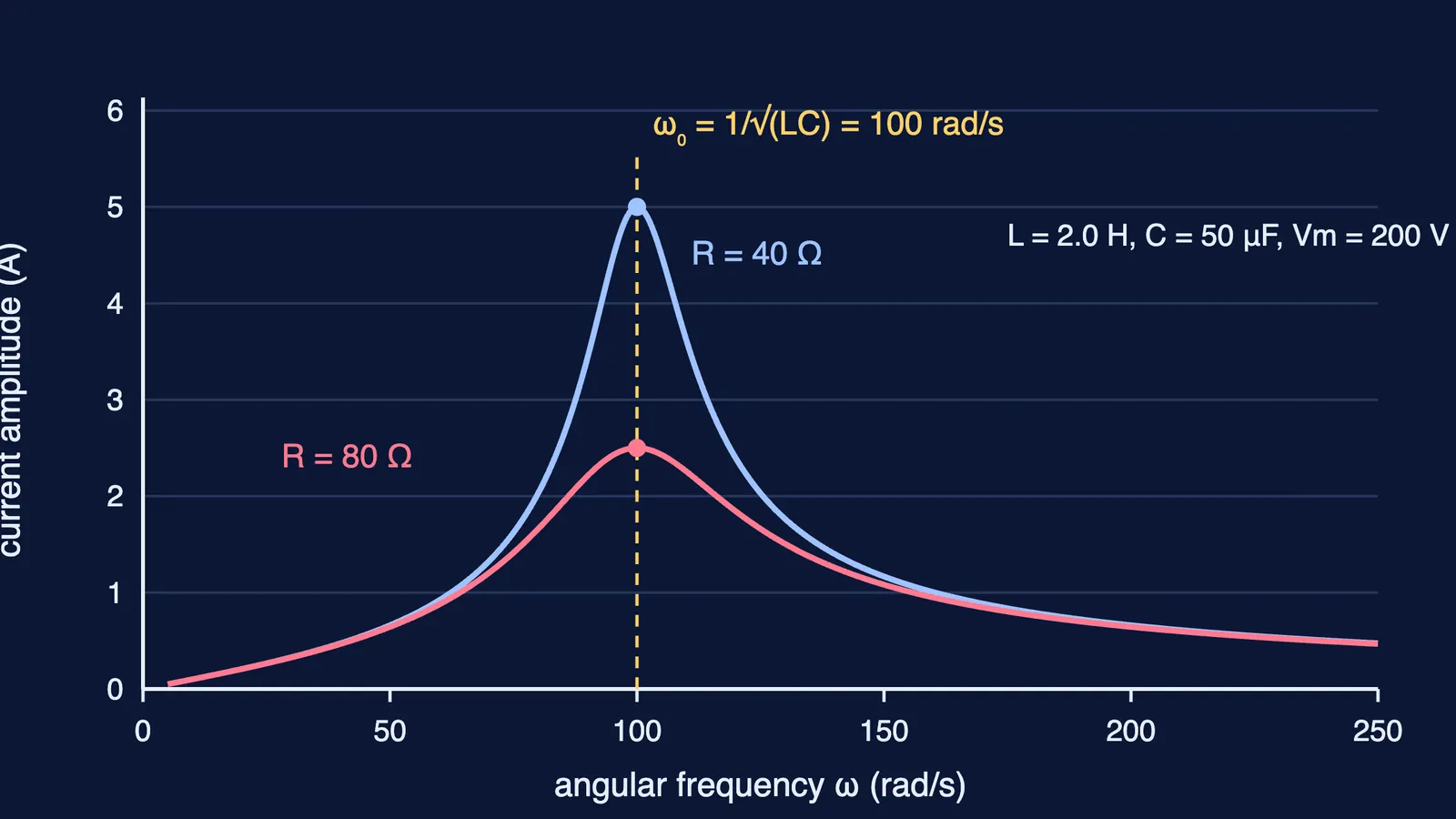
Q9 (hard). Statement I: A series LCR circuit with L = 2.0 H and C = 50 μF has a resonant angular frequency of 100 rad/s. Statement II: At resonance in a series LCR circuit, the impedance equals R and the power factor is 1.
Answer: (A). Both correct. ω0 = 1/√(LC) = 1/√(2.0 × 50 × 10⁻⁶) = 1/√(10⁻⁴) = 100 rad/s. At resonance X_L = X_C, so Z = R, φ = 0 and cos φ = 1.
Trap: converting 50 μF as 50 × 10⁻³ F, or giving the answer in hertz (about 15.9 Hz).
Q10 (hard). Statement I: An ideal inductor of 0.2 H carrying a steady current of 3 A stores 0.9 J of magnetic energy. Statement II: The self-induced emf in an inductor opposes the current itself, so it is largest when the current is largest.
Answer: (C). Statement I is correct: U = ½LI² = ½ × 0.2 × 3² = 0.9 J. Statement II is incorrect: the back emf, −L dI/dt, opposes changes in current; a large steady current gives zero emf.
Trap: reading "opposes" as opposing the current, not its change.
How should you use this set?
Answer all 10 with the answers covered, then tag each miss: wrong fact, wrong formula or wrong A-R link.
Rewrite every false statement so it is true. If the phase and resonance ideas behind Q4, Q7 and Q9 are hard to picture, the Fermi Simulation Lab has interactive simulations for ideas that are easier to see than to read. Then try our EMI and AC NEET practice questions with solutions and plan revision with the chapter guide to electromagnetic induction and alternating currents for NEET.