On this page
Here are 10 original questions, 6 assertion-reason and 4 Statement I / Statement II pairs, easy to hard. All stay inside NCERT Class 10 Maths chapter 4, Quadratic Equations (Reprint 2026-27), with every number checked.
How do assertion-reason questions work in CBSE Class 10 Maths?
The CBSE Class 10 Mathematics Standard sample question paper for 2026-27 has two 1-mark assertion-reason questions, numbers 19 and 20. Keys for the assertion-reason items:
(A) Both A and R are true and R is the correct explanation of A.
(B) Both A and R are true but R is NOT the correct explanation of A.
(C) A is true but R is false.
(D) A is false but R is true.
Keys for the statement pairs:
(A) Both statements are correct.
(B) Both statements are incorrect.
(C) Statement I is correct, Statement II is incorrect.
(D) Statement I is incorrect, Statement II is correct.
Judge A alone, then R alone, then ask whether R is the reason A is true. For the full method, see our three-check method for assertion-reason questions.
Assertion-reason questions on quadratic equations
Q1 (easy). Assertion (A): (x − 3)² = x² + 9 is not a quadratic equation. Reason (R): An equation is quadratic only if, in simplified standard form, the x² coefficient is not zero.
Answer: (A). Expanding gives −6x = 0, which is linear. R is the test NCERT uses, so it explains A.
Trap: judging by the look of the equation.
Q2 (easy). Assertion (A): x = 3 is a root of 3x² − 7x − 6 = 0. Reason (R): A quadratic equation can have at most two roots.
Answer: (B). Putting x = 3 gives 27 − 21 − 6 = 0, so A is true, and R is true. But R only limits how many roots exist; it does not show that 3 is one.
Trap: picking (A) because both mention roots.
Q3 (medium). Assertion (A): 5x² − 2x + 1 = 0 has two distinct real roots. Reason (R): A quadratic equation has two distinct real roots when b² − 4ac > 0.
Answer: (D). b² − 4ac = 4 − 20 = −16, so there are no real roots and A is false. R is the correct rule.
Trap: forgetting to subtract 4ac.
Q4 (medium). Assertion (A): The equation x² = 5x has exactly one root, x = 5. Reason (R): Dividing both sides of an equation by x can lose the root x = 0.
Answer: (D). x(x − 5) = 0 gives two roots, 0 and 5, so A is false. R is true: it is the mistake that produces A.
Trap: cancelling x instead of factoring it out.
Q5 (medium). Assertion (A): The roots of x² − 2x − 2 = 0 are 1 + √3 and 1 − √3. Reason (R): The quadratic formula works only when the equation can be factorised using whole numbers.
Answer: (C). The formula gives (2 ± √12)/2 = 1 ± √3, so A is true. R is false: the formula works whenever b² − 4ac is 0 or more.
Trap: thinking no neat factors means no roots.
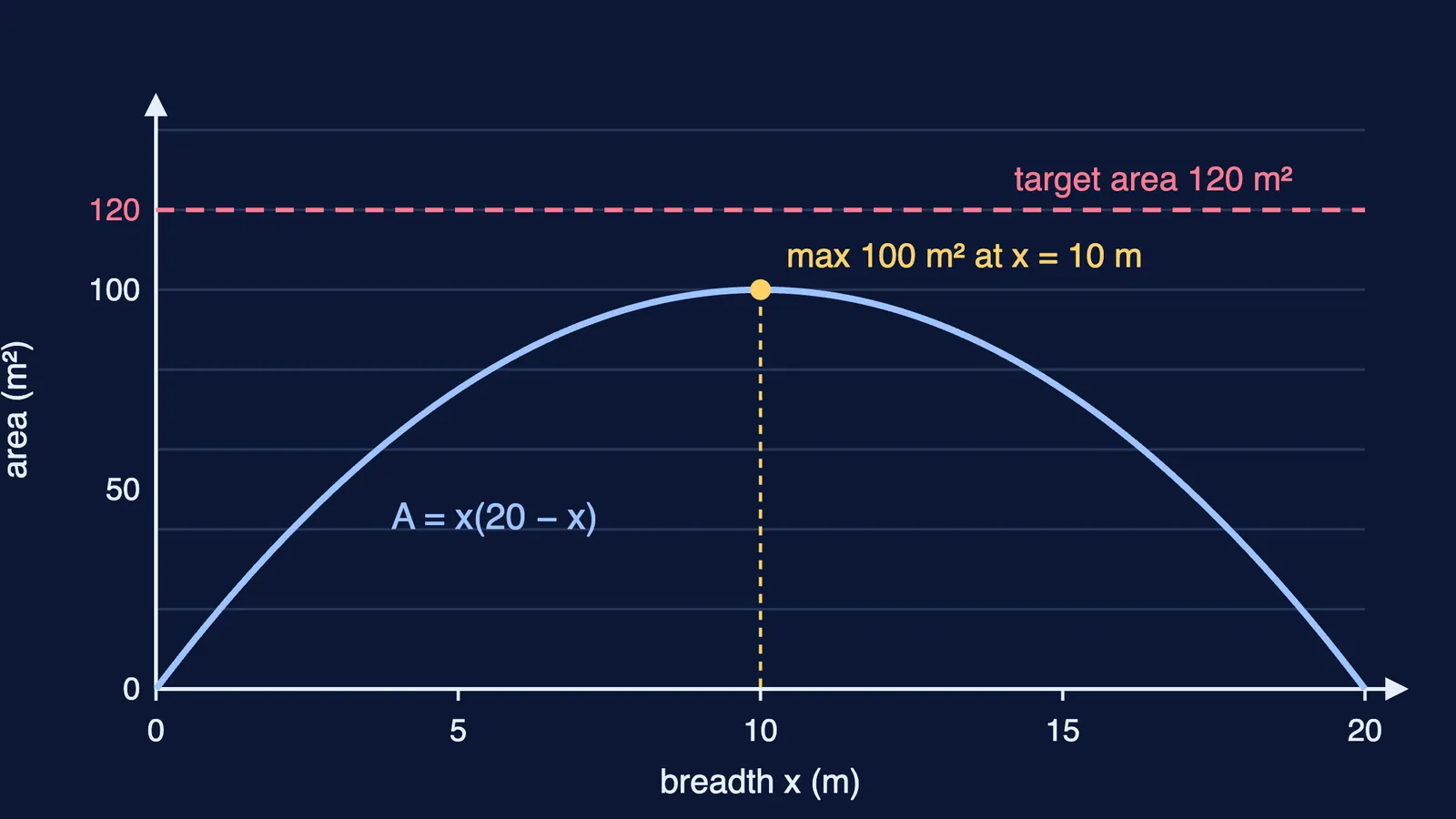
Q6 (hard). Assertion (A): No rectangle has perimeter 40 m and area 120 m². Reason (R): Its breadth x would satisfy x² − 20x + 120 = 0, whose discriminant is negative.
Answer: (A). Length plus breadth is 20 m, so x(20 − x) = 120. The discriminant is 400 − 480 = −80, so no real breadth exists; R directly explains A.
Trap: trying a few whole numbers and calling that a proof.
Statement I and Statement II questions on quadratic equations
Q7 (easy). Statement I: Both roots of 4x² − 4x + 1 = 0 are equal to 1/2. Statement II: If c = 0 in ax² + bx + c = 0, then x = 0 is a root.
Answer: (A). In I, b² − 4ac = 16 − 16 = 0, so both roots are −b/2a = 1/2. In II, putting x = 0 leaves c, which is 0.
Trap: thinking equal roots means the equation is not quadratic.
Q8 (medium). Statement I: (x − 1)³ = x³ + 2 is quadratic. Statement II: The equation x² − x + 1 = 0 has two real roots.
Answer: (C). The cubes cancel in I, leaving x² − x + 1 = 0, which is quadratic. In II, b² − 4ac = 1 − 4 = −3, so there are no real roots.
Trap: calling I cubic.
Q9 (medium). Statement I: 3x² + kx + 12 = 0 has two equal roots only when k = 12. Statement II: If kx² − 4x + 1 = 0 has two equal real roots, then k = 4.
Answer: (D). Equal roots need k² − 144 = 0, so k = ±12 and I is false. In II, 16 − 4k = 0 gives k = 4.
Trap: forgetting k = −12.
Q10 (hard). Statement I: If a word problem's quadratic has a negative root, the equation was set up wrongly. Statement II: If a and c have opposite signs, ax² + bx + c = 0 has no real roots for some values of b.
Answer: (B). NCERT's prayer-hall example gets x = 12 or −12.5 and just rejects the negative breadth, so I is false. With opposite signs, −4ac is positive, so b² − 4ac is positive and two distinct real roots always exist; II is false.
Trap: missing that −4ac is positive when ac is negative.
How should you use this practice set?
Cover the answers and key all ten in one sitting.
For each miss, name what you misjudged: A, R, or the link.
Write a, b and c with their signs before every discriminant.
In word problems, say what x stands for before keeping a root.
If one method keeps going wrong, the Fermi Problem Library has worked problems with a step-by-step solver that explains the reasoning rather than printing an answer.
To revise the chapter, read our guide to quadratic equations in Class 10: factorisation, formula and roots.