On this page
Every statement stays inside the NCERT chapter (Reprint 2026-27); we checked every area with Python.
How do you answer assertion-reason questions on areas?
The CBSE Class 12 Mathematics sample paper for 2026-27 has two 1-mark assertion-reason questions (Q19 and Q20). The 2026-27 curriculum limits this chapter to areas under lines, circles, parabolas and ellipses in standard form.
Judge A, judge R, then read "A because R". The usual trick: a signed-integral fact offered as the reason for an area. More in our assertion-reason question strategy.
Assertion-reason keys:
(A) Both A and R are true and R is the correct explanation of A.
(B) Both A and R are true but R is NOT the correct explanation of A.
(C) A is true but R is false.
(D) A is false but R is true.
Statement I / Statement II keys:
(A) Both statements are correct.
(B) Both statements are incorrect.
(C) Statement I is correct, Statement II is incorrect.
(D) Statement I is incorrect, Statement II is correct.
Application of integrals assertion-reason questions with answers
Q1 (easy). Assertion (A): The area bounded by y = x², the x-axis, x = 0 and x = 3 is 9 square units. Reason (R): If f(x) ≥ 0 on [a, b], the area bounded by y = f(x), the x-axis, x = a and x = b is ∫ from a to b of f(x) dx.
Answer: (A). ∫ from 0 to 3 of x² dx = 9, using R directly.
Trap: writing x³ without dividing by 3 and getting 27.
Q2 (easy). Assertion (A): The area enclosed by the ellipse x²/36 + y²/4 = 1 is 144π square units. Reason (R): The ellipse x²/a² + y²/b² = 1 is symmetric about both axes, so its area is four times its first-quadrant area.
Answer: (D). With a = 6, b = 2, the area is πab = 12π, so A is false. R is how NCERT sets it up.
Trap: multiplying 36 and 4 instead of a and b.
Q3 (medium). Assertion (A): The area enclosed by the circle x² + y² = 25 is 25π square units. Reason (R): The circle x² + y² = 25 is symmetric about the x-axis only.
Answer: (C). 4 × ∫ from 0 to 5 of √(25 − x²) dx = 25π. The circle is symmetric about both axes, so R is false.
Trap: multiplying by 2 instead of 4.
Q4 (medium). Assertion (A): The area bounded by y = cos x, the x-axis, x = 0 and x = π is 2 square units. Reason (R): ∫ from 0 to π of cos x dx = 0.
Answer: (B). The area is 1 + |−1| = 2 (split at π/2) and the signed integral is 0. R is a cancellation, not the reason.
Trap: choosing (A) because both use one integral.
Q5 (hard). Assertion (A): The first-quadrant area bounded by x² = 9y, the y-axis, y = 1 and y = 4 is 14 square units. Reason (R): The area bounded by x = g(y), the y-axis, y = c and y = d is ∫ from c to d of g(y) dy.
Answer: (A). Horizontal strips with x = 3√y: ∫ from 1 to 4 of 3√y dy = 14. R is the formula used.
Trap: integrating x²/9 from 3 to 6 (giving 7), the area against the wrong axis.
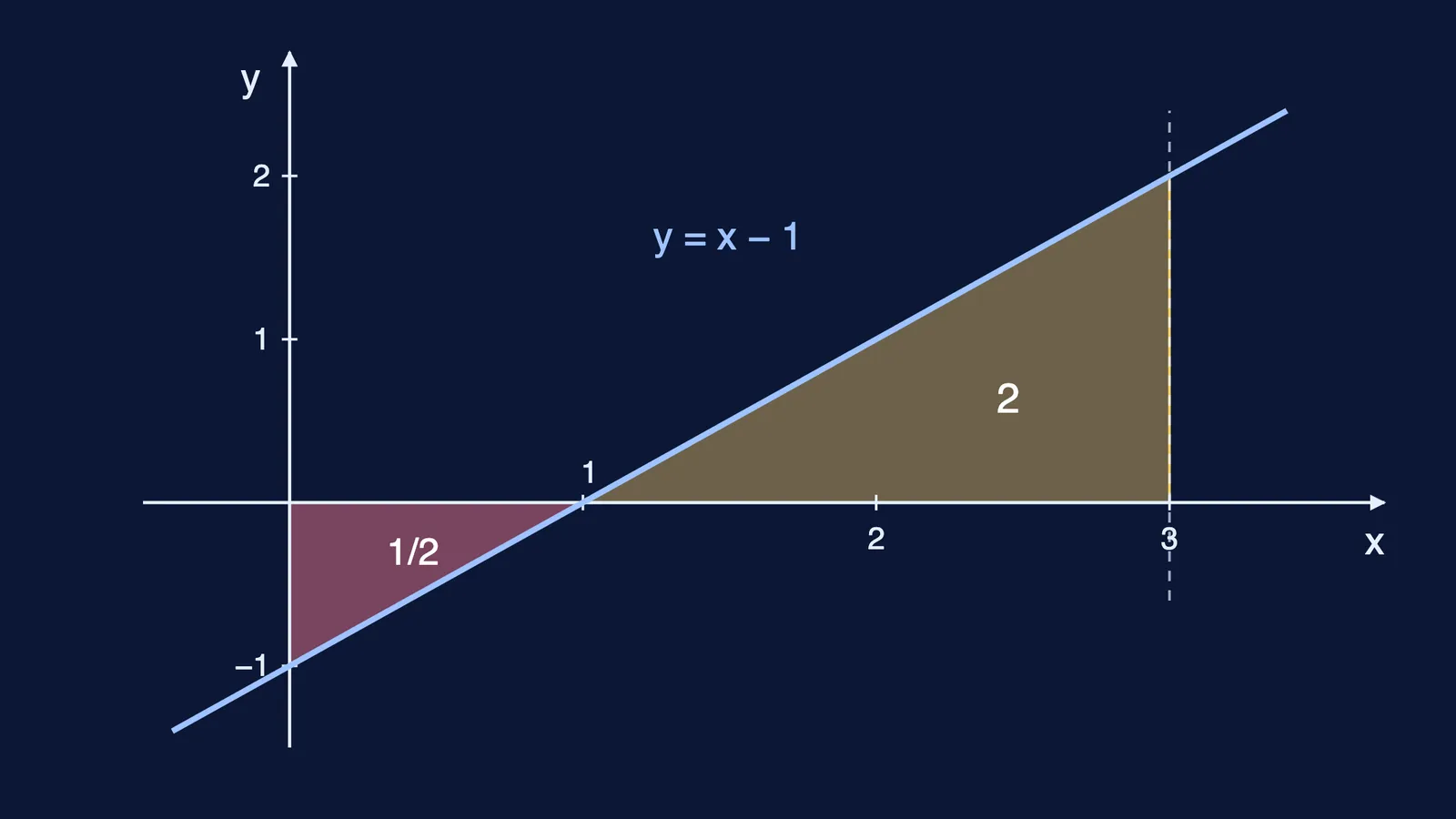
Q6 (hard). Assertion (A): The area bounded by y = x − 1, the x-axis, x = 0 and x = 3 is 3/2 square units. Reason (R): If part of the curve lies below the x-axis, the area is |A₁| + A₂, with A₁ and A₂ the integrals over the parts below and above the axis.
Answer: (D). The line crosses the axis at x = 1, so the area is |−1/2| + 2 = 5/2; 3/2 is the signed integral. R is NCERT's rule.
Trap: integrating straight from 0 to 3.
Statement I and Statement II questions on application of integrals
Q7 (easy). Statement I: The area bounded by y = 3, the x-axis, x = 1 and x = 5 is 12 square units. Statement II: The area bounded by y = x, the x-axis and x = 4 is 16 square units.
Answer: (C). I is a rectangle. In II, ∫ from 0 to 4 of x dx = 8: a triangle, half the square.
Trap: squaring 4 out of habit.
Q8 (medium). Statement I: The area of the part of the circle x² + y² = 9 that lies above the x-axis is 9π/4 square units. Statement II: The area enclosed by the ellipse x²/25 + y²/4 = 1 is 10π square units.
Answer: (D). Half of 9π is 9π/2, so I is incorrect. II is πab = π × 5 × 2.
Trap: taking a quarter instead of a half of the circle.
Q9 (medium). Statement I: The area bounded by y = √x, the x-axis and x = 4 is 16/3 square units. Statement II: The area bounded by x = y², the y-axis, y = 0 and y = 2 is 8/3 square units.
Answer: (A). ∫ from 0 to 4 of √x dx = 16/3 and ∫ from 0 to 2 of y² dy = 8/3.
Trap: assuming two such different values cannot both be right.
Q10 (hard). Statement I: The area bounded by y = x² − 2x and the x-axis is −4/3 square units. Statement II: That region lies above the x-axis.
Answer: (B). The curve is negative between its roots 0 and 2 (y(1) = −1), so II is incorrect. The integral is −4/3, but the area is 4/3, so I is incorrect.
Trap: a negative area, or assuming an upward parabola sits above the axis.
How should you use this set?
Cover the answers; do all ten in one timed sitting.
For every miss, sketch the region and mark where the curve crosses the axis.
Redo Q4, Q6 and Q10 on paper later in the week.
If your areas keep going wrong, the Fermi Problem Library has worked problems with a step-by-step solver that explains the reasoning rather than printing an answer. For step marks, see our application of integrals Class 12 board exam guide and this worked area between a parabola and a line.