On this page
Areas Related to Circles, Chapter 11 of NCERT Class 10 Mathematics (Reprint 2026-27), rests on three results: sector area, arc length and segment area. The CBSE 2026-27 Class 10 Maths syllabus limits segment problems to central angles of 60°, 90° and 120°, and so does this set. Use π = 22/7 unless stated; every number was rechecked.
How do you answer assertion-reason questions on areas related to circles?
The CBSE Class 10 Maths (Standard) sample paper for 2026-27 sets questions 19 and 20 as 1-mark assertion-reason items, with the four options used below.
Judge each line true or false on its own; if both are true, ask whether R proves A. Our three-check method for assertion-reason questions has more.
Keys for Q1 to Q6:
(A) Both A and R are true and R is the correct explanation of A.
(B) Both A and R are true but R is NOT the correct explanation of A.
(C) A is true but R is false.
(D) A is false but R is true.
Keys for Q7 to Q10:
(A) Both statements are correct.
(B) Both statements are incorrect.
(C) Statement I is correct, Statement II is incorrect.
(D) Statement I is incorrect, Statement II is correct.
Areas related to circles assertion-reason questions with answers
Q1 (easy). Assertion (A): The area of a sector of angle 90° in a circle of radius 14 cm is 154 cm². Reason (R): The area of a sector of angle θ (in degrees) in a circle of radius r is (θ/360) × πr².
Answer: (A). Both are true and R gives A: (90/360) × (22/7) × 14² = 154 cm².
Trap: using 2πr instead of πr².
Q2 (easy). Assertion (A): If the radius of a circle is doubled and the angle stays the same, the area of the sector doubles. Reason (R): For a fixed angle, the area of a sector is proportional to the square of the radius.
Answer: (D). A is false: doubling r makes r², and so the area, four times as large. R is true and shows why A fails.
Trap: treating area like length.
Q3 (medium). Assertion (A): In a circle of radius 28 cm, the arc of a sector of angle 45° is 22 cm long. Reason (R): The area of that sector is 308 cm².
Answer: (B). Both are true (arc 22 cm, area 308 cm²), but an area cannot explain a length; A comes from (θ/360) × 2πr.
Trap: choosing (A) because both lines describe one sector.
Q4 (medium). Assertion (A): A chord of a circle of radius 20 cm subtends 90° at the centre, so (with π = 3.14) the minor segment is 114 cm². Reason (R): Area of a segment = area of the corresponding sector − area of the corresponding triangle.
Answer: (A). Both are true and R is the method: sector 314 cm² minus triangle 200 cm² gives 114 cm².
Trap: stopping at the sector.
Q5 (medium). Assertion (A): The perimeter of a sector of radius 35 cm and angle 72° is 114 cm. Reason (R): The perimeter of a sector is equal to the length of its arc.
Answer: (C). A is true: two radii plus the arc, 35 + 35 + 44 = 114 cm. R is false: it leaves out the radii.
Trap: reporting only the arc.
Q6 (hard). Assertion (A): In a circle of radius 16 cm, a chord that subtends 120° at the centre is 16 cm long. Reason (R): The perpendicular from the centre of a circle to a chord bisects the chord.
Answer: (D). A is false: with OM perpendicular to the chord, each half is 16 × sin 60° = 8√3 cm, so the chord is 16√3 ≈ 27.7 cm. R is true.
Trap: assuming triangle OAB is equilateral; that needs 60°.
Statement I and II questions on sectors and segments
Q7 (medium). Statement I: A 7 cm minute hand sweeps 154/3 cm² (about 51.3 cm²) in 20 minutes. Statement II: The minute hand turns through 360° in one hour.
Answer: (A). Both are correct. At 6° a minute, 20 minutes is 120°, and (120/360) × (22/7) × 7² = 154/3 cm².
Trap: using the hour hand's 30° per hour.
Q8 (medium). Statement I: If the arc of a sector of radius 14 cm is 22 cm long, the angle of the sector is 60°. Statement II: The area of a sector with arc length l and radius r is l × r.
Answer: (B). Both are incorrect. The circumference is 88 cm and 22 is a quarter of it, so the angle is 90°. The area is (1/2) × l × r = 154 cm².
Trap: forgetting the 1/2.
Q9 (hard). Statement I: A goat tied with a 7 m rope at a corner of a 20 m by 15 m field can graze 38.5 m². Statement II: Tied instead at the middle of the 20 m side, it can graze three times as much.
Answer: (C). Statement I is correct: a quadrant, (1/4) × (22/7) × 49 = 38.5 m². Statement II is incorrect: a semicircle gives 77 m², double, not triple.
Trap: guessing the ratio instead of comparing 180° with 90°.
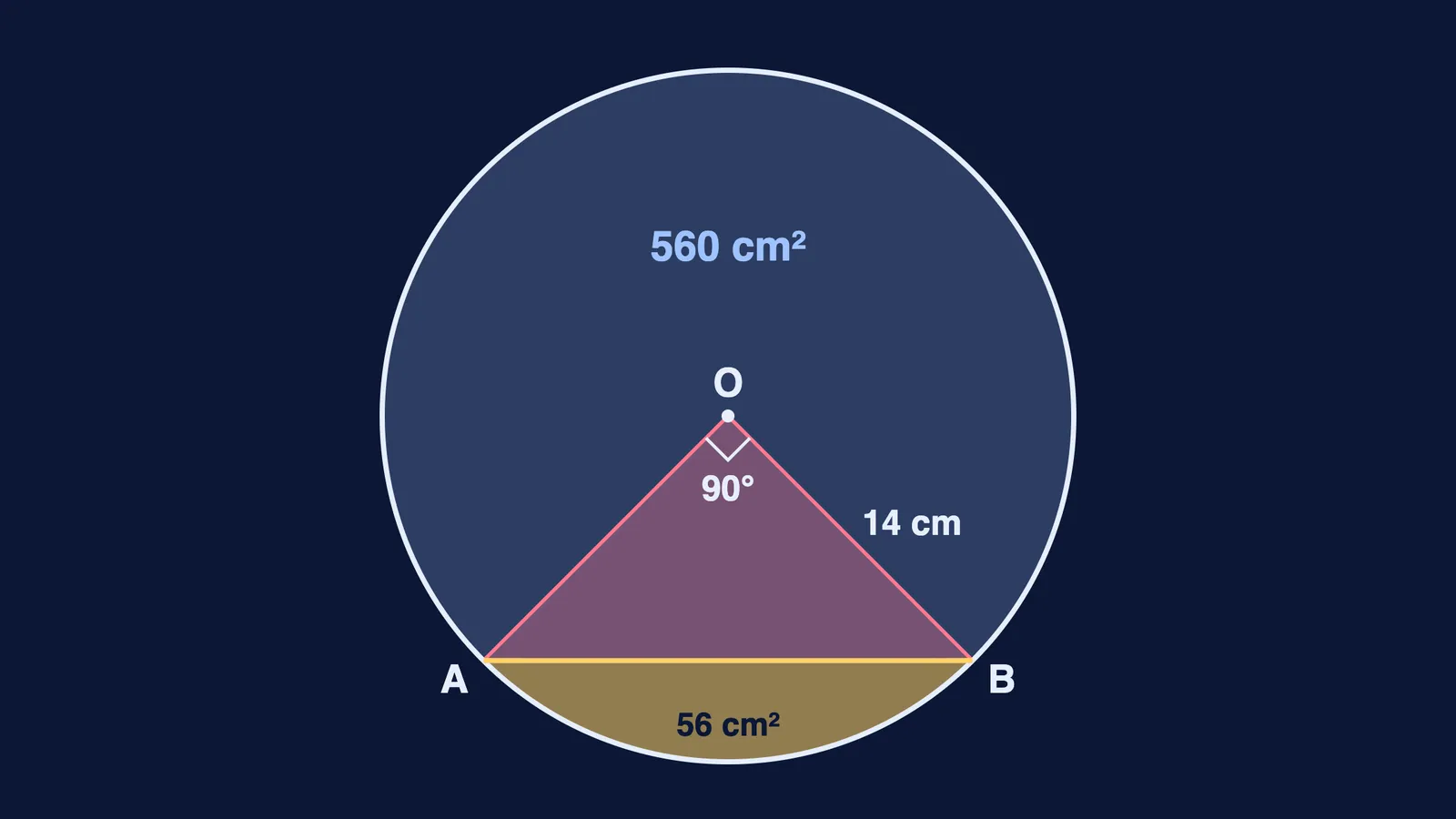
Q10 (hard). Statement I: A chord of a circle of radius 14 cm subtends 90° at the centre, so the major segment is 364 cm². Statement II: Area of the major segment = πr² − area of the minor segment.
Answer: (D). Statement I is incorrect: the minor segment is 154 − 98 = 56 cm², so the major segment is 616 − 56 = 560 cm². Statement II is the NCERT relation.
Trap: 462 − 98 = 364 subtracts the triangle, which lies inside the major segment; shade the region first.
How should you use this set?
Cover the answers; mark each line T or F first.
For every (B), write the real reason.
Redo missed items after two days, drawing the figure first.
If the slip was the formula, reread our Areas related to circles Class 10 guide. If it was the working, the Fermi Problem Library has worked problems with a step-by-step solver that explains the reasoning rather than printing an answer. For where this chapter sits in the paper, see our section-by-section plan for the CBSE Class 10 maths paper.