

On this page
Chapter 7 of NCERT Class 10 Mathematics gives you three tools: the distance, section and mid-point formulas. Every statement below was checked against NCERT Class 10 Mathematics, Chapter 7 Coordinate Geometry (Reprint 2026-27), and every number was recomputed. To revise the chapter first, read our coordinate geometry Class 10 guide.
How do you answer assertion-reason questions in coordinate geometry?
Judge each line on its own as true or false. Only when both are true, ask: is R the direct reason A is true? Always do the arithmetic.
Keys for Q1 to Q6:
(A) Both A and R are true and R is the correct explanation of A.
(B) Both A and R are true but R is NOT the correct explanation of A.
(C) A is true but R is false.
(D) A is false but R is true.
Keys for Q7 to Q10:
(A) Both statements are correct.
(B) Both statements are incorrect.
(C) Statement I is correct, Statement II is incorrect.
(D) Statement I is incorrect, Statement II is correct.
For the general method, see our three-check method for assertion-reason questions.
Coordinate geometry assertion-reason questions with answers
Q1 (easy). Assertion (A): The distance of the point (−5, 12) from the origin is 13 units. Reason (R): The distance of a point P(x, y) from the origin is √(x² + y²).
Answer: (A). R is the rule that gives A: √(25 + 144) = √169 = 13.
Trap: adding −5 + 12 = 7 instead of squaring.
Q2 (easy). Assertion (A): The point (0, −4) lies on the y-axis. Reason (R): Every point on the y-axis has its y-coordinate equal to 0.
Answer: (C). A is true. R is false: points on the y-axis have the form (0, y), so their x-coordinate is 0.
Trap: mixing up which coordinate vanishes on which axis.
Q3 (medium). Assertion (A): The point P(4, 3) divides the segment joining A(2, 1) and B(8, 7) in the ratio 1 : 2. Reason (R): The points A, P and B all lie on the line y = x − 1.
Answer: (B). Both are true: the section formula gives ((8 + 4)/3, (7 + 2)/3) = (4, 3). But every point of the segment lies on that line, whatever the ratio, so R does not explain the 1 : 2.
Trap: treating "on the line" as proof of a ratio.
Q4 (medium). Assertion (A): The distance between (3, −1) and (−1, 2) is 7 units. Reason (R): The distance between P(x₁, y₁) and Q(x₂, y₂) can also be written as √((x₁ − x₂)² + (y₁ − y₂)²).
Answer: (D). A is false: the distance is √(4² + 3²) = √25 = 5. R is true, since (x₁ − x₂)² = (x₂ − x₁)².
Trap: adding the differences 4 + 3 instead of squaring them.
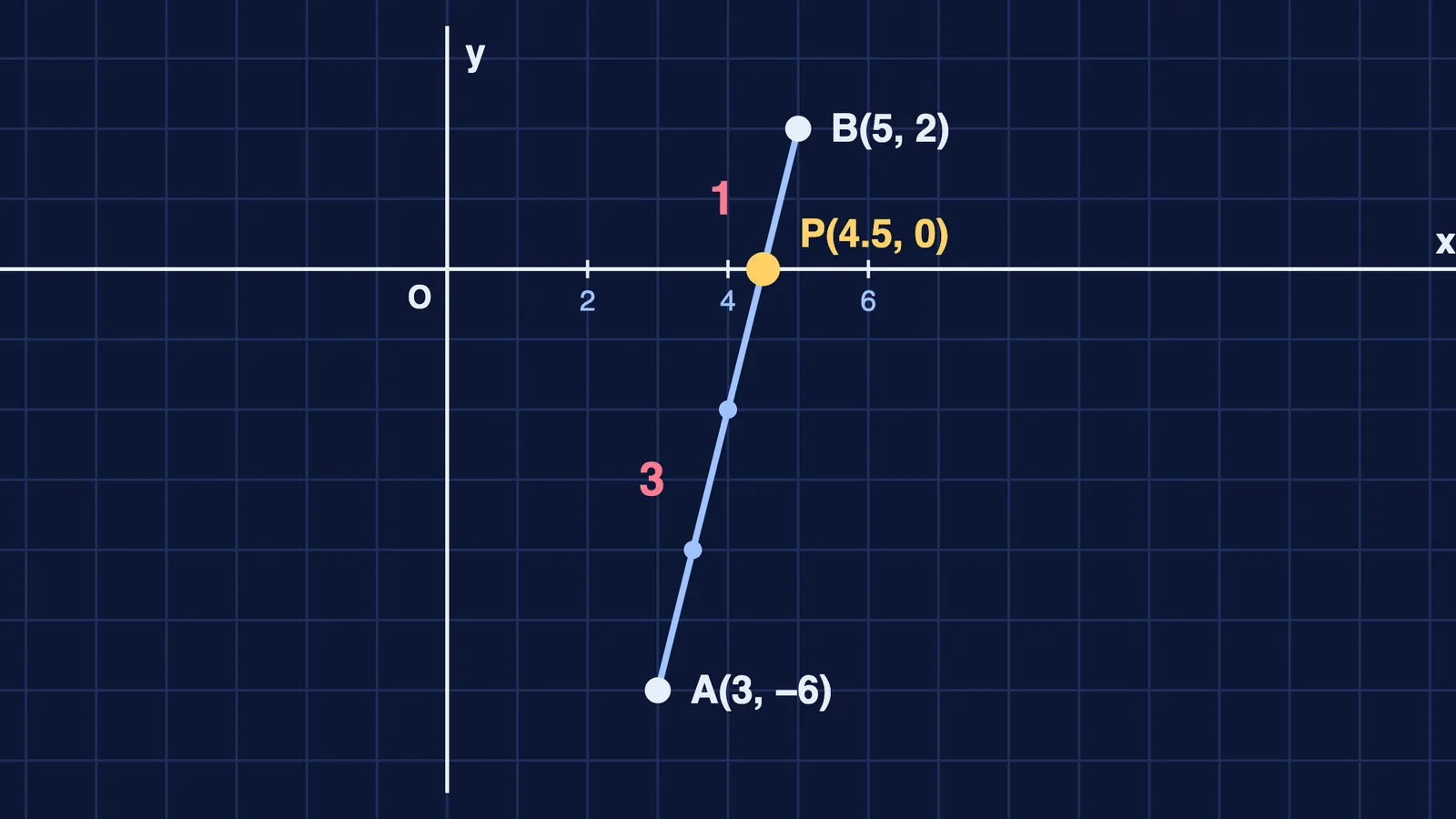
Q5 (medium). Assertion (A): The x-axis divides the segment joining (3, −6) and (5, 2) in the ratio 3 : 1, measured from (3, −6). Reason (R): If y₁ and y₂ have opposite signs, the x-axis divides the segment joining (x₁, y₁) and (x₂, y₂) in the ratio −y₁ : y₂.
Answer: (A). R gives A directly: −(−6) : 2 = 3 : 1. Check: (2k − 6)/(k + 1) = 0 gives k = 3, at (4.5, 0).
Trap: writing 1 : 3 because the order of the ends got swapped.
Q6 (hard). Assertion (A): The points (1, 1), (4, 2), (5, 5) and (2, 4), taken in order, form a rhombus that is not a square. Reason (R): A quadrilateral with all four sides equal is always a square.
Answer: (C). A is true: all four sides are √10, but the diagonals are √32 and √8. R is false, and A is the counterexample.
Trap: stopping after the four sides.
Statement I and Statement II questions on coordinate geometry
Q7 (easy). Statement I: The point (−3, 0) lies in the second quadrant. Statement II: The mid-point of the segment joining (−4, 6) and (8, −2) is (2, 2).
Answer: (D). Statement I is false: a point with y-coordinate 0 sits on the x-axis and lies in no quadrant. Statement II is true: ((−4 + 8)/2, (6 − 2)/2) = (2, 2).
Trap: picking a quadrant from the sign of x alone.
Q8 (medium). Statement I: The points (−1, −1), (2, 3) and (5, 6) are collinear. Statement II: The point dividing the segment joining (2, 4) and (8, 10) in the ratio 1 : 2 is (6, 8).
Answer: (B). Statement I is false: 5 + 3√2 ≈ 9.243, but the longest distance is √85 ≈ 9.220. Statement II is false: the 1 : 2 point is (4, 6); (6, 8) is the 2 : 1 point.
Trap: trusting points that look almost in line, and swapping m₁ and m₂.
Q9 (hard). Statement I: The point on the x-axis equidistant from (−4, 6) and (3, 1) is (−3, 0). Statement II: Every point equidistant from two points A and B lies on the perpendicular bisector of AB.
Answer: (A). Both are correct. (x + 4)² + 36 = (x − 3)² + 1 gives x = −3, and both squared distances are 37. Statement II is the property NCERT states in this chapter.
Trap: a sign slip when expanding (x + 4)².
Q10 (hard). Statement I: The points of trisection of the segment joining (−3, 2) and (6, −4) are (0, 0) and (3, −2). Statement II: If PA = PB, then P is the mid-point of AB.
Answer: (C). Statement I is correct: ratios 1 : 2 and 2 : 1 give (0, 0) and (3, −2). Statement II is incorrect: P can be anywhere on the perpendicular bisector of AB.
Trap: assuming equal distances put P on AB.
How should you use this set?
Cover the answers and mark each line T or F, with a one-line calculation.
For every (A) or (B), write the "because" link before checking.
Redo any item you missed with your own numbers.
If you pick the right method but land on the wrong number, the Fermi Problem Library has worked problems with a step-by-step solver that explains the reasoning rather than printing an answer. For a next step beyond the plane, read how the distance formula works in three dimensions.


