On this page
These ten original items cover Unit 14, Some Basic Principles of Organic Chemistry, of the NEET (UG)-2026 syllabus notified by the National Medical Commission, and the matching sections of Unit 8 of NCERT Class 11 Chemistry Part II. Every statement was checked against its Reprint 2026-27 text. For the chapter plan, see our guide to preparing GOC for NEET.
How do you answer assertion-reason questions?
Work in three steps:
Is the Assertion true on its own?
Is the Reason true on its own?
Only if both are true: is R the textbook's own cause of A?
Our three-check method for assertion-reason questions has more step-3 examples.
Keys for Q1 to Q6:
(A) Both A and R are true and R is the correct explanation of A.
(B) Both A and R are true but R is NOT the correct explanation of A.
(C) A is true but R is false.
(D) A is false but R is true.
Keys for Q7 to Q10:
(A) Both statements are correct.
(B) Both statements are incorrect.
(C) Statement I is correct, Statement II is incorrect.
(D) Statement I is incorrect, Statement II is correct.
Assertion-reason questions on basic principles of organic chemistry
Answer facts come from NCERT Class 11 Chemistry, Unit 8, sections 8.2 to 8.7.
Q1 (easy). Assertion (A): Free rotation about the C2=C3 bond of but-2-ene is not possible at room temperature. Reason (R): Turning one end of the double bond would destroy the side-by-side overlap of the parallel p orbitals that form the π bond.
Answer: (A). Both are true, and R is NCERT's own explanation (section 8.2.2): twisting one end breaks the π overlap.
Trap: blaming the σ bond.
Q2 (easy). Assertion (A): 1-Methoxybutane and 1-ethoxypropane are metamers. Reason (R): Metamerism arises when the functional group sits at different positions on the same carbon chain.
Answer: (C). A is true: both are C5H12O, with different alkyl groups on either side of the oxygen. R is false: it describes position isomerism. Metamerism comes from different alkyl chains on either side of the functional group.
Trap: mixing up position isomers and metamers.
Q3 (medium). Assertion (A): The methyl carbocation has a trigonal planar shape. Reason (R): The carbon of a carbanion is generally sp3 hybridised, with a distorted tetrahedral shape.
Answer: (B). Both are true. The methyl cation is planar because its carbon is sp2 hybridised. R describes a different species, the carbanion, so it cannot explain A.
Trap: choosing (A) because both lines are about shapes of intermediates.
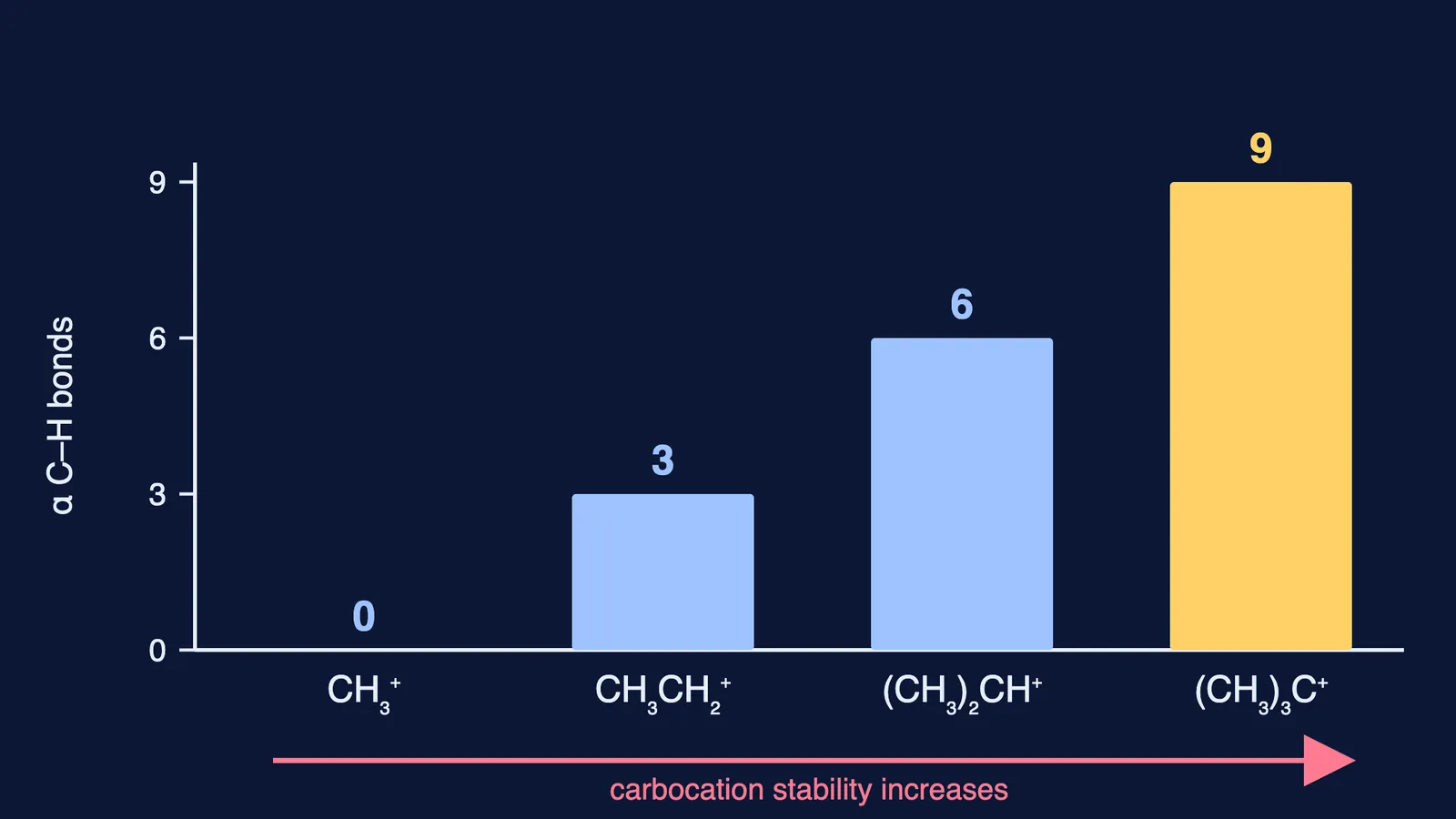
Q4 (medium). Assertion (A): The tert-butyl cation is less stable than the ethyl cation. Reason (R): The more alkyl groups attached to the positively charged carbon, the greater the hyperconjugation and the more stable the cation.
Answer: (D). A is false: NCERT's order is CH3+ < CH3CH2+ < (CH3)2CH+ < (CH3)3C+, so tert-butyl is the most stable of the four. R is true, and it is why tert-butyl comes out on top. The diagram at the top counts the C–H bonds each cation can use.
Trap: thinking a bulkier cation must be less stable.
Q5 (hard). Assertion (A): Both carbon-oxygen bonds in the ethanoate (acetate) ion have the same length. Reason (R): The real ion is a resonance hybrid of two equivalent contributing structures, not either one of them.
Answer: (A). Both are true, and R is NCERT's explanation for equal bond lengths in benzene and nitromethane: the real species is the hybrid, so each C–O bond is intermediate between a single and a double bond.
Trap: picturing the ion flipping between two real structures.
Q6 (hard). Assertion (A): The methyl carbocation gets no stabilisation from hyperconjugation. Reason (R): The methyl carbocation has no C–H bonds.
Answer: (C). A is true. R is false: CH3+ has three C–H bonds. Its empty p orbital is perpendicular to the plane in which those bonds lie, so they cannot overlap with it. Hyperconjugation needs C–H bonds on an adjacent carbon.
Trap: counting every C–H bond, not only those next to the positive carbon.
Statement I and Statement II questions on GOC
Judge each statement on its own against NCERT Unit 8.
Q7 (easy). Statement I: Heterolytic cleavage of the C–Cl bond in chloromethane gives a methyl radical and a chlorine atom. Statement II: The stability of alkyl free radicals increases from primary to secondary to tertiary.
Answer: (D). Statement I is incorrect: in heterolytic cleavage the shared pair stays with the more electronegative chlorine, giving CH3+ and Cl–; radicals come from homolytic cleavage. Statement II is correct.
Trap: expecting radicals from every bond cleavage.
Q8 (medium). Statement I: A carbocation is an electrophile because its positive carbon has only six valence electrons. Statement II: A neutral water molecule can act as a nucleophile.
Answer: (A). Both are correct. The electron-deficient carbon accepts an electron pair, and water can donate a lone pair from oxygen.
Trap: thinking only anions can be nucleophiles.
Q9 (medium). Statement I: The electromeric effect is a permanent effect, present even when no attacking reagent is near. Statement II: Hyperconjugation is a temporary effect that appears only when a reagent attacks.
Answer: (B). Both are incorrect: the labels are swapped. The electromeric effect is temporary, acting only on the demand of an attacking reagent; hyperconjugation is permanent.
Trap: remembering the two labels but not which goes where.
Q10 (hard). Statement I: In aniline the –NH2 group shows a +R effect, while in nitrobenzene the –NO2 group shows a –R effect. Statement II: When the inductive and electromeric effects act in opposite directions, the inductive effect predominates.
Answer: (C). Statement I is correct: –NH2 pushes its lone pair into the ring, while –NO2 pulls π electrons towards itself. Statement II is incorrect: NCERT says the electromeric effect predominates.
Trap: assuming the permanent effect always wins.
How should you use this set?
Cover the answers and write your key for all ten, with one line on why.
Wrong on truth? Reread the NCERT section. Wrong only between (A) and (B)? Find NCERT's reason.
Then try our basic principles of organic chemistry NEET questions with solutions.
If a trap exposes a concept gap, such as why hyperconjugation needs an adjacent C–H bond, the Fermi Concept Library has a lesson for every concept in chemistry, each with its place in the map.