On this page
Ecosystem is a short chapter, so its assertion-reason items hinge on fine distinctions. Every statement below was checked against the NCERT Class 12 Biology chapter on Ecosystem (2026-27 reprint), and every topic sits inside the NMC syllabus for NEET (UG)-2026. For notes on the whole chapter, start with our Ecosystem Class 12 board exam guide.
How do you answer assertion-reason questions?
Judge each statement on its own first. Only when both are true, ask: is R the direct reason NCERT gives for A? Our three-check method for assertion-reason questions explains this in detail.
Keys for every question:
Assertion-reason: (A) Both A and R are true and R is the correct explanation of A. (B) Both A and R are true but R is NOT the correct explanation of A. (C) A is true but R is false. (D) A is false but R is true.
Statement pairs: (A) Both statements are correct. (B) Both statements are incorrect. (C) Statement I is correct, Statement II is incorrect. (D) Statement I is incorrect, Statement II is correct.
Ecosystem assertion-reason questions with answers
Q1 (easy). Assertion (A): An energy pyramid cannot be drawn inverted for any ecosystem. Reason (R): Each time energy passes from one trophic level to the next, some of it is lost as heat.
Answer: (A). Both are true, and NCERT gives the heat loss at every step as the reason the energy pyramid is always upright. Trap: carrying the inverted biomass pyramid of the sea over to energy.
Q2 (easy). Assertion (A): In a forest or grassland, more of the energy flows through the detritus food chain than through the grazing food chain. Reason (R): Decomposers secrete digestive enzymes onto dead matter and then absorb the simple inorganic products.
Answer: (B). Both are true, but how a decomposer feeds does not explain why land differs from water, where the grazing food chain is the major conduit. Trap: picking (A) because both lines are about the detritus food chain.
Q3 (medium). Assertion (A): Humus acts as a reservoir of nutrients in the soil. Reason (R): Microbes break humus down quickly, so its nutrients are released within days.
Answer: (C). A is true: humus is colloidal, so it holds nutrients. R is false: humus is highly resistant to microbial action and decomposes at an extremely slow rate. Trap: assuming a reservoir must empty fast.
Q4 (medium). Assertion (A): The pyramid of biomass in the sea is generally upright. Reason (R): In the sea, the biomass of fishes far exceeds that of phytoplankton.
Answer: (D). R is true, and it is exactly why the sea's biomass pyramid is generally inverted, so A is false. Trap: assuming every pyramid has a broad base.
Q5 (medium). Assertion (A): A grazing food chain cannot keep adding trophic levels. Reason (R): Only about 10 per cent of the energy at one trophic level is transferred to the next.
Answer: (A). Both are true, and NCERT names the 10 per cent law as the reason the number of trophic levels in a grazing food chain is restricted. Trap: blaming a shortage of predators instead of energy.
Q6 (hard). Assertion (A): Oceans cover about 70 per cent of Earth's surface yet produce less than half of the biosphere's annual net primary productivity. Reason (R): Less than 50 per cent of incident solar radiation is photosynthetically active radiation (PAR).
Answer: (B). Both are true: the NCERT Ecosystem chapter gives the oceans only 55 of about 170 billion tons (dry weight), so land produces roughly twice as much, and puts PAR below 50 per cent of incident radiation. But the PAR fraction applies to land as well, so it cannot explain why oceans produce less. Trap: accepting any true fact about light as the reason.
Ecosystem Statement I and Statement II questions
Q7 (medium). Statement I: Decomposition is largely an oxygen-requiring process. Statement II: Low temperature and anaerobic conditions speed up decomposition.
Answer: (C). Statement I is true. Statement II is false: low temperature and anaerobiosis inhibit decomposition, so organic matter builds up. Trap: reading "conditions" and forgetting the direction of the effect.
Q8 (medium). Statement I: Leaching is the breakdown of detritus into smaller particles by detritivores such as the earthworm. Statement II: Leaching carries water-soluble inorganic nutrients down the soil, where they settle out as salts that plants cannot use.
Answer: (D). Statement I describes fragmentation, not leaching, so it is false. Statement II is NCERT's description of leaching. Trap: mixing up the names of the decomposition steps.
Q9 (hard). Statement I: In the food chain grass, goat, man, man occupies the second trophic level. Statement II: Secondary productivity is the rate at which producers form new organic matter.
Answer: (B). Both are false. Man is at the third trophic level, after grass and goat. Secondary productivity is the rate of formation of new organic matter by consumers, not producers. Trap: counting consumers (man is the second consumer) instead of trophic levels.
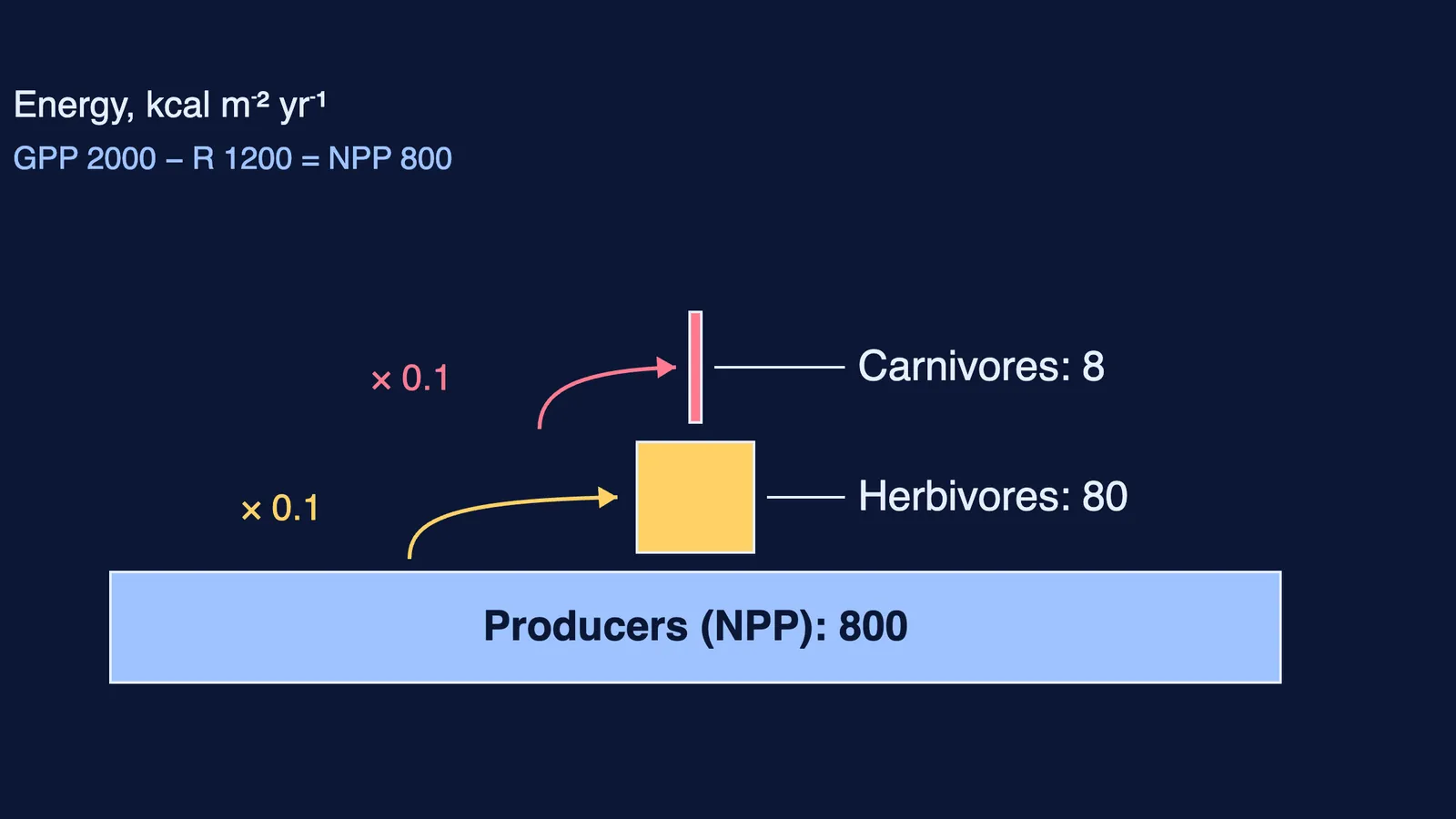
Q10 (hard). Statement I: A grassland with GPP of 2,000 kcal m⁻² yr⁻¹ and respiration losses of 1,200 kcal m⁻² yr⁻¹ has an NPP of 800 kcal m⁻² yr⁻¹. Statement II: By the 10 per cent law, about 8 kcal m⁻² yr⁻¹ of that NPP reaches the third trophic level.
Answer: (A). Both are correct. GPP minus R is NPP, so 2,000 minus 1,200 is 800. Then 10 per cent of 800 is 80 for herbivores, and 10 per cent of 80 is 8 for primary carnivores. Trap: taking one 10 per cent step (80) and calling it the third level.
How should you use this set?
Attempt all 10 in one sitting, without notes.
For every miss, write which step failed: truth of A, truth of R, or the link between them.
Reread only the NCERT paragraph behind each miss, then redo the item a day later.
If one idea, such as GPP and NPP, keeps tripping you up, the Fermi Concept Library gives every biology concept its own lesson and its place in the map. For mixed practice on food chains, pyramids and populations, try our ecology questions for NEET.