On this page
Ecosystem is Chapter 12 of the NCERT Class 12 Biology textbook (Reprint 2026-27), and it sits in Unit X, Ecology and Environment, which carries 10 of the 70 theory marks in the CBSE 2026-27 Biology curriculum. Two other chapters share those marks, so answers must be quick and exact. This guide is for written board answers.
What is in the Ecosystem chapter for 2026-27?
The curriculum lists patterns, components, productivity, decomposition, energy flow and the three pyramids, matching the five sections of the NCERT chapter. Succession is not in the chapter. Nutrient cycling is named in the introduction and in section 12.1 but explained only in the summary: carbon is a gaseous cycle, phosphorus a sedimentary one. Learn that line; our explainer on why energy flows one way but nutrients cycle gives the contrast.
Definitions to write exactly, all from NCERT:
Primary productivity: the rate of biomass production by plants, in g m⁻² yr⁻¹ or kcal m⁻² yr⁻¹.
GPP − R = NPP: net primary productivity is what is left for herbivores and decomposers after plant respiration.
Secondary productivity: the rate at which consumers form new organic matter.
Decomposition steps: fragmentation (detritivores such as earthworms), leaching (soluble nutrients sink and precipitate as unavailable salts), catabolism (bacterial and fungal enzymes), humification (humus, slow to break down, a nutrient reservoir) and mineralisation (inorganic nutrients released).
Decomposition factors: slower when detritus is rich in lignin and chitin, faster when rich in nitrogen and sugars; warm, moist conditions speed it up, while cold and anaerobiosis slow it.
Food chains: the grazing chain starts with plants, the detritus chain with dead matter. Water: grazing chain carries most energy; land: the detritus chain carries more. Linked chains form a food web.
Practise Figures 12.1, 12.2 and 12.4.
How do you work out energy flow with the 10 per cent law?
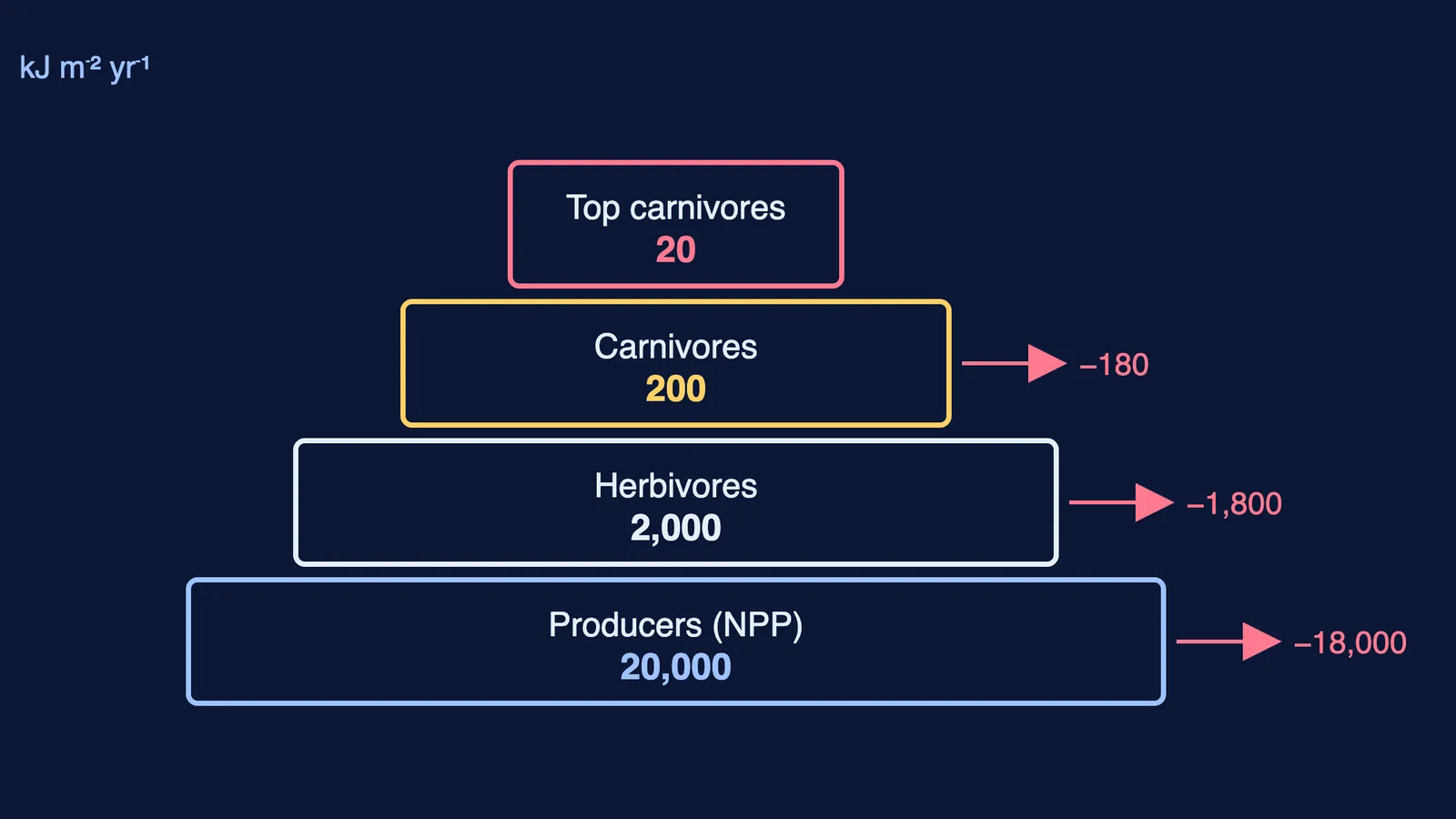
NCERT states that only 10 per cent of energy passes from one trophic level to the next, which keeps grazing chains short. Take an invented field: GPP is 30,000 kJ m⁻² yr⁻¹ and plant respiration uses 10,000.
Method 1, step by step. NPP = 30,000 − 10,000 = 20,000. Herbivores get 2,000, carnivores 200, top carnivores 20.
Method 2, one line. Top carnivores sit three transfers above producers: 20,000 × (1/10)³ = 20.
Independent check. Add what each step does not pass on, plus the top: 18,000 + 1,800 + 180 + 20 = 20,000, the starting NPP. Working back, 20 × 10³ = 20,000 too.
The same layout appears in the CBSE 2026-27 marking scheme for option A of Question 21, a 2-mark Section B question in the sample paper: NPP = 3,500 − 1,300 = 2,200 g/m²/year. If the method feels shaky, the Fermi Problem Library has worked problems with a step-by-step solver that explains the reasoning rather than printing an answer.
How should you set out 2-, 3- and 5-mark answers?
The sample paper has 2-mark questions in Section B, 3-mark in Section C, 4-mark case studies in Section D and 5-mark in Section E. Frames:
2 marks: a definition or formula, then one example or significance line. "GPP − R = NPP, and NPP is what herbivores and decomposers can use."
3 marks: three separate points, or a labelled diagram with two points. Factors of decomposition: chemical make-up of detritus, temperature and moisture, oxygen.
5 marks: labelled diagram, then each step or type on its own line with a reason. Pyramids: number, biomass and energy, the inverted cases, then the limitations NCERT gives (one species at two levels, no food web, saprophytes left out).
To practise layout against the clock, try our 20-minute board answer-writing drill.
Which assertion-reason and case-study traps catch students?
In the sample paper's assertion-reason format, a true reason that does not explain the assertion is option B. Traps from NCERT:
Inverted pyramids. Pyramid of numbers for insects on one big tree is inverted; the sea's biomass pyramid is generally inverted because fish biomass far exceeds phytoplankton. Energy pyramids are always upright, since some energy is lost as heat at every step.
Leaching does not release usable nutrients; they end as unavailable salts.
Humus resists microbes and decomposes very slowly.
Trophic level is functional: a sparrow eating seeds is a primary consumer, eating insects a secondary one.
The summary names three decomposition processes; the main text lists five steps. Write all five.
What is a good revision plan for the Ecosystem chapter?
Day 1: read NCERT, then write the six definitions from memory.
Day 2: draw Figures 12.1, 12.2 and 12.4 from memory and label them.
Day 3: redo the energy example with your own numbers; solve Question 21 from the sample paper.
Day 4: write a timed 3-mark and 5-mark answer; mark them against NCERT.
Day 5: list every inverted pyramid and every "always", and fix the summary line on nutrient cycles.
After day 5, sit the full sample paper in three hours and mark it against the marking scheme.