

On this page
Energy flow is unidirectional, yet nutrients cycle. Both move through the same grass, goat and fungus, so why does only one come back? Energy leaves as heat that plants cannot use, while the atoms in a dead body are still carbon and phosphorus, and decomposers hand them back.
Why is energy flow in an ecosystem unidirectional?
The NCERT Class 12 Biology chapter on ecosystems describes a "unidirectional flow of energy from the sun to producers and then to consumers". Three facts from the same chapter explain why.
Less than 50 per cent of incident sunlight is photosynthetically active radiation (PAR), and plants capture only 2-10 per cent of that PAR.
Only about 10 per cent of the energy at one trophic level reaches the next, the "10 per cent law".
Ecosystems "are not exempt from the Second Law of Thermodynamics" and need a constant supply of energy.
Where does the other 90 per cent go? Much of it is used in respiration and ends up as metabolic heat. The OpenStax Biology 2e section on energy flow names the second law of thermodynamics as the main reason for this loss: whenever energy is converted from one form to another, there is a tendency toward disorder.
Producers make food by fixing the sun's radiant energy, as NCERT puts it. Heat from a warm goat or a rotting log is spread-out, low-grade energy, not the light photosynthesis runs on. It cannot be fed back to plants, so the sun must keep supplying fresh energy.
How do decomposers recycle carbon and phosphorus?
Matter behaves differently. The opening of the OpenStax section on biogeochemical cycles says it plainly: energy enters as sunlight and leaves as heat, but "the matter that makes up living organisms is conserved and recycled."
Decomposers do the recycling. According to NCERT, they break complex organic matter into carbon dioxide, water and inorganic nutrients through fragmentation, leaching, catabolism, humification and mineralisation. Fungi and bacteria meet their own energy needs from detritus, and lose that energy as heat too. What they release is the raw material.
Carbon runs a gaseous cycle; NCERT names the atmosphere or hydrosphere as its reservoir. Respiration returns carbon dioxide to the air, and photosynthesis pulls it back in (OpenStax).
Phosphorus runs a sedimentary cycle with Earth's crust as its reservoir (NCERT). Weathering leaches phosphate from rock into rivers, lakes and the ocean (OpenStax), plants absorb it, and decomposers release it again from dead tissue.
A carbon atom can sit in a neem leaf this year and a grasshopper next year. A joule that leaves the grasshopper as heat never comes back.
What does the diagram show?
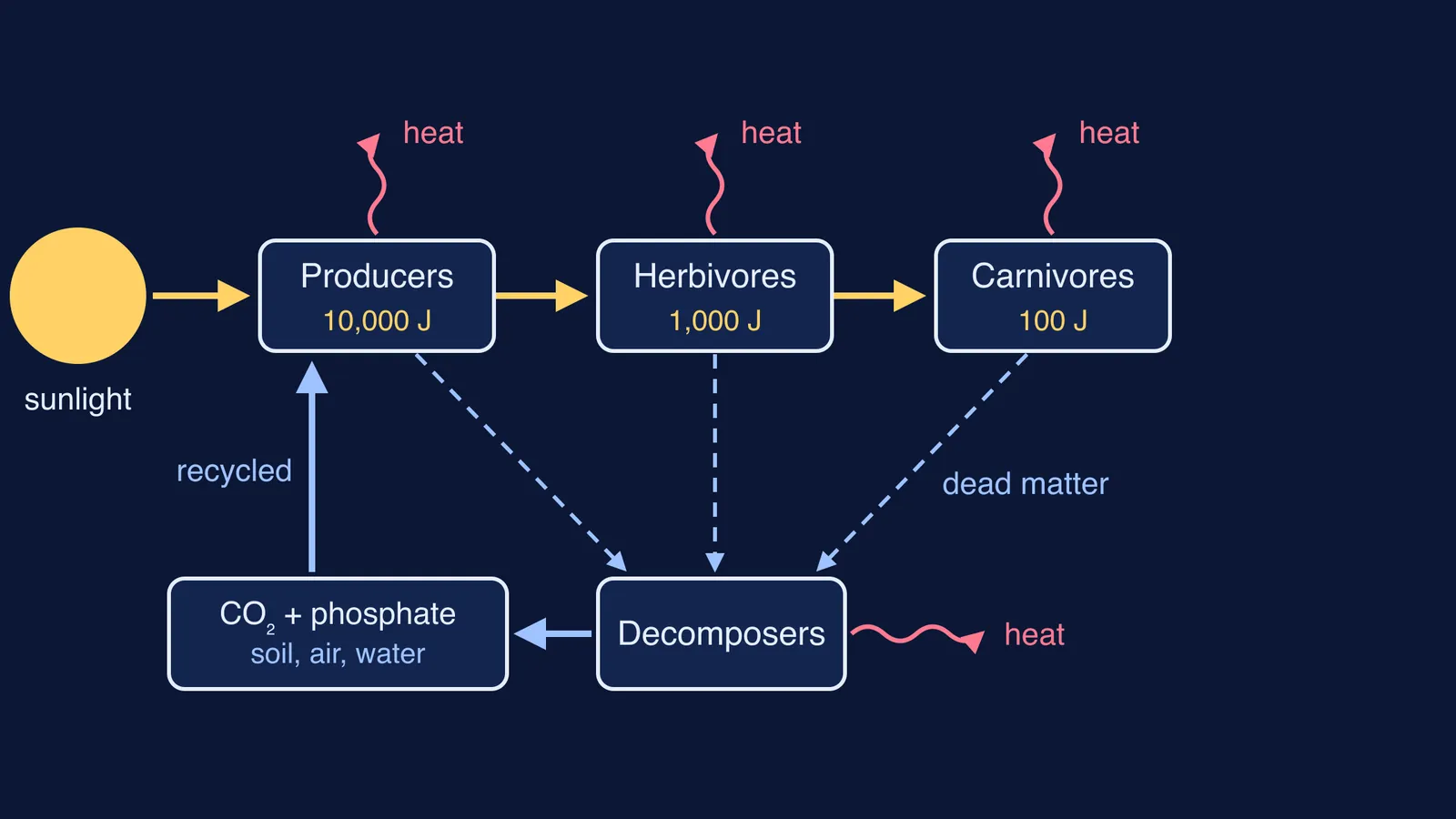
The diagram at the top draws both flows together. Yellow arrows carry energy through producers, herbivores and carnivores, using the ideal values from NCERT's pyramid of energy. Pink arrows carry heat out of every level, decomposers included; none returns. Blue arrows carry dead matter to decomposers and nutrients back to producers.
To draw it in an exam:
Draw energy as a straight chain that starts at the sun.
Add a heat arrow leaving every box, including decomposers.
Draw a separate loop for nutrients that runs through decomposers and back to producers.
Never draw an arrow carrying energy from heat, or from decomposers, back to plants.
Is the 10 per cent law exact?
No, it is a rule of thumb. The OpenStax energy flow section reports measurements from Silver Springs, Florida: producers fixed 20,810 kcal/m²/yr and used or lost 13,187 kcal/m²/yr in respiration and heat. Of the roughly 7,600 kcal/m²/yr left (OpenStax gives 7,633 in its text and 7,618 in its figure), primary consumers used 3,373, 4,250 went to decomposers, and herbivore production was 1,103 kcal/m²/yr.
Work it out. 1,103 ÷ 7,618 ≈ 0.145, so about 14.5 per cent passed to herbivores, the 14.48 per cent transfer efficiency OpenStax gives. And 13,187 ÷ 20,810 ≈ 0.63: producers spent about 63 per cent of what they fixed on their own respiration. That heat is gone; the carbon and phosphorus in their dead leaves go to decomposers.
What mistakes cost marks in this topic?
Writing that energy "cycles" because nutrients do.
Forgetting the heat arrow from decomposers.
Saying a pyramid of energy can be inverted. NCERT says it is always upright, because some energy is lost as heat at each step.
Treating phosphorus like carbon. Its reservoir is the Earth's crust, not the air.
If one idea is shaky, the Fermi Concept Library gives every biology concept its own lesson and its place in the map. For numericals, the Fermi Problem Library has worked problems with a step-by-step solver that explains the reasoning rather than printing an answer.
To keep going, try these 10 per cent law energy flow numericals, compare the grazing and detritus food chains, and trace the five carbon stores and the flows between them.


