

On this page
The carbon cycle is the bookkeeping of where carbon sits (the stores, or reservoirs) and how fast it moves between them (the flows, or fluxes). Once you think in stores and flows, two common questions, what burning fuel does and what planting trees does, become addition and subtraction.
What are the reservoirs in the carbon cycle?
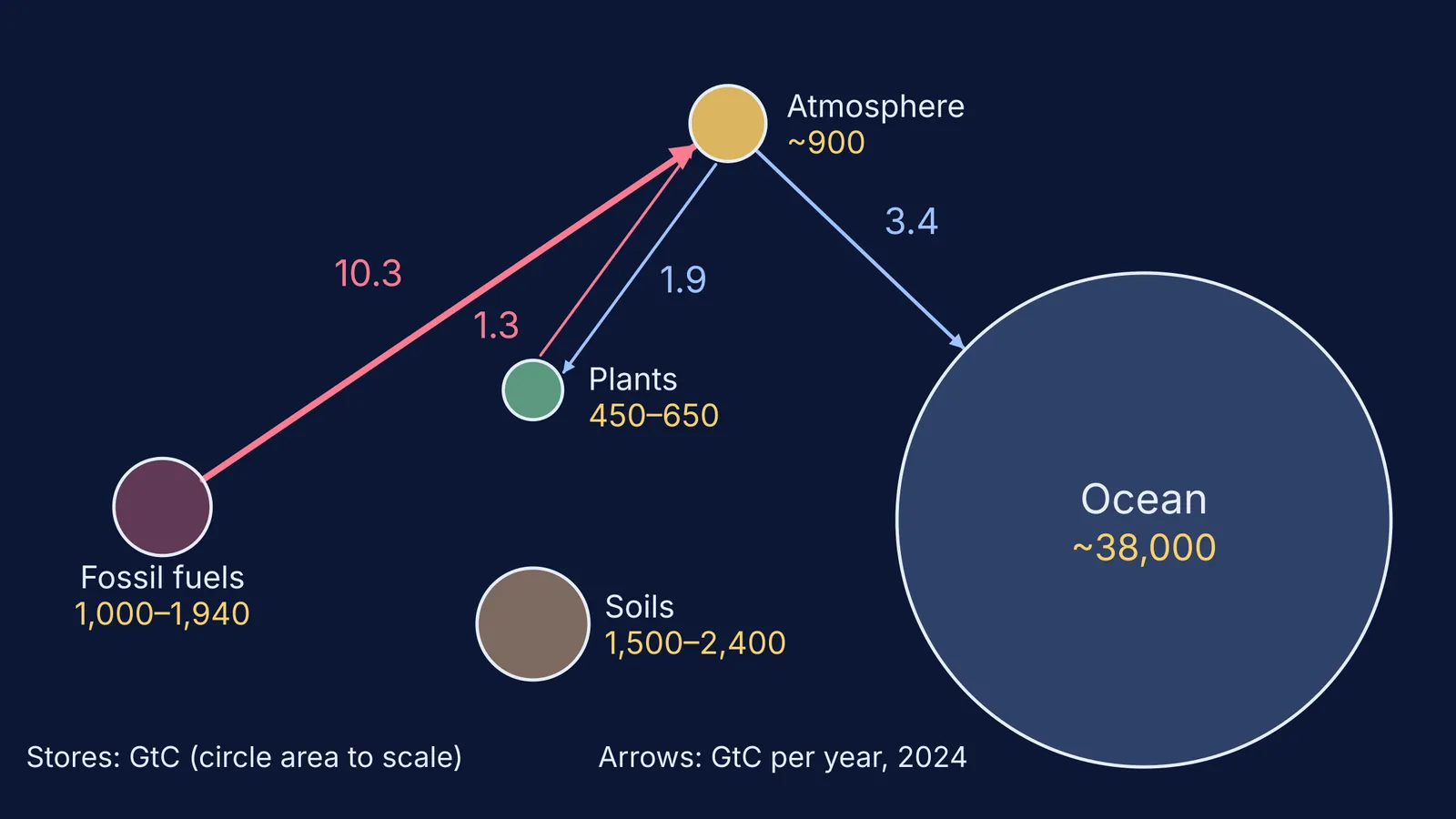
A reservoir is a place carbon is held, measured as a mass of carbon, and a flux is the rate carbon moves between reservoirs, in mass per year, as used in IPCC AR5 Chapter 6 on carbon and other biogeochemical cycles. Scientists count in gigatonnes of carbon (GtC, also written PgC): one GtC is a billion tonnes.
That IPCC chapter gives these sizes:
Ocean: about 38,000 GtC, mostly dissolved inorganic carbon
Soils: 1,500 to 2,400 GtC in dead organic matter and litter, plus about 1,700 GtC in permafrost
Plants: 450 to 650 GtC in living vegetation
Fossil fuel reserves: gas 383 to 1,135, oil 173 to 264 and coal 446 to 541 GtC
Atmosphere: 828 GtC in 2011, when carbon dioxide was about 390.5 ppm
The Global Carbon Budget 2025 puts the 2024 average at 422.8 ppm and converts with 1 ppm = 2.124 GtC, so the atmosphere holds roughly 422.8 × 2.124 ≈ 898 GtC. Rocks hold far more than any of these: NASA Earth Observatory says most of Earth's carbon, about 65,500 billion tonnes, is stored in rocks. Our post on the carbon and phosphorus cycles with real numbers applies the same logic to phosphorus.
How big are the carbon flows each year?
Natural flows are large and close to balanced. Plants take about 123 GtC a year out of the air by photosynthesis, and plant and soil respiration plus fire return a similar amount, says IPCC AR5 Chapter 6.
Human flows are smaller but run mostly one way. In 2024 fossil carbon dioxide emissions were 10.3 GtC and land-use change, such as clearing forests, added 1.3 GtC, reports the Global Carbon Budget 2025. That year the ocean took up 3.4 GtC, the land took up 1.9 GtC, and the atmosphere grew by 7.9 GtC, or 3.73 ppm. Those sinks add up to more than the 11.6 GtC emitted: a 1.7 GtC budget imbalance that the report calls a measure of imperfect data and incomplete understanding.
What happens to the carbon when you burn fossil fuel?
Burning coal, oil or gas moves carbon from the fossil store into the air. The IPCC describes this as moving carbon from the slow domain (rocks and sediments, turnover of 10,000 years or longer) into the fast domain (air, ocean, plants and soils). Guy Callendar linked that extra carbon dioxide to warming in a 1938 paper, as our profile of Guy Callendar and carbon dioxide warming explains.
Over 2015 to 2024, about 50% of human emissions stayed in the air, 29% went into the ocean and 21% into land (Global Carbon Budget 2025). Burn 10 GtC of extra fuel and, as a rough guide using that average split:
Fossil store: down 10 GtC.
Atmosphere: up about 5 GtC, which is 5 ÷ 2.124 ≈ 2.4 ppm.
Ocean: up about 2.9 GtC, which makes seawater more acidic.
Plants and soils: up about 2.1 GtC.
The IPCC chapter adds the long tail: natural removal of human-emitted carbon dioxide takes a few hundred thousand years, and about 15 to 40% of what is emitted until 2100 will stay in the air longer than 1,000 years.
Does planting trees put the carbon back?
Partly. A growing forest moves carbon from the air into wood, and later into soil. But that flow stays inside the fast domain: the fossil store does not refill. Compare the sizes from the Global Carbon Budget 2025: the whole land sink was 1.9 GtC in 2024, against 10.3 GtC of fossil emissions. Clearing forests runs the arrow the other way, and it is counted in the 1.3 GtC of net land-use emissions.
How do you predict any carbon cycle change?
Use four steps:
Name the move: which store loses carbon and which gains it.
Check the units: GtC or GtCO2, per year or in total.
Apply the split: about half stays in the air, the rest divides between ocean and land.
Ask the timescale: is carbon returning to rock (slow domain) or shuffling between air, water and living things (fast domain)?
Write your prediction for each store before you check it. Moving the arrows yourself often helps; see our post on simulations versus static diagrams. The Fermi Simulation Lab has interactive simulations for ideas that are easier to see than to read, and Fermi's AI tutor can draw the figure and check your understanding as it goes.
Start with one question tonight: if India planted a forest that absorbed 1 GtC, which stores change, and which one does not?


