On this page
This guide covers board answers for Chapter 5 of CBSE Class 12 Biology: what to write, how to set it out, where marks leak. For the concepts from scratch, read our explainer on molecular basis of inheritance, from DNA to the lac operon.
How many marks does molecular basis of inheritance carry in 2026-27?
The CBSE Biology curriculum for 2026-27 prints Unit VII, Genetics and Evolution, at 20 marks in the 70-mark theory paper. CBSE does not split them by chapter; this chapter shares them with Principles of Inheritance and Variation, and Evolution.
The 2026-27 sample question paper tests transcription initiation, the transforming principle, Meselson-Stahl densities, nucleosome counts and, for 5 marks, mutations and the genetic code.
What must you write for each topic?
Write from the NCERT chapter (Reprint 2026-27):
DNA structure: two antiparallel chains, bases inside; A=T by two hydrogen bonds, G≡C by three; right-handed, pitch 3.4 nm, about 10 bp per turn.
Chargaff's rule: in double-stranded DNA, the A:T and G:C ratios are each 1.
Packaging: DNA (negative) coils around a histone octamer (positive) to form a nucleosome; a typical one holds 200 bp.
Experiments: Griffith (1928): heat-killed S plus live R killed mice; R was transformed. Hershey-Chase (1952): radioactive phosphorus (DNA) entered bacteria; radioactive sulfur (protein) did not. Meselson-Stahl (1958): moved from 15N to 14N, DNA was hybrid after one generation and half hybrid, half light after two: semiconservative replication.
Replication: DNA polymerase works only 5'→3', so one strand is continuous, the other discontinuous; DNA ligase joins the fragments.
Transcription and code: the 3'→5' strand is the template; the coding strand matches the RNA, with T for U. The code is triplet, degenerate, unpunctuated, nearly universal; 61 codons code for amino acids; UAA, UAG, UGA stop; AUG codes for methionine and starts translation.
Translation: tRNA anticodons pair with codons; untranslated regions flank the coding part; a release factor at the stop codon ends it.
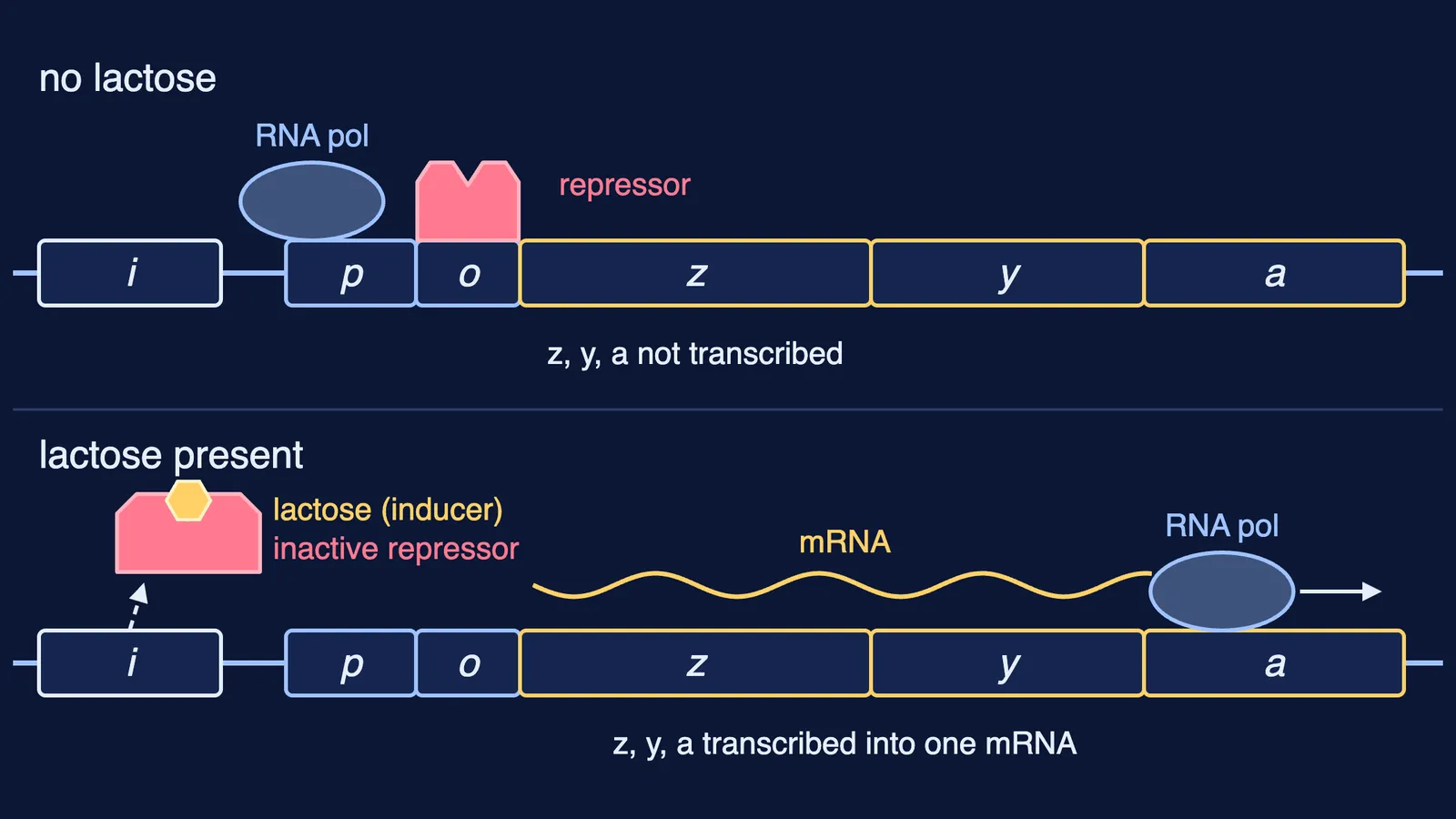
Lac operon: the i gene makes the repressor all the time; z, y, a code for beta-galactosidase, permease, transacetylase. Lactose, the inducer, inactivates the repressor, letting RNA polymerase transcribe.
Human Genome Project: completed in 2003; 3164.7 million bp; protein-coding DNA is under 2 per cent of the genome.
DNA fingerprinting: Alec Jeffreys; VNTR probe; isolation, restriction digestion, electrophoresis, blotting, hybridisation, autoradiography.
How should you set out 2-, 3- and 5-mark answers?
The 2026-27 marking scheme marks point by point, often in halves: its 5-mark mutation question gives 0.5 for "cistron", 1 for each mutation type, 2 for the amino-acid sequence and count, and 0.5 for "degenerate".
2 marks: two points, or a definition plus an example; for a difference, two matched pairs (template vs coding strand: polarity, sequence).
3 marks: three numbered points or a labelled diagram plus two lines (Meselson-Stahl: setup, result per generation, conclusion).
5 marks: one sub-part per part asked, a labelled diagram (lac operon: i, p, o, z, y, a, repressor), working shown, a closing conclusion.
Worked example: how many base pairs, and how long?
Sample-paper Question 10 is this type. Practise on 350 nucleosomes, with NCERT's 200 bp per nucleosome and 0.34 nm per bp:
Method 1, per base pair. 350 nucleosomes × 200 bp = 70,000 bp. Length = 70,000 × 0.34 nm = 23,800 nm, or 23,800 × 10⁻⁹ m.
Method 2, per turn. A turn holds about 10 bp over 3.4 nm. 70,000 ÷ 10 = 7,000 turns; 7,000 × 3.4 nm = 23,800 nm.
Independent check. Backwards: 23,800 ÷ 0.34 = 70,000 bp; 70,000 ÷ 200 = 350 nucleosomes. NCERT's 2.2 m for 6.6 × 10⁹ bp (about 0.33 nm per bp) gives about 23,300 nm, within 2%, as 2.2 m is rounded.
Which assertion-reason and case-study traps cost marks?
The marking scheme answers sample-paper Question 7 with 25% hybrid, 75% light.
False, per NCERT:
"The i gene codes for the inducer." The i stands for inhibitor; it codes for the repressor.
"Glucose induces the lac operon." Glucose and galactose are not inducers; lactose is.
"The coding strand is transcribed." The template strand is read.
"15N is radioactive." It is a stable heavy isotope, told apart from 14N by density.
NCERT gives two gene counts: about 20,000-25,000 as an HGP goal and 30,000 as its estimate. Quote the one asked for.
In sequence case studies, mark the untranslated regions at both ends and remove introns before counting codons (sample-paper Question 31B). Drill with these assertion-reason traps on replication, the genetic code and operons.
A seven-day revision plan
DNA structure, Chargaff, packaging; draw the helix and a nucleosome.
The experiments as three-line notes: setup, result, conclusion.
Replication fork and transcription unit, every 5' and 3' labelled.
Genetic code; translate two short mRNA sequences.
Lac operon with and without lactose; HGP and fingerprinting steps.
This chapter's sample-paper questions, timed, self-marked.
Redo every mistake; then fit the chapter into your CBSE Class 12 biology revision plan.
If a term feels shaky, the Fermi Concept Library has every concept in physics, chemistry, biology, mathematics and computing, each with its own lesson and its place in the map.