On this page
Molecular basis of inheritance is one of the longest chapters in Class 12 biology, and students often try to memorise it line by line. Most of its exam questions are reasoning questions in disguise: a percentage of adenine, a number of generations, a strand sequence, a mutated gene. This post works through each type with numbers you can check.
What does the NEET syllabus ask from this chapter?
The NEET (UG)-2026 syllabus lists, under Genetics and Evolution: the search for genetic material, structure of DNA and RNA, DNA packaging, DNA replication, the central dogma, transcription, the genetic code, translation, gene expression and regulation (the lac operon), the human genome project and DNA fingerprinting. All of it is in Chapter 5 of the Class 12 NCERT book, Molecular Basis of Inheritance. Check the syllabus for your own exam year when NMC releases it.
How do you solve base-pairing questions?
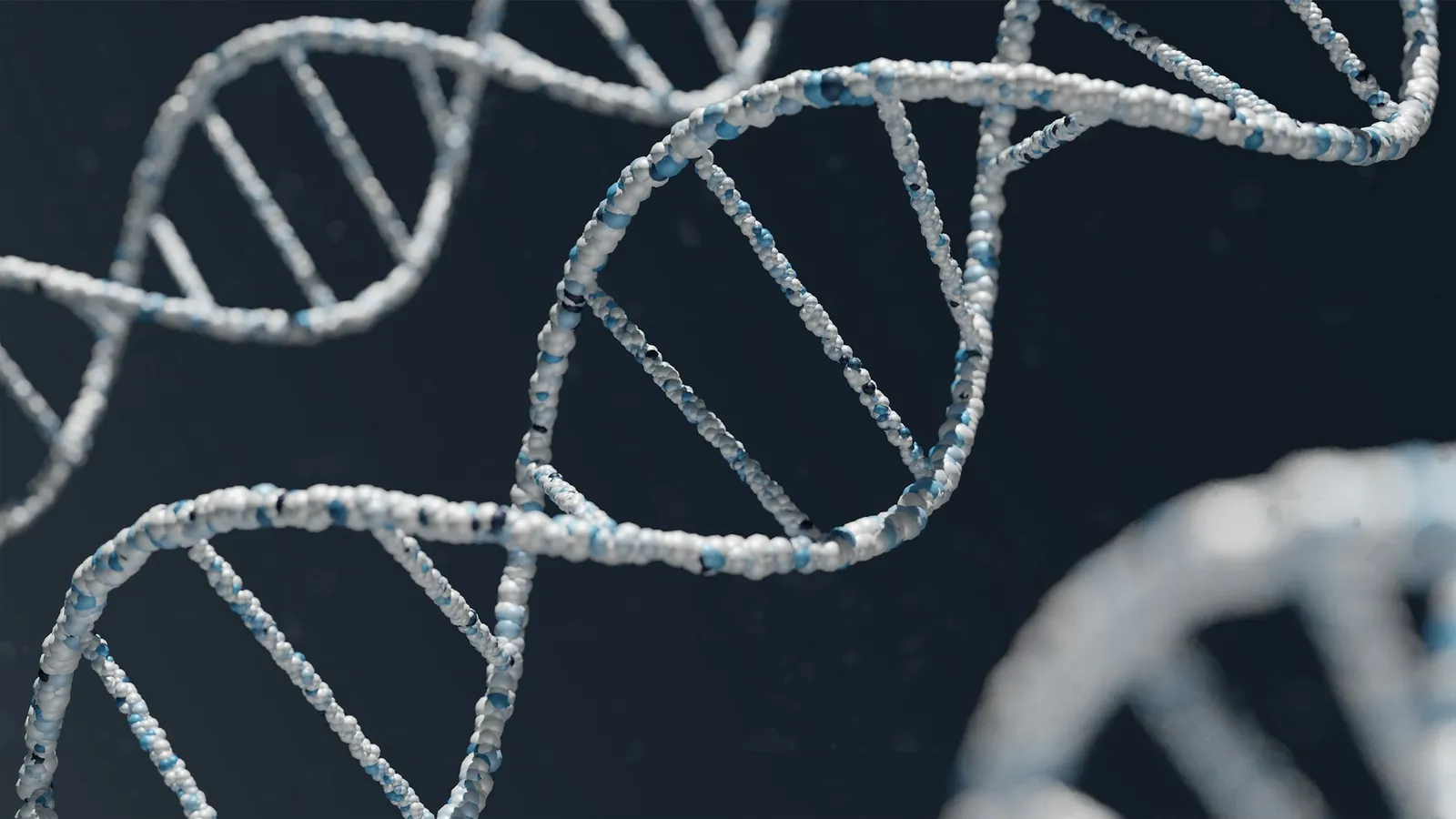
NCERT notes that Watson and Crick's 1953 double helix rested on Erwin Chargaff's observation that in double-stranded DNA, A/T and G/C ratios equal one. The 1962 Nobel Prize in Physiology or Medicine went to Crick, Watson and Wilkins "for their discoveries concerning the molecular structure of nucleic acids and its significance for information transfer in living material".
Worked example. A double-stranded DNA sample has 20% adenine. Find the other bases.
A = T, so T = 20%.
A + T = 40%, so G + C = 60%.
G = C, so each is 30%.
The common mistake is applying this to single-stranded DNA or RNA, where Chargaff's rule does not hold. Read the question for "double-stranded".
How long is the DNA in a cell?
NCERT gives 0.34 nm between consecutive base pairs, 4.6 × 10⁶ bp for *E. coli*, and 6.6 × 10⁹ bp in a typical mammalian (diploid) cell.
*E. coli*: 4.6 × 10⁶ × 0.34 × 10⁻⁹ m = 1.56 × 10⁻³ m, about 1.6 mm.
Human cell: 6.6 × 10⁹ × 0.34 × 10⁻⁹ m ≈ 2.2 m, the figure NCERT quotes.
Watch two traps: the haploid human genome is 3.3 × 10⁹ bp, half the diploid figure, and the number of nucleotides is twice the number of base pairs.
What did Meselson and Stahl show?
Meselson and Stahl (1958) grew *E. coli* for many generations in a medium with heavy nitrogen, ¹⁵N, then moved the cells to ordinary ¹⁴N and separated the DNA by density in a caesium chloride gradient. As NCERT describes it, after one generation (20 minutes) all the DNA was hybrid; after two generations it was half hybrid and half light. That is what semiconservative replication predicts.
Worked example. What are the proportions after 80 minutes?
80 minutes is 80/20 = 4 generations.
One heavy molecule becomes 2⁴ = 16 molecules.
The two original heavy strands survive, each in a different molecule, so 2 molecules are hybrid.
The other 14 are light. Ratio hybrid : light = 2 : 14 = 1 : 7.
The general rule: after n generations, the hybrid fraction is 2/2ⁿ. No band is ever fully heavy after the transfer.
How do you write mRNA from a DNA strand?
NCERT defines the template strand as the one with 3'→5' polarity and the coding strand as the one with 5'→3' polarity, whose sequence matches the RNA except that T is replaced by U. Using NCERT's example, if the coding strand is 5'-TACGTACG-3', the mRNA is 5'-UACGUACG-3'. The usual mistake is writing the complement of the coding strand, which gives the template, not the mRNA.
How does the lac operon switch on and off?
The 1965 Nobel Prize in Physiology or Medicine went to Jacob, Lwoff and Monod "for their discoveries concerning genetic control of enzyme and virus synthesis". NCERT's version has four parts to learn:
The i gene makes the repressor all the time.
The z, y and a genes code for beta-galactosidase, permease and transacetylase.
With no lactose, the repressor binds the operator and blocks transcription.
Lactose (or allolactose) is the inducer. It inactivates the repressor, so RNA polymerase can transcribe the genes. Glucose and galactose cannot act as inducers.
Exams test this with changes. If the i gene is mutated so that no working repressor is made, the structural genes are expressed even without lactose. If the operator cannot bind the repressor, the same thing happens. Reason from "what is bound to the operator?" each time.
A revision routine for this chapter
Day 1: Ten base-pairing and DNA-length sums, mixing haploid and diploid figures.
Day 2: Draw the Meselson-Stahl tubes for generations 0 to 4 from memory, then check against NCERT Figure 5.7.
Day 3: Write five coding strands and their mRNAs, marking 5' and 3' every time.
Day 4: Draw the lac operon with and without lactose, then answer three "what if this gene is mutated?" questions.
Day 5: Mixed set of 15 questions from the whole chapter.
When you get one wrong and cannot see why, work through the reasoning step by step. The Fermi Problem Library has a step-by-step solver that explains the reasoning rather than printing an answer. For the history of how the genetic code was cracked, read our profile of Har Gobind Khorana.
Start with Day 1 today, and time yourself so you know how long a base-pairing sum really takes you.