On this page
Principles of Inheritance and Variation rewards neat crosses and precise definitions, set out so an examiner can mark every step.
How many marks does this chapter carry in the 2026-27 board exam?
The CBSE Biology curriculum for 2026-27 gives Unit VII, Genetics and Evolution, 20 marks out of 70 in the Class XII theory paper. The unit also covers Molecular Basis of Inheritance and Evolution; the curriculum does not split marks by chapter. Its chapter topics run from Mendelian inheritance to linkage, sex determination, disorders and three chromosomal syndromes.
The 2026-27 sample paper has 33 questions in five sections, from 1-mark items to 5-mark long answers. From this chapter it asks a pedigree MCQ (Q8, answer: sickle-cell anaemia), an assertion-reason item on linkage (Q14), a 3-mark dihybrid cross in mice (Q24) and a 3-mark question on phenylketonuria and pleiotropy (Q25).
Which crosses and diagrams should you be able to draw?
Use NCERT Chapter 4 (reprint 2026-27) as your reference and practise these from memory:
Monohybrid cross: Tt × Tt gives 3:1 phenotypes and 1:2:1 genotypes.
Dihybrid cross: RrYy × RrYy gives 9:3:3:1.
Test cross: a dominant-looking plant crossed with the recessive parent. All dominant offspring means homozygous; 1:1 means heterozygous.
Incomplete dominance: in snapdragon, the F1 (Rr) is pink and the F2 is 1 red : 2 pink : 1 white.
Co-dominance and multiple alleles: the I gene has three alleles (IA, IB, i) and six genotypes; IA and IB both show in group AB. Our post on ABO blood group inheritance works through these crosses.
Linkage: genes on one chromosome give more parental combinations than recombinants, as Morgan showed (see chromosomal theory of inheritance).
Sex determination: XO in grasshoppers, XY in humans and Drosophila, ZW females and ZZ males in birds, and haplodiploidy in honey bees (females 32 chromosomes, drones 16).
Pedigree symbols: square for male, circle for female, diamond for sex unspecified, shading for affected, a double line for mating between relatives.
For the difference question: Mendelian disorders come from a single-gene change (haemophilia, sickle-cell anaemia, phenylketonuria, thalassemia, colour blindness), while chromosomal disorders come from missing, extra or rearranged chromosomes, such as Down's syndrome (trisomy 21), Klinefelter's (47, XXY) and Turner's (45, X0).
How do you set out 2-, 3- and 5-mark answers?
The marking scheme splits the 3-mark mice cross into three 1-mark parts: parent genotypes and gametes with the Punnett square, the phenotype ratio (3:3:1:1), then the expected count.
2 marks: a definition plus one example, or a two-point difference side by side.
3 marks: parents' genotypes, gametes, the square, then the ratio in words.
5 marks: a labelled cross, the law it shows and a conclusion.
How do you solve one cross two ways?
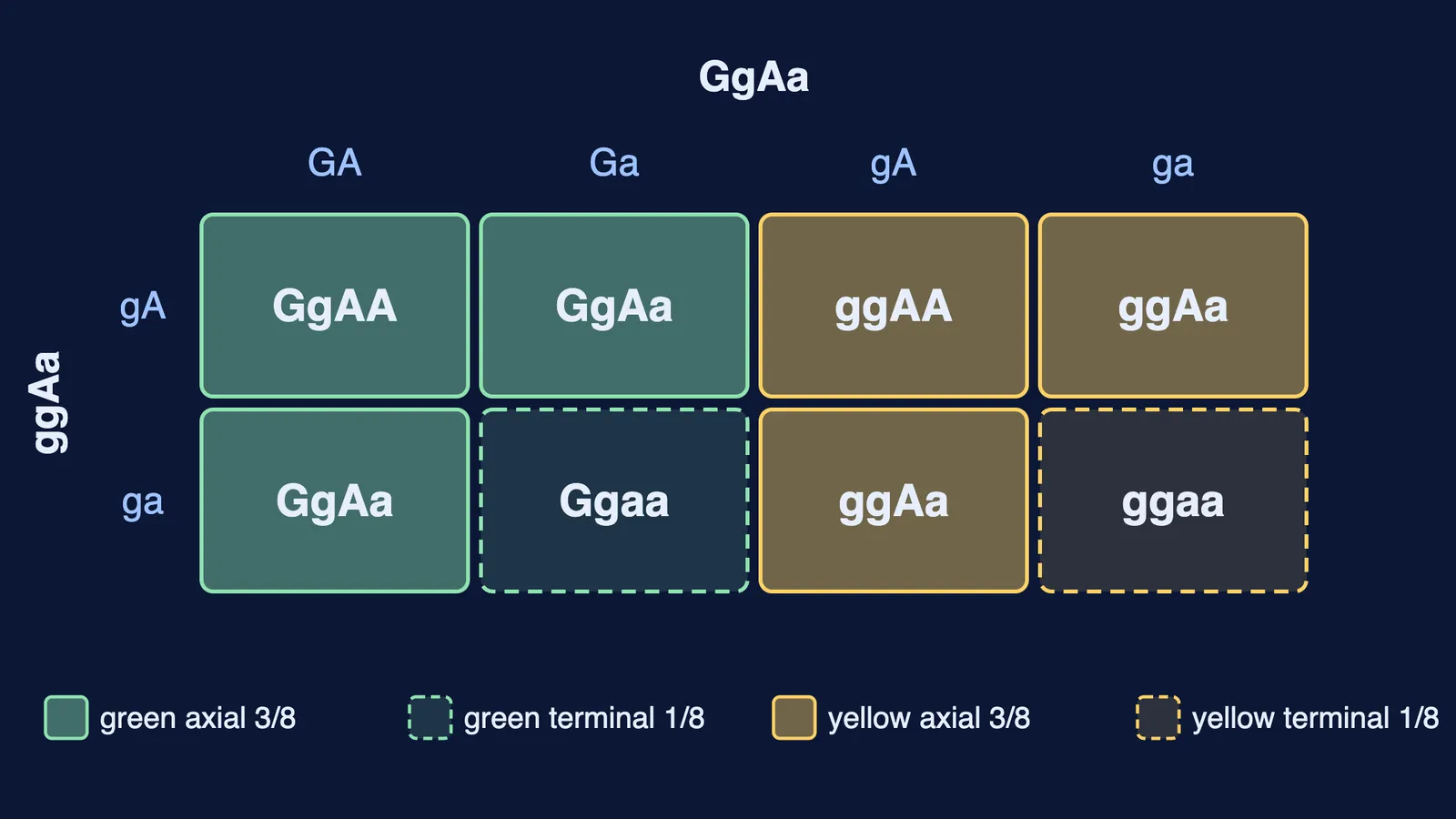
Try a fresh cross. Green pods (G) are dominant over yellow (g), and axial flowers (A) over terminal (a). A green-podded, axial-flowered pea (GgAa) is crossed with a yellow-podded, axial-flowered pea (ggAa). What fraction of the offspring have yellow pods and terminal flowers, and what fraction are GgAa?
Method 1, Punnett square. GgAa makes gametes GA, Ga, gA and ga; ggAa makes gA and ga. The 8 boxes give 3 green axial, 1 green terminal, 3 yellow axial and 1 yellow terminal. So yellow terminal is 1/8, and GgAa fills 2 boxes, or 1/4.
Method 2, product rule. Take each gene separately, as NCERT does when it combines (3:1)(3:1) into 9:3:3:1. Gg × gg gives green 1/2, yellow 1/2. Aa × Aa gives axial 3/4, terminal 1/4, and genotype Aa 1/2. Yellow terminal = 1/2 × 1/4 = 1/8. GgAa = 1/2 × 1/2 = 1/4.
The Fermi Problem Library has worked problems with a step-by-step solver that explains the reasoning rather than printing an answer; try it when a ratio comes out wrong. Also sitting NEET? Our NEET guide to this chapter covers the crosses and traps NEET tests.
What are the assertion-reason and case-study traps?
In the sample paper's linkage item, the assertion says recombination does not vary with how tightly genes are linked. That is false: NCERT records tight linkage giving low recombination. The reason is true, so the answer is option D: A false, R true.
In the pedigree MCQ, unaffected parents have an affected son and an affected daughter. Unaffected parents with an affected child point to a recessive trait, and an affected daughter of an unaffected father rules out X-linked recessive, which is why the answer is sickle-cell anaemia.
Thalassemia is a quantitative problem (too little globin); sickle-cell anaemia is qualitative (faulty globin).
In birds the egg, not the sperm, decides the sex of the chick.
Case-based questions come in 1- and 2-mark parts; label each answer.
How should you plan your revision?
Days 1-3: monohybrid, dihybrid and test crosses.
Days 4-5: incomplete dominance, ABO, pleiotropy and polygenic traits.
Days 6-7: linkage, sex determination and pedigree symbols.
Days 8-9: Mendelian and chromosomal disorders as a two-column table.
Days 10-12: every NCERT end-of-chapter exercise, timed.
Days 13-14: the sample paper's genetics questions, marked against the scheme.
If a term feels shaky, the Fermi Concept Library covers every concept in biology, each with its own lesson.