On this page
CBSE marks answers point by point, so write neat, labelled answers in NCERT's terms. Preparing for NEET-UG too? Our NCERT-first plan for Human Reproduction in NEET covers the MCQ side.
How many marks is Human Reproduction worth in the Class 12 board exam?
The CBSE Biology curriculum for 2026-27 prints Unit VI, Reproduction, at 16 marks out of a 70-mark theory paper. That 16 covers the whole unit, including Sexual Reproduction in Flowering Plants and Reproductive Health; there is no separate mark for this chapter. Pregnancy, placenta, parturition and lactation are listed as "elementary idea" topics.
The 2026-27 sample paper has 33 questions: 16 of 1 mark, 5 of 2 marks, 7 of 3 marks, 2 case-based questions of 4 marks and 3 of 5 marks. This chapter appears as a trophoblast MCQ, an assertion-reason item on gametogenesis and a 4-mark menstrual-cycle case.
Which diagrams should you practise labelling?
Practise the figures in NCERT's Human Reproduction chapter (Reprint 2026-27); its exercises name several:
Male reproductive system (Figure 2.1b)
Female reproductive system (Figure 2.3b), with our female reproductive system labelling guide
Seminiferous tubule in section (Figures 2.2 and 2.5)
Sperm: head, acrosome, neck, middle piece, tail (Figure 2.6)
Section of ovary with follicles, secondary oocyte and corpus luteum (Figure 2.7)
Mammary gland (Figure 2.4)
Draw in pencil with straight label lines on one side.
Spermatogenesis vs oogenesis: what is the difference?
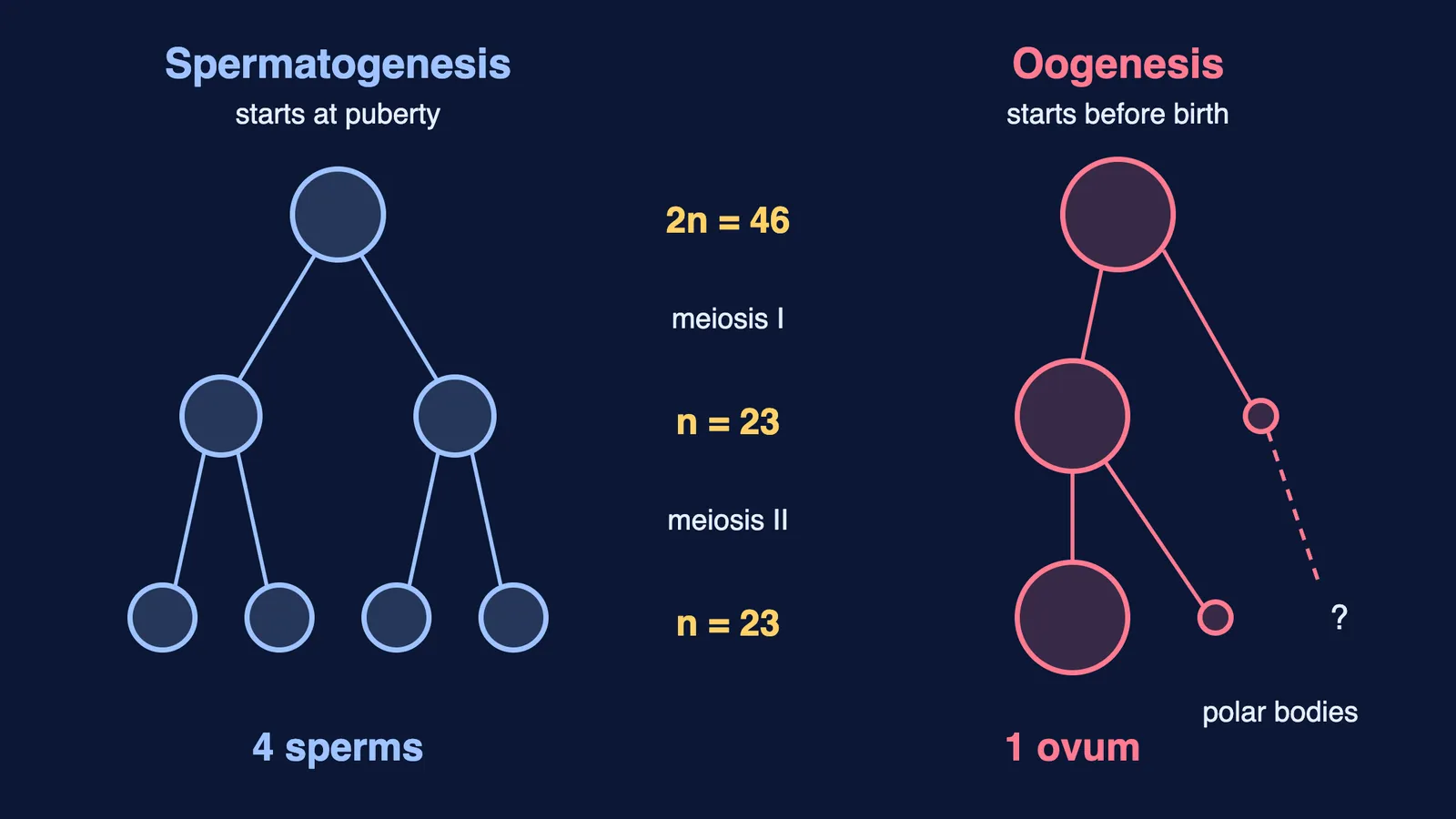
Spermatogenesis begins at puberty, while oogenesis begins in the fetal ovary and no new oogonia are added after birth, according to NCERT. One primary spermatocyte gives four equal haploid spermatids. A primary oocyte's first meiotic division is unequal, giving a large secondary oocyte and a tiny first polar body. The secondary oocyte completes its second division only after a sperm enters, forming the ovum and a second polar body. Spermatogonia have 46 chromosomes and secondary spermatocytes have 23.
Worked example. How many primary spermatocytes and primary oocytes are needed for 100 sperms and 100 ova?
Method 1, yield per cell: each primary spermatocyte gives 4 sperms, so 100 ÷ 4 = 25. Each primary oocyte gives 1 ovum, so 100.
Method 2, count backwards: 100 sperms come from 100 spermatids (spermiogenesis does not divide), which come from 50 secondary spermatocytes, which come from 25 primary spermatocytes. Each oocyte division keeps one large cell, so 100 ova need 100 secondary and 100 primary oocytes.
Both give 25 and 100. Do not total the polar bodies: NCERT is not certain whether the first one divides.
How do you set out 2-, 3- and 5-mark answers?
One clear point per mark, in order. Practice questions built from NCERT:
2 marks, "What is the LH surge?" (1) LH rises rapidly to its maximum at mid-cycle, about day 14. (2) This ruptures the Graafian follicle, releasing the ovum (ovulation).
3 marks, fertilisation to implantation. Fertilisation in the ampullary region of the fallopian tube. Cleavage of the zygote into a morula (8 to 16 blastomeres), then a blastocyst. The trophoblast attaches to the endometrium and the blastocyst is embedded: implantation.
5 marks, the menstrual cycle. Sketch a day line: menstrual phase (3-5 days), follicular phase, ovulation (about day 14), luteal phase. Then one line each on FSH and LH, estrogens from growing follicles, progesterone from the corpus luteum, and what follows without fertilisation.
In the sample paper, 5-mark questions come in marked sub-parts (Question 32 splits 2 + 2 + 1), so label each part.
Keep parturition and lactation short: the foetal ejection reflex prompts the mother's pituitary to release oxytocin, the stronger contractions it causes release more oxytocin, and colostrum carries antibodies.
What are the assertion-reason and case-study traps?
Reason explains only half. Sample Question 13 contrasts continuous spermatogenesis with discontinuous oogenesis; the Reason describes only oogenesis's arrests. The marking scheme answer is A: the arrests in R are what make oogenesis discontinuous, so R explains A. More drills: our assertion-reason guide for human reproduction.
Swapped cells and places. From NCERT exercise 16: androgens come from Leydig cells, not Sertoli cells, and Leydig cells are not in the ovary. Fertilisation is in the ampullary region, not the uterus.
Case studies want the hormone chain. Question 29 splits 1 + 2 + 1, with a choice in the last part. Its 2-mark answer runs: no LH surge, so ovulation may not occur, so no corpus luteum and no progesterone. Write the chain, not a diagnosis.
If a step in that chain does not click, the Fermi Concept Library has every concept in physics, chemistry, biology, mathematics and computing, each with its own lesson and its place in the map.
A 7-day revision plan for Human Reproduction
Day 1: draw Figures 2.1b and 2.3b from memory, then check.
Day 2: seminiferous tubule, sperm, ovary section, mammary gland.
Day 3: gametogenesis differences; redo the worked example for 60 sperms.
Day 4: redraw the menstrual-cycle sketch from memory.
Day 5: fertilisation to lactation; NCERT exercises 1, 17 and 18.
Day 6: sample Questions 3, 13 and 29, timed, marked against the scheme.
Day 7: rewrite every answer that lost marks.