On this page
In the CBSE Biology curriculum for 2026-27, Unit IX, Biotechnology and its Applications, carries 12 marks out of the 70-mark theory paper, shared with Chapter 10. Preparing for NEET? Our NEET guide to restriction enzymes, PCR and cloning vectors is built for MCQs.
What does the CBSE paper ask from this chapter?
The CBSE 2026-27 Biology sample paper has 33 questions: 1-mark MCQs and assertion-reason items, 2- and 3-mark short answers, two 4-mark case studies and three 5-mark long answers. From this chapter it set a 1-mark MCQ on a contaminated fermenter (Q11), a 3-mark question on turning pathogens into vectors (Q27) and a 5-mark choice question (Q32) on screening recombinants or isolating DNA. The marking scheme splits Q27 into 1 + 1 + 1 and each Q32 option into 2 + 2 + 1.
Which NCERT facts must you write exactly?
From NCERT Chapter 9 (Reprint 2026-27):
Restriction enzymes: endonucleases that recognise a specific palindromic sequence, then cut both DNA strands at fixed points in their sugar-phosphate backbones.
Naming: in EcoRI, E is the genus (Escherichia), co the species (coli), R the strain (RY 13), and I the order of isolation from that strain.
Palindrome: 5'-GAATTC-3' reads the same as its partner, 3'-CTTAAG-5', when both are read in the same direction.
Sticky ends: each strand is cut slightly off-centre in the palindrome, leaving single-stranded overhangs that pair with matching ends and help DNA ligase join them.
Gel electrophoresis: negatively charged DNA moves towards the anode through agarose; smaller fragments move farther; bands show after ethidium bromide staining under UV; cutting out a band is elution.
Vector features: origin of replication (ori), which also controls copy number; a selectable marker; and cloning sites, preferably single ones.
Competent host: cells treated with a divalent cation such as calcium, incubated with DNA on ice, heat-shocked briefly at 42°C, then returned to ice.
PCR: each cycle is denaturation, primer annealing and extension; a thermostable DNA polymerase from Thermus aquaticus survives the heat; repeated cycles give about a billion copies.
Bioreactors: vessels that process 100-1000 litres of culture while keeping temperature, pH, substrate, salts, vitamins and oxygen at their best; stirred-tank types are most common.
Downstream processing: separation and purification, then formulation with preservatives and quality control.
How should you set out 2-, 3- and 5-mark answers?
2 marks: a definition plus one reason or example. Selectable marker: define it, then name ampicillin resistance in E. coli.
3 marks: three separate points. For Q27: why pathogens make good vectors, the disarmed retrovirus, and the Ti plasmid of Agrobacterium tumefaciens.
5 marks: a labelled diagram (pBR322, PCR or a stirred-tank bioreactor) and steps in order.
Which antibiotic plates identify recombinants?
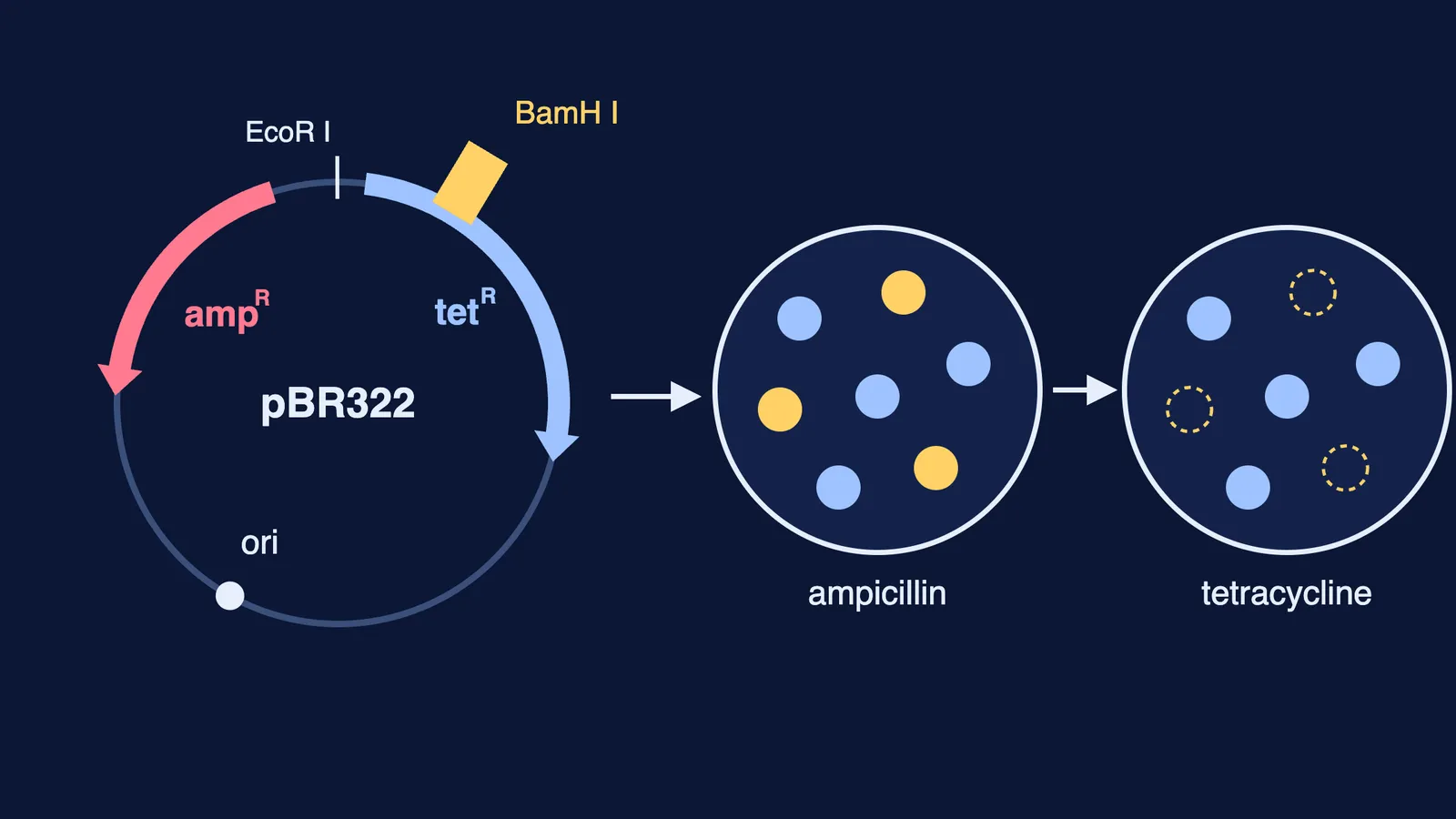
The question: foreign DNA is ligated at the BamH I site of pBR322 and put into E. coli. Which plates pick out the recombinants?
Method 1, from the genes. BamH I lies inside tetR. An insert there breaks tetR but leaves ampR working. So plate on ampicillin, transfer the colonies to tetracycline, and pick those that grew on ampicillin but not on tetracycline.
Method 2, from the cells. Untransformed cell: no plasmid, no growth on ampicillin. Non-recombinant: both genes intact, grows on both. Recombinant: ampR intact, tetR broken, grows on ampicillin only. Only recombinants show that pattern, matching Method 1.
Check by swapping the site. NCERT's pBR322 figure puts Pst I inside ampR. An insert there flips the pattern: recombinants grow on tetracycline but not ampicillin. Either way, recombinants lose resistance to the antibiotic whose gene holds the insert.
Which mistakes cost marks in this chapter?
Direction and size: DNA runs to the anode and the smallest fragments travel farthest. "Towards the cathode" makes R false.
True but unrelated: Taq polymerase is used because it stays active through denaturation heat, not merely because it comes from a bacterium.
Blue-white logic: without an insert, colonies turn blue on a chromogenic substrate; recombinants stay colourless because the β-galactosidase gene is inactivated.
Wrong enzyme: the sample paper's alternative 5-mark question added cellulase to bacterial, plant and fungal cells. Only plant DNA isolation works; bacteria need lysozyme, fungi chitinase.
Falling fermenter yield: Q11's contaminated culture needs sterile handling, not added antibiotics or heat.
A 7-day revision plan for Chapter 9
Day 1: restriction enzymes, EcoRI naming, palindromes, sticky ends.
Day 2: draw pBR322 with ori, ampR, tetR and restriction sites; redo the worked example without notes.
Day 3: competent host, micro-injection, biolistics, disarmed pathogens, and DNA isolation.
Day 4: gel electrophoresis and the three PCR steps, drawn.
Day 5: label a stirred-tank bioreactor; downstream processing.
Day 6: sample-paper Q27 and Q32 under time, marked against the scheme.
Day 7: assertion-reason practice, then Unit IX with Chapter 10 using our post on biotechnology applications such as Bt crops, RNAi and gene therapy.
If one idea keeps slipping, such as copy number, the Fermi Concept Library covers every concept in physics, chemistry, biology, mathematics and computing, each with its own lesson and its place in the map.