On this page
Every statement was checked against NCERT Introduction to Trigonometry and Some Applications of Trigonometry (Reprint 2026-27); every value was recomputed in Python.
How do you answer assertion-reason questions in Class 10 Maths?
The CBSE Class 10 Mathematics Standard sample question paper for 2026-27 has two assertion-reason questions, Q19 and Q20, in Section A at 1 mark each. Judge each statement on its own, then ask: does R directly prove A? Keys for the assertion-reason items:
(A) Both A and R are true and R is the correct explanation of A.
(B) Both A and R are true but R is NOT the correct explanation of A.
(C) A is true but R is false.
(D) A is false but R is true.
Keys for the statement pairs:
(A) Both statements are correct.
(B) Both statements are incorrect.
(C) Statement I is correct, Statement II is incorrect.
(D) Statement I is incorrect, Statement II is correct.
All items stay inside Unit V of the CBSE 2026-27 Class 10 Maths syllabus, including heights and distances with angles of 30°, 45° and 60° only.
Assertion-reason questions on trigonometry
Q1 (easy). Assertion (A): 2 sin 30° = sin 60°. Reason (R): sin 30° = 1/2.
Answer: (D). R is the table value. A is false: 2 × 1/2 = 1, but sin 60° = √3/2.
Trap: treating 2 sin 30° as sin (2 × 30°).
Q2 (easy). Assertion (A): A right triangle with sides 5, 12, 13 cm is enlarged to sides 10, 24, 26 cm. The sine of its smallest angle stays 5/13. Reason (R): The trigonometric ratios of an angle do not change with the lengths of the sides of the triangle, if the angle stays the same.
Answer: (A). Enlarging keeps every angle the same, and 5/13 = 10/26. R is the NCERT result behind this.
Trap: thinking a bigger triangle gives a bigger ratio.
Q3 (medium). Assertion (A): tan 90° is not defined. Reason (R): cos 0° = 1.
Answer: (B). Both are true, but A holds because tan A = sin A / cos A and cos 90° = 0. The value of cos 0° plays no part.
Trap: picking (A) because R is a true table value.
Q4 (medium). Assertion (A): If sin A = 3/5 for an acute angle A, then cos A = 4/5. Reason (R): sin A + cos A = 1 for every acute angle A.
Answer: (C). A is true: cos²A = 1 − 9/25 = 16/25, so cos A = 4/5. R is false: the identity is sin²A + cos²A = 1, and here 3/5 + 4/5 = 7/5.
Trap: dropping the squares from the identity.
Q5 (medium). Assertion (A): No acute angle θ has sin θ = 4/3. Reason (R): In a right triangle the hypotenuse is the longest side.
Answer: (A). sin θ is opposite side ÷ hypotenuse, so it cannot exceed 1. R is the reason NCERT gives.
Trap: accepting any fraction as a sine value.
Q6 (hard). Assertion (A): The identity 1 + tan²A = sec²A is true at A = 0°. Reason (R): cosec A and cot A are not defined at A = 0°.
Answer: (B). A is true: 1 + 0 = 1 = sec²0°. R is true, but it explains why cot²A + 1 = cosec²A fails at 0°, not anything about tan or sec.
Trap: giving all three identities the same range of A.
Statement I and Statement II questions with answers
Q7 (easy). Statement I: The angle of elevation and the angle of depression are both measured between the line of sight and the horizontal. Statement II: As the Sun rises higher in the sky, the shadow of a vertical pole gets longer.
Answer: (C). I matches the NCERT definitions. II is false: shadow length = height ÷ tan θ, and tan θ grows with θ.
Trap: mixing up morning and noon shadows.
Q8 (medium). Statement I: If tan A = √3 for an acute angle A, then sin A = 1/2. Statement II: If sec A = 2 for an acute angle A, then A = 60°.
Answer: (D). I is false: tan A = √3 gives A = 60°, so sin A = √3/2. II is true: sec A = 2 means cos A = 1/2, so A = 60°.
Trap: reading the 30° value from the table for a 60° angle.
Q9 (hard). Statement I: From a point 24 m from the foot of a vertical building on level ground, the angle of elevation of its top is 60°, so the building is 24√3 m tall. Statement II: From the top of a 20 m tower, the angle of depression of a car on the level road is 30°, so the car is 20√3 m from the foot of the tower.
Answer: (A). I: height = 24 × tan 60° = 24√3 m. II: the angle at the car is also 30°, so distance = 20 ÷ tan 30° = 20√3 m.
Trap: using tan 30° = √3 in II.
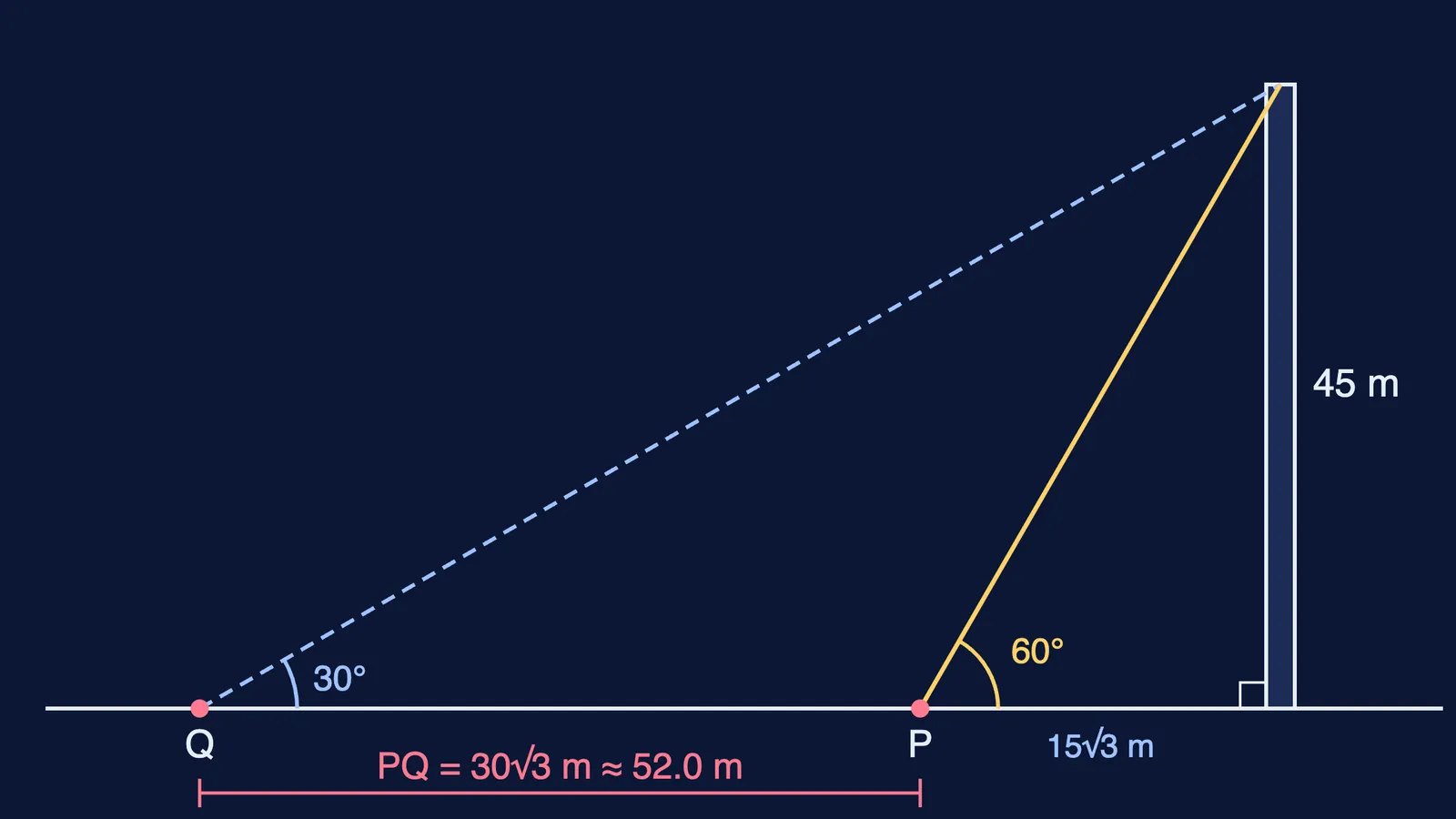
Q10 (hard). Statement I: If a pole's shadow is √3 times its height, the Sun's altitude is 60°. Statement II: The top of a 45 m tower is seen at 60° from point P and at 30° from point Q, on the same side on level ground, so PQ = 30 m.
Answer: (B). I is false: tan θ = 1/√3 gives 30°. II is false: P is 45 ÷ √3 = 15√3 m away and Q is 45√3 m away, so PQ = 30√3 m.
Trap: subtracting 15 from 45 and losing the √3.
How should you use this set?
Attempt all ten in 12 minutes, marking T or F beside each statement.
For each miss, note what you misjudged: A, R, or the link between them.
Redo Q9 and Q10 with a labelled figure.
Turn one wrong value into a new pair.
The hero diagram is Q10 drawn to scale.
If you mix up which side is opposite and which is adjacent, the Fermi Concept Library gives every concept in mathematics its own lesson and its place in the map.
For section-wise timing and marks, read our CBSE Class 10 maths paper strategy. For the method behind this format, see our assertion-reason strategy guide.