On this page
Surface Areas and Volumes, Chapter 12 of NCERT Class 10 Mathematics (Reprint 2026-27), is about what happens when two solids are joined. The CBSE 2026-27 Maths syllabus covers combinations of any two of cubes, cuboids, spheres, hemispheres and right circular cylinders or cones, and every item stays inside it.
How do you answer assertion-reason questions on surface areas and volumes?
In the CBSE Class 10 Maths (Standard) sample paper for 2026-27, questions 19 and 20 are 1-mark assertion-reason items with the four options used for Q1 to Q6.
Judge each line on its own; only if both are true, ask whether R is the step that makes A true. Our three-check method for assertion-reason questions has more.
Keys, Q1 to Q6:
(A) Both A and R are true and R is the correct explanation of A.
(B) Both A and R are true but R is NOT the correct explanation of A.
(C) A is true but R is false.
(D) A is false but R is true.
Keys, Q7 to Q10:
(A) Both statements are correct.
(B) Both statements are incorrect.
(C) Statement I is correct, Statement II is incorrect.
(D) Statement I is incorrect, Statement II is correct.
Surface areas and volumes assertion-reason questions with answers
Q1 (easy). Assertion (A): Three cubes of edge 2 cm are joined in a row. The surface area of the cuboid formed is 56 cm². Reason (R): When solids are joined, the faces in contact are hidden.
Answer: (A). R is the working: 3 × 24 = 72 cm², minus four hidden 4 cm² faces, is 56 cm².
Trap: adding the cubes to get 72 cm².
Q2 (easy). Assertion (A): A toy made by joining a cone and a hemisphere of the same radius has volume equal to the sum of their volumes. Reason (R): Its total surface area is the sum of their total surface areas.
Answer: (C). A is true: joining loses no volume. R is false: the two flat circles that meet are hidden, leaving only the two curved surfaces.
Trap: assuming area adds like volume.
Q3 (medium). Assertion (A): A toy made of a cone (radius 3 cm, height 4 cm) on a hemisphere of radius 3 cm has surface area 33π cm². Reason (R): The volume of a hemisphere of radius r is two-thirds of the volume of a cylinder of radius r and height r.
Answer: (B). Both are true: slant height 5 cm gives 15π + 18π = 33π. R is a volume fact, so it cannot explain an area.
Trap: choosing (A) because R is true and from the same chapter.
Q4 (medium). Assertion (A): A hemisphere of diameter 7 cm is scooped out of one face of a cube of edge 10 cm, so the surface area falls below the cube's 600 cm². Reason (R): The curved surface area of a hemisphere is twice the area of its flat circular face.
Answer: (D). A is false: you lose a circle (πr²) but gain a bowl (2πr²), so the area rises to 600 + 38.5 = 638.5 cm² (π = 22/7). R is true, and it is why A fails.
Trap: assuming "cut out" means "less".
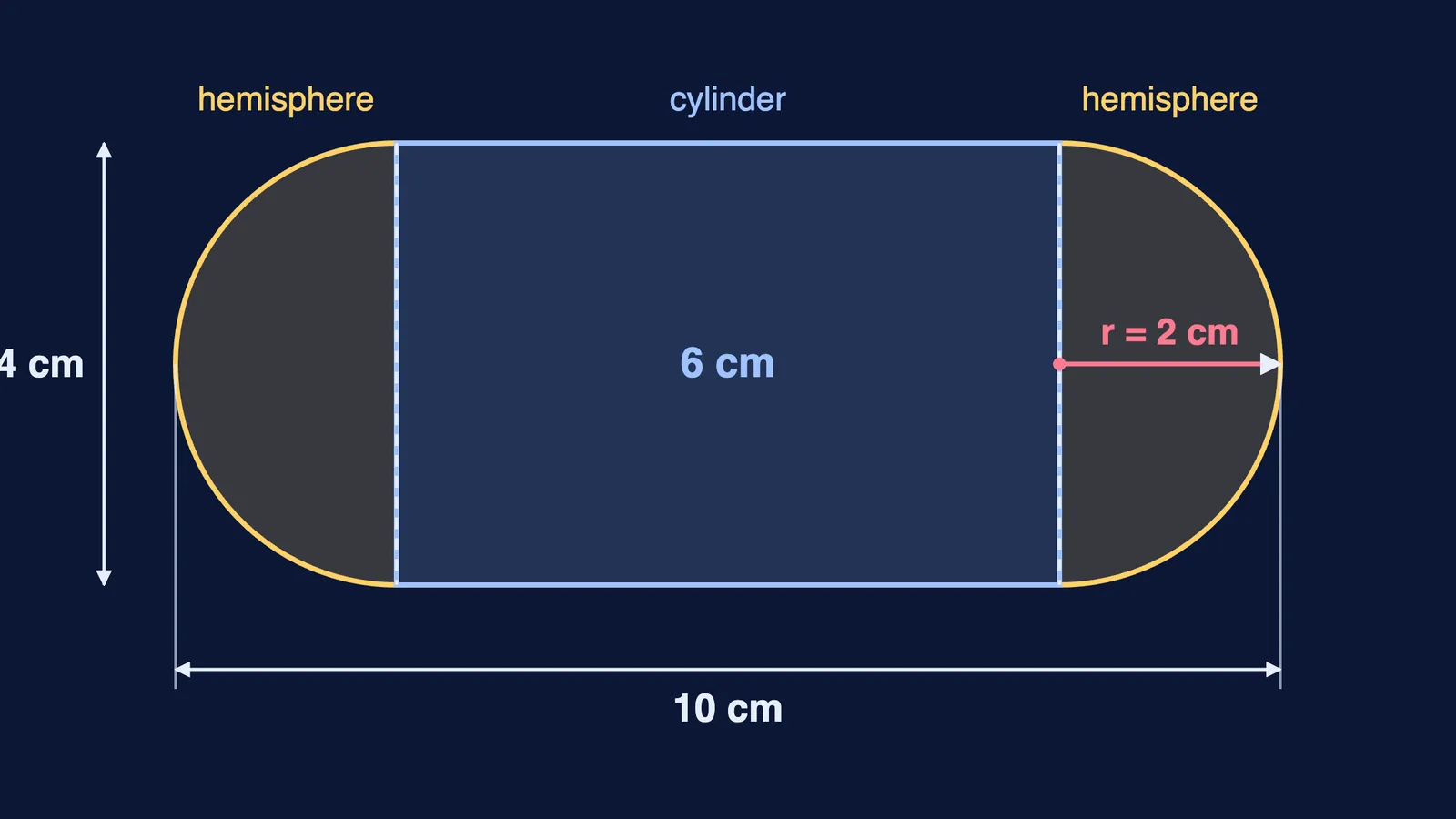
Q5 (hard). Assertion (A): A capsule (a cylinder with a hemisphere at each end) 10 cm long and 4 cm wide has volume 104π/3 cm³. Reason (R): The two ends together make a sphere of radius 2 cm, and the cylinder between them is 6 cm long.
Answer: (A). R gives the method: 24π (cylinder) + 32π/3 (sphere) = 104π/3 cm³.
Trap: taking the cylinder as 10 cm long.
Q6 (hard). Assertion (A): A cone and a cylinder of radius r and height r, and a hemisphere of radius r, have volumes in the ratio 1 : 3 : 2. Reason (R): The total surface area of a solid hemisphere of radius r is 3πr².
Answer: (B). Both are true: the volumes are πr³/3, πr³ and 2πr³/3. R (2πr² + πr²) is about area.
Trap: picking (A) because both lines mention a hemisphere.
Statement I and II questions on surface areas and volumes
Q7 (easy). Statement I: A cone (radius 3 cm, height 4 cm) on a hemisphere of radius 3 cm makes a toy 7 cm tall. Statement II: The slant height of that cone is 7 cm.
Answer: (C). I is true: 4 + 3 = 7 cm. II is false: the slant height is √(3² + 4²) = 5 cm.
Trap: confusing height with slant height.
Q8 (medium). Statement I: A cube of edge 6 cm topped by a hemisphere of radius 2 cm has surface area (216 + 8π) cm². Statement II: The volume of that solid is (216 + 16π/3) cm³.
Answer: (D). I is false: the base hides 4π cm² and the dome adds 8π cm², giving (216 + 4π) cm². II is true: 6³ = 216 and the hemisphere adds (2/3)π × 2³ = 16π/3.
Trap: not subtracting the covered part of the cube.
Q9 (medium). Statement I: A sphere of radius r has two-thirds the volume of a cylinder of radius r and height 2r. Statement II: That cylinder's curved surface area equals the sphere's surface area.
Answer: (A). I: (4/3)πr³ ÷ 2πr³ = 2/3. II: 2πr × 2r = 4πr².
Trap: using height r instead of 2r for the cylinder.
Q10 (hard). Statement I: Doubling a cylinder's radius, height unchanged, doubles its volume. Statement II: Doubling every length of a cone-on-hemisphere toy doubles its surface area.
Answer: (B). Both are false. Volume πr²h grows 4 times when r doubles. Every area term (πrl, 2πr²) multiplies two lengths, so the area also grows 4 times.
Trap: expecting everything to scale like length.
How should you use this set before the board exam?
Cover the answers and mark all ten keys in 10 minutes.
For each miss, note what you misjudged: A, R, or the link.
Redo Q1, Q4, Q5 and Q8 on paper, with units.
Rework that type of solid from our worked guide to combined solids in Class 10.
If one method keeps failing, the Fermi Problem Library has worked problems with a step-by-step solver that explains the reasoning rather than printing an answer.
Fit this into revision with our section-by-section plan for the CBSE Class 10 maths paper.