

On this page
Circles, Chapter 10 of NCERT Class 10 Mathematics (Reprint 2026-27), rests on two theorems that the CBSE 2026-27 Maths syllabus asks you to prove: a tangent is perpendicular to the radius at the point of contact, and tangents from an external point are equal.
How do you answer assertion-reason questions on circles?
In the CBSE Class 10 Maths (Standard) sample paper for 2026-27, questions 19 and 20 are 1-mark assertion-reason items with these options.
Judge each line on its own; if both are true, ask whether R proves A. Our three-check method for assertion-reason questions has more.
Keys for Q1 to Q6:
(A) Both A and R are true and R is the correct explanation of A.
(B) Both A and R are true but R is NOT the correct explanation of A.
(C) A is true but R is false.
(D) A is false but R is true.
Keys for Q7 to Q10:
(A) Both statements are correct.
(B) Both statements are incorrect.
(C) Statement I is correct, Statement II is incorrect.
(D) Statement I is incorrect, Statement II is correct.
Circles assertion-reason questions with answers
Q1 (easy). Assertion (A): The tangent at P to a circle with centre O and radius 6 cm passes through Q, with OQ = 10 cm. Then PQ = 8 cm. Reason (R): The tangent at any point of a circle is perpendicular to the radius through the point of contact.
Answer: (A). Both are true and R is the key step: OP ⟂ PQ, so PQ = √(10² − 6²) = 8 cm.
Trap: adding the squares instead of subtracting.
Q2 (easy). Assertion (A): No tangent to a circle passes through a point inside it. Reason (R): Exactly one tangent can be drawn to a circle from a point outside it.
Answer: (C). A is true: every line through an inside point cuts the circle twice. R is false: an outside point gives exactly two tangents.
Trap: confusing "on" with "outside".
Q3 (medium). Assertion (A): If AB is a diameter of a circle, the tangents at A and at B never meet. Reason (R): The lengths of tangents drawn from an external point to a circle are equal.
Answer: (B). Both are true, but R does not explain A. Both tangents are perpendicular to AB, so they are parallel; R concerns tangents that meet.
Trap: picking the theorem you remember best.
Q4 (medium). Assertion (A): Tangents PA and PB to a circle with centre O meet at an angle of 70°, so ∠AOB = 70°. Reason (R): The angle between two tangents from an external point and the angle AB subtends at the centre add up to 180°.
Answer: (D). A is false: the angles at A and B are 90°, so ∠AOB = 180° − 70° = 110°. R is true and disproves A.
Trap: assuming the angles are equal.
Q5 (hard). Assertion (A): Quadrilateral ABCD circumscribes a circle, with AB = 7 cm, BC = 9 cm and CD = 8 cm, so AD = 6 cm. Reason (R): The lengths of tangents drawn from an external point to a circle are equal.
Answer: (A). Both are true and R explains A: equal tangents from each vertex give AB + CD = AD + BC, so 7 + 8 = AD + 9 and AD = 6 cm.
Trap: pairing adjacent sides.
Q6 (hard). Assertion (A): For concentric circles of radii 13 cm and 5 cm, the chord of the larger one that touches the smaller one is 24 cm. Reason (R): The lengths of tangents drawn from an external point to a circle are equal.
Answer: (B). Both are true, but R does not explain A. The chord AB touches the small circle at P, so OP ⟂ AB and P bisects AB: AP = √(13² − 5²) = 12 cm, AB = 24 cm. R needs one external point.
Trap: citing equal tangents for equal halves.
Statement I and II questions on tangents
Q7 (medium). Statement I: Given any line, no circle has more than two tangents parallel to it. Statement II: The line containing the radius through the point of contact is called the tangent at that point.
Answer: (C). Statement I is correct: they touch at the ends of one diameter. Statement II is incorrect: NCERT says that line is sometimes called the normal.
Trap: swapping "normal" and "tangent".
Q8 (medium). Statement I: If the tangent from Q is 15 cm long and Q is 17 cm from the centre, the radius is 10 cm. Statement II: The length of a tangent is measured from the external point to the point of contact.
Answer: (D). Statement I is incorrect: the radius is √(17² − 15²) = 8 cm. Statement II is the NCERT definition.
Trap: skipping Pythagoras.
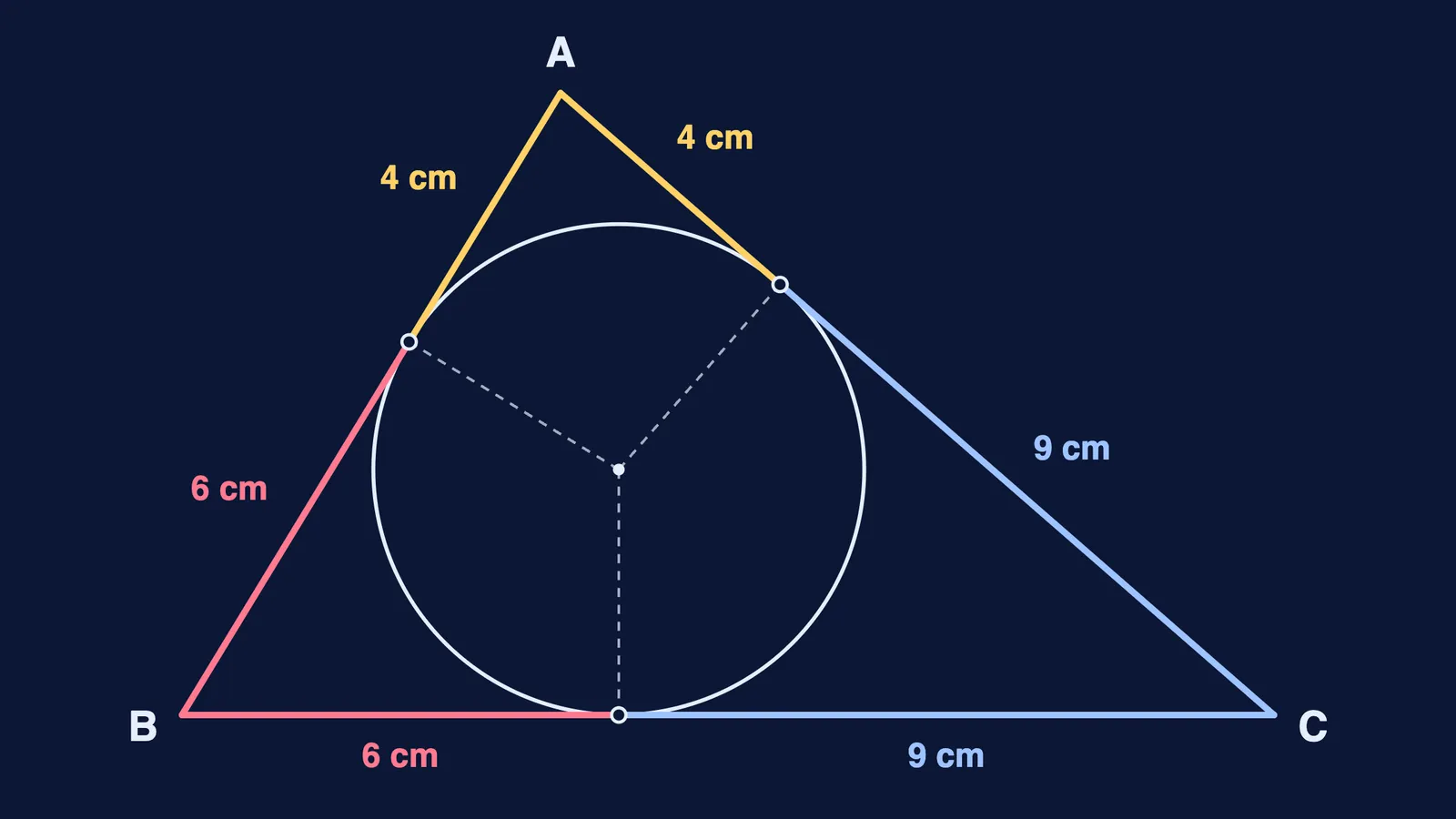
Q9 (hard). Statement I: A circle touches the sides AB, BC and CA of triangle ABC at F, D and E. If AF = 4 cm, BD = 6 cm and CE = 9 cm, the perimeter is 38 cm. Statement II: AB = 10 cm.
Answer: (A). Both are correct. Equal tangents give AE = 4, BF = 6 and CD = 9, so the perimeter is 2 × 19 = 38 cm and AB = 4 + 6 = 10 cm.
Trap: stopping at 19.
Q10 (hard). Statement I: TP and TQ are tangents from T to a circle with centre O. If ∠PTQ = 50°, then ∠OPQ = 50°. Statement II: A parallelogram circumscribing a circle must be a rectangle.
Answer: (B). Both are incorrect. TP = TQ gives ∠TPQ = 65°, so ∠OPQ = 90° − 65° = 25°. A parallelogram circumscribing a circle is a rhombus, not necessarily a rectangle.
Trap: confusing rhombus with rectangle.
How should you use this set?
Cover the answers; mark each line T or F.
For every (B), write the real reason.
Redo missed items after two days, drawing each figure first.
If the slip is the idea, reread the proofs in our Circles Class 10 guide to tangent theorems. The Fermi Concept Library gives every concept in mathematics its own lesson and its place in the map. For more sets, see our assertion-reason practice for CBSE papers.


