On this page
Most Triangles mistakes come from using a theorem backwards or matching the wrong vertices. These 10 questions target both.
What does this set cover?
Every item is inside the CBSE Class X Mathematics syllabus for 2026-27: the basic proportionality theorem (BPT), its converse and the AAA, SSS and SAS criteria. Each statement was checked against NCERT Class 10 Mathematics, Chapter 6 Triangles (Reprint 2026-27). The CBSE Class 10 Mathematics Standard sample paper for 2026-27 has two 1-mark assertion-reason questions (Q19 and Q20). For theory and the BPT proof, see our Triangles (similarity) Class 10 guide.
How do you answer assertion-reason questions?
Judge each line alone. If both are true, ask whether R is the direct reason for A. See our three-check method for assertion-reason questions.
Keys for Q1 to Q6:
(A) Both A and R are true and R is the correct explanation of A.
(B) Both A and R are true but R is NOT the correct explanation of A.
(C) A is true but R is false.
(D) A is false but R is true.
Keys for Q7 to Q10:
(A) Both statements are correct.
(B) Both statements are incorrect.
(C) Statement I is correct, Statement II is incorrect.
(D) Statement I is incorrect, Statement II is correct.
Triangles assertion-reason questions with answers
Q1 (easy). Assertion (A): Triangles with sides 3, 4, 5 cm and 7.5, 10, 12.5 cm are similar. Reason (R): Two triangles whose sides are proportional are similar.
Answer: (A). 3/7.5 = 4/10 = 5/12.5 = 2/5, and R (the SSS criterion) explains why they are similar.
Trap: checking only one pair of sides.
Q2 (easy). Assertion (A): A square of side 4 cm and a rhombus of side 6 cm with one angle of 60° are not similar. Reason (R): Two polygons with the same number of sides are similar if their corresponding sides are in the same ratio.
Answer: (C). A is true: the sides are in ratio 2 : 3, but the angles differ. R is false: polygons also need equal corresponding angles.
Trap: applying the triangle-only SSS rule to quadrilaterals.
Q3 (medium). Assertion (A): If ΔABC ~ ΔQRP, then AB/PQ = BC/QR. Reason (R): In ΔABC ~ ΔQRP, vertex A corresponds to vertex Q.
Answer: (D). R is true: the letter order fixes A↔Q, B↔R, C↔P. So the correct ratios are AB/QR = BC/RP = CA/PQ, and A is false.
Trap: pairing sides alphabetically, not by position.
Q4 (medium). Assertion (A): In ΔABC, D on AB and E on AC give AD = 2 cm, DB = 3 cm, AE = 2.4 cm and EC = 3.6 cm, so DE ∥ BC. Reason (R): A line parallel to one side of a triangle divides the other two sides in the same ratio.
Answer: (B). A is true: 2/3 = 2.4/3.6. R is the BPT, also true, but it runs the other way. A needs its converse.
Trap: quoting BPT when the question needs its converse.
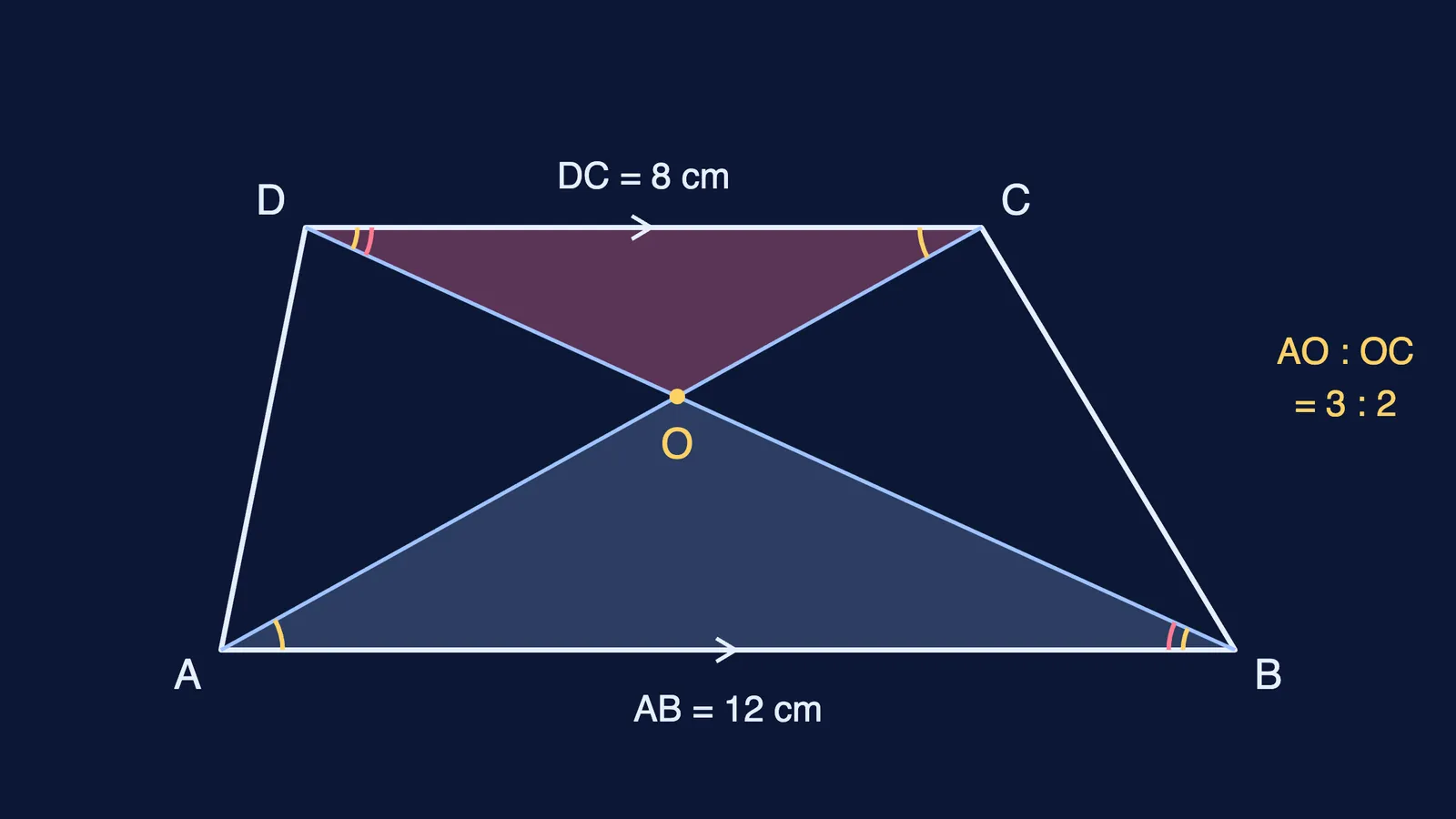
Q5 (medium). Assertion (A): In trapezium ABCD with AB ∥ DC, AB = 12 cm and DC = 8 cm, the diagonals meet at O with AO : OC = 3 : 2. Reason (R): ΔAOB ~ ΔCOD by the AA criterion.
Answer: (A). Alternate angles give ∠OAB = ∠OCD and ∠OBA = ∠ODC, so the triangles are similar and AO/CO = AB/CD = 12/8 = 3/2.
Trap: writing ΔAOB ~ ΔDOC, which pairs A with D.
Q6 (hard). Assertion (A): In ΔABC, DE ∥ BC with D on AB, E on AC and AD : DB = 2 : 3, so DE : BC = 2 : 5. Reason (R): DE/BC = AD/DB.
Answer: (C). ΔADE ~ ΔABC (AA), so DE/BC = AD/AB = 2/5, and A is true. R is false: AD/DB = 2/3 compares two pieces of one side.
Trap: using the BPT ratio for an uncut side.
Statement I and II questions with answers
Q7 (easy). Statement I: All isosceles triangles are similar. Statement II: All congruent triangles are similar.
Answer: (D). Isosceles triangles with apex angles 30° and 100° are not similar, so I is incorrect. Congruent triangles have equal angles and sides in ratio 1 : 1, so II is correct.
Trap: confusing "isosceles" with "equilateral".
Q8 (medium). Statement I: In ΔPQR, S on PQ and T on PR give ST ∥ QR. If PS = 4 cm, SQ = 6 cm and PR = 15 cm, then PT = 6 cm. Statement II: If ΔABC ~ ΔDEF, ∠A = 50° and ∠E = 70°, then ∠C = 60°.
Answer: (A). 4/10 = PT/15 gives PT = 6 cm. ∠B = ∠E = 70°, so ∠C = 180° − 50° − 70° = 60°.
Trap: writing 4/6 = PT/15, using SQ instead of PQ.
Q9 (hard). Statement I: Two triangles with two sides proportional and an equal angle not between them must be similar. Statement II: If D is on AB and E is on AC of ΔABC with AD/DB = AE/AC, then DE ∥ BC.
Answer: (B). I is incorrect: AB = 8 cm, AC = 5 cm and ∠B = 30° fit two triangles, as A is only 8 sin 30° = 4 cm from the other arm of ∠B. II is incorrect: AD = 2, DB = 3, AE = 2, EC = 1 gives AD/DB = AE/AC = 2/3, but AE/EC = 2, so DE is not parallel to BC.
Trap: treating SSA like SAS, or mixing part and whole ratios.
Q10 (hard). Statement I: ΔABC ~ ΔDEF with AB = 6 cm and DE = 9 cm. If medians AM and DN (to BC and EF) have AM = 4 cm, then DN = 6 cm. Statement II: A line through the mid-point of one side of a triangle, parallel to a second side, cuts the third side 1 : 2.
Answer: (C). AB/DE = BM/EN = 2/3 and ∠B = ∠E, so ΔABM ~ ΔDEN (SAS) and DN = 4 × 3/2 = 6 cm. II is incorrect: by BPT the cut is 1 : 1.
Trap: assuming medians do not scale.
How should you use this set?
Attempt all ten in 15 minutes.
Label each miss: wrong fact, wrong direction or wrong vertex match.
Redraw each missed figure; redo it two days later.
If choosing a criterion keeps tripping you up, the Fermi Concept Library covers every concept in mathematics, each with its own lesson.