On this page
Some Basic Concepts in Chemistry is Unit I of the NEET (UG)-2026 Chemistry syllabus: laws of chemical combination, the mole concept, formulae and stoichiometry (NMC syllabus for NEET (UG)-2026). Molarity and molality sit in its Unit 5, and significant figures in Physics Unit 1, but NCERT teaches them in this chapter. Every statement below was checked against Unit 1 of NCERT Class 11 Chemistry Part I, Reprint 2026-27.
New to the chapter? Start with our guide on how to prepare Some Basic Concepts of Chemistry for NEET.
How do you answer assertion-reason questions?
Mark each line true or false on its own. Only when both are true, ask: is R the direct reason NCERT gives for A?
Use these keys for Q1 to Q6:
(A) Both A and R are true and R is the correct explanation of A.
(B) Both A and R are true but R is NOT the correct explanation of A.
(C) A is true but R is false.
(D) A is false but R is true.
For the full method, read our three-check method for assertion-reason questions.
Assertion-reason questions on some basic concepts of chemistry
Q1 (easy). Assertion (A): For a reaction in a sealed flask, the total mass of flask and contents is the same before and after. Reason (R): In a chemical reaction, matter is neither created nor destroyed.
Answer: (A). Both are true, and R, the law of conservation of mass, is exactly why the mass does not change.
Trap: imagining gas escapes a sealed flask.
Q2 (easy). Assertion (A): One mole of water and one mole of carbon dioxide contain the same number of molecules, though their masses differ. Reason (R): The molar mass of a substance in grams is numerically equal to its molecular mass in u.
Answer: (B). Both are true. A holds because a mole of anything contains 6.02214076 × 10²³ entities. R explains the masses (18.02 g, 44.01 g), not the equal count.
Trap: picking (A) because both lines are about moles.
Q3 (medium). Assertion (A): The number 0.00250 has five significant figures. Reason (R): Zeros to the left of the first non-zero digit are not significant.
Answer: (D). R is true and makes A false. The leading zeros only mark the decimal point; 2, 5 and the final zero after the decimal point count: three.
Trap: counting every zero, or none.
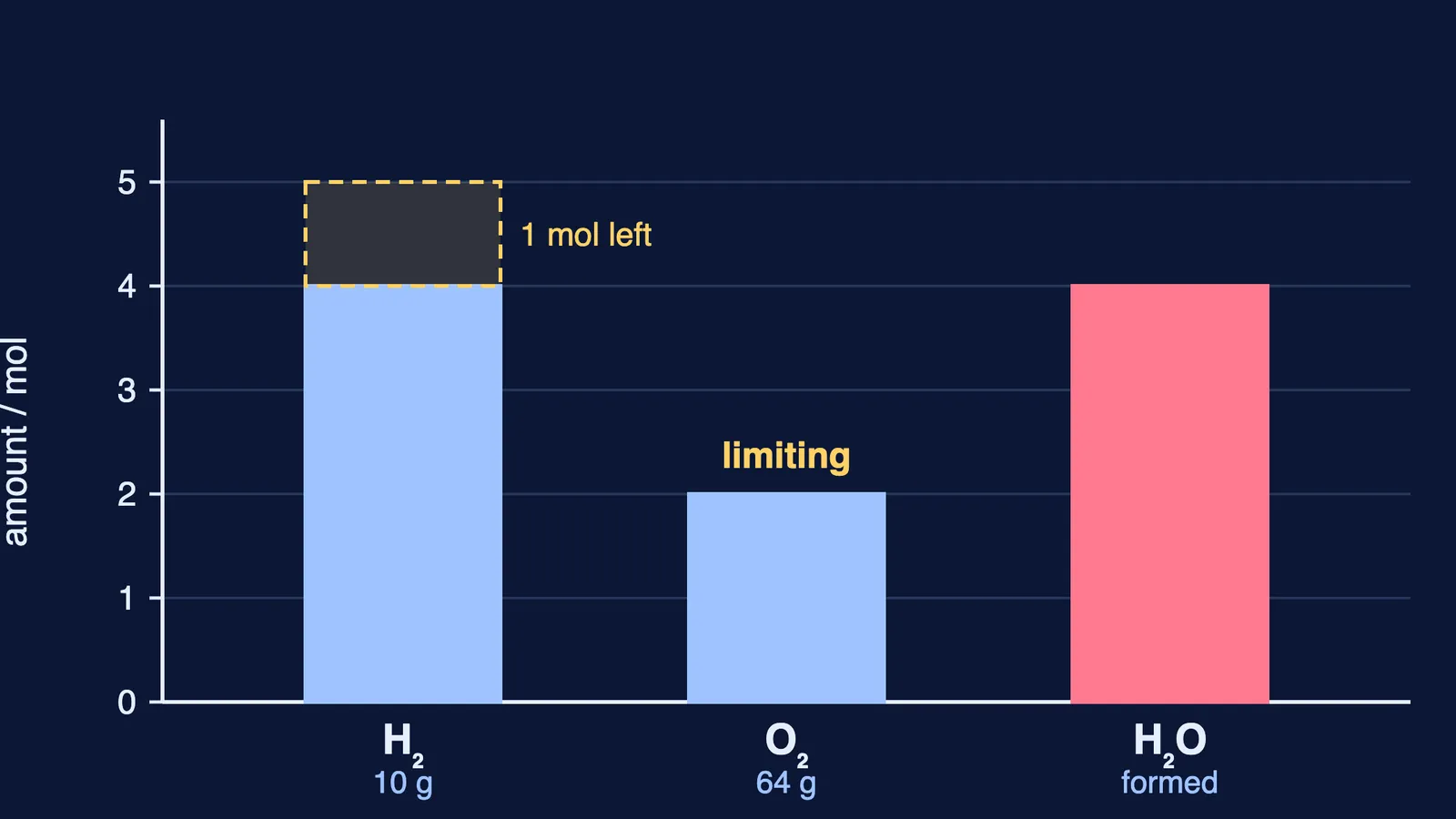
Q4 (medium). Assertion (A): When 10 g of hydrogen reacts with 64 g of oxygen to form water (2H₂ + O₂ → 2H₂O; H = 1 u, O = 16 u), oxygen is the limiting reagent. Reason (R): The limiting reagent is the reactant present in the smaller mass.
Answer: (C). A is true: 2 mol O₂ needs only 4 of the 5 mol H₂, so O₂ runs out first, giving 4 mol (72 g) of water with 1 mol H₂ left. R is false: the limiting reagent is the one consumed first, judged in moles against the equation; here it is the larger mass.
Trap: comparing grams, not moles per coefficient.
Q5 (hard). Assertion (A): The molality of a solution changes when the solution is heated. Reason (R): The volume of a solution changes with temperature.
Answer: (D). R is true; NCERT uses it to explain why molarity depends on temperature. A is false: molality is moles of solute per kilogram of solvent, and mass is unaffected by temperature.
Trap: reading "molality" as "molarity".
Q6 (hard). Assertion (A): At a fixed temperature and pressure, 40 mL of hydrogen reacts completely with 20 mL of oxygen, and 40 mL of water vapour forms. Reason (R): Equal volumes of gases at the same temperature and pressure contain equal numbers of molecules, and hydrogen and oxygen molecules are diatomic.
Answer: (A). Both are true. NCERT says Avogadro's work explained Gay Lussac's law, and diatomic molecules make the 2 : 1 : 2 volume ratio follow.
Trap: crediting Dalton's theory, which NCERT says could not explain gaseous volumes.
Statement I and Statement II questions
Use these keys for Q7 to Q10:
(A) Both statements are correct.
(B) Both statements are incorrect.
(C) Statement I is correct, Statement II is incorrect.
(D) Statement I is incorrect, Statement II is correct.
Q7 (medium). Statement I: A body's mass is constant, but its weight can vary from place to place because gravity varies. Statement II: The SI unit of mass is the gram.
Answer: (C). Statement I is correct. Statement II is wrong: it is the kilogram.
Trap: trusting the unit you use most.
Q8 (medium). Statement I: Every carbon atom has a mass of 12.011 u. Statement II: One atomic mass unit is exactly one-twelfth of the mass of one carbon-12 atom.
Answer: (D). Statement I is wrong: 12.011 u is the abundance-weighted average of carbon's isotopes; a ¹²C atom is exactly 12 u, a ¹³C atom about 13.003 u. Statement II is NCERT's definition.
Trap: reading the periodic-table value as one atom's mass.
Q9 (hard). Statement I: 32 g of oxygen gas contains 6.022 × 10²³ oxygen atoms. Statement II: Benzene (C₆H₆) and acetylene (C₂H₂) have different empirical formulas because their molecular formulas differ.
Answer: (B). Both are wrong. 32 g of O₂ is 1 mol of molecules, so it holds twice 6.022 × 10²³ atoms. Both compounds reduce to CH, the simplest whole-number ratio.
Trap: counting atoms when the mole was of molecules.
Q10 (hard). Statement I: Dissolving 5.85 g of NaCl in water to make 500 mL of solution gives a 0.2 M solution. Statement II: Dissolving 5.85 g of NaCl in 500 g of water gives a 0.2 mol kg⁻¹ solution.
Answer: (A). Both are correct. 5.85 g ÷ 58.5 g mol⁻¹ = 0.1 mol. I divides by 0.5 L of solution, II by 0.5 kg of solvent; different definitions, same 0.2 here.
Trap: assuming molarity and molality can never match.
How should you use this set?
Attempt all ten without notes, writing T or F beside each line first.
For each miss, note what failed: A, R, or the link.
Redo Q4 with 6 g of hydrogen: which reagent limits now?
Then try our Some Basic Concepts of Chemistry NEET MCQs with solutions.
If limiting-reagent numericals keep failing at the same step, the Fermi Problem Library has worked problems with a step-by-step solver that explains the reasoning rather than printing an answer.