On this page
Eight new NEET-style questions on electromagnetic induction and alternating current, written for this page. Each answer ends with the trap: the wrong option you are most likely to pick.
What does NEET cover in EMI and AC?
The NMC's updated syllabus for NEET (UG)-2026 lists Unit 14 as Faraday's and Lenz's laws, eddy currents, inductance, RMS values, impedance, LCR resonance, power and wattless current, the AC generator and the transformer. In the 2026-27 NCERT books this is Class 12 Physics Chapter 6 and Chapter 7.
New to the unit? Read our guide on how to prepare EMI and AC for NEET first.
How should you use this set?
In NEET-UG 2026, each question had four options and one correct answer, scored +4 for right and −1 for wrong, according to the NTA information bulletin. So practise:
Cover the answers and allow 12 minutes for all eight.
Skip any question you cannot start within 20 seconds.
Read every trap line, even where you were right.
Easy: flux, reactance and direction
Q1 (easy). The flux linked with a coil varies as Φ = (4t² − 3t) mWb, with t in seconds. The magnitude of the induced emf at t = 2 s is:
(A) 5 mV (B) 10 mV (C) 13 mV (D) 16 mV
Answer: (C). emf = |dΦ/dt| = 8t − 3 = 13 mV at t = 2 s. Trap: (B) is the flux itself at 2 s. The emf is the rate of change, not the value.
Q2 (easy). A pure inductor draws 2.0 A rms from a 200 V, 50 Hz supply. Its inductance and the average power it draws are:
(A) 0.32 H, 0 W (B) 0.32 H, 400 W (C) 0.45 H, 0 W (D) 2.0 H, 0 W
Answer: (A). X_L = V/I = 100 Ω, so L = X_L/(2πf) = 100/(2π × 50) = 0.32 H. Current lags voltage by 90°, so cos φ = 0 and the average power is zero: a wattless current. Trap: (B) multiplies V by I and forgets the power factor.
Q3 (easy). A flat rectangular loop lies in the plane of the page in a uniform field pointing into the page. The field strength is steadily decreasing. Seen from the front, the induced current and the force on the loop are:
(A) clockwise; the loop tends to expand (B) anticlockwise; the loop tends to expand (C) clockwise; the loop tends to shrink (D) anticlockwise; the loop tends to shrink
Answer: (A). The into-page flux is falling, so the induced current makes its own field into the page, which means clockwise. The side forces then point outward, enlarging the area. Trap: (C) forgets that the force also opposes the change.
Medium: inductors, generators and phase
Q4 (medium). An air-core solenoid has 1000 turns, length 50 cm and cross-section 10 cm². Take μ₀ = 4π × 10⁻⁷ T m A⁻¹. The energy stored when it carries 4.0 A is closest to:
(A) 5.0 mJ (B) 20 mJ (C) 40 mJ (D) 0.20 J
Answer: (B). L = μ₀N²A/l = 4π × 10⁻⁷ × 10⁶ × 10⁻³/0.50 = 2.5 mH, and U = ½LI² = ½ × 2.5 × 10⁻³ × 16 = 20 mJ. Trap: (D) takes 10 cm² as 10⁻² m²; it is 10⁻³ m².
Q5 (medium). A 150-turn coil of area 200 cm² spins at 3000 rpm about an axis perpendicular to a 0.10 T field. The rms emf it generates is closest to:
(A) 15 V (B) 67 V (C) 94 V (D) 900 V
Answer: (B). ω = 3000 × 2π/60 = 100π rad/s, so the peak emf NBAω = 150 × 0.10 × 0.020 × 314 = 94 V, and the rms value is 94/√2 = 67 V. Trap: (C) is the peak, not rms.
Q6 (medium). A series circuit has R = 30 Ω, L = 20 mH and C = 50 μF, driven at ω = 500 rad/s. Relative to the supply voltage, the current:
(A) lags by 45° (B) leads by 45° (C) leads by 59° (D) is in phase
Answer: (B). X_L = ωL = 10 Ω and X_C = 1/(ωC) = 40 Ω. The net reactance is 30 Ω capacitive, so tan φ = 30/30 = 1: the current leads by 45°. Trap: (A) misses that X_C > X_L makes the circuit capacitive.
Hard: charge and half power
Q7 (hard). A 50-turn coil of area 40 cm² lies with its plane perpendicular to a 0.25 T field. The circuit resistance is 5.0 Ω. The coil is turned through 180° in 0.10 s. The charge that flows through it is:
(A) 0 (B) 10 mC (C) 20 mC (D) 0.20 C
Answer: (C). The flux per turn goes from +BA to −BA, a change of 2BA. So Q = N × 2BA/R = 50 × 2 × 0.25 × 4.0 × 10⁻³/5.0 = 0.020 C. The time does not matter. Trap: (B) uses BA as the change, forgetting that the flux reverses.
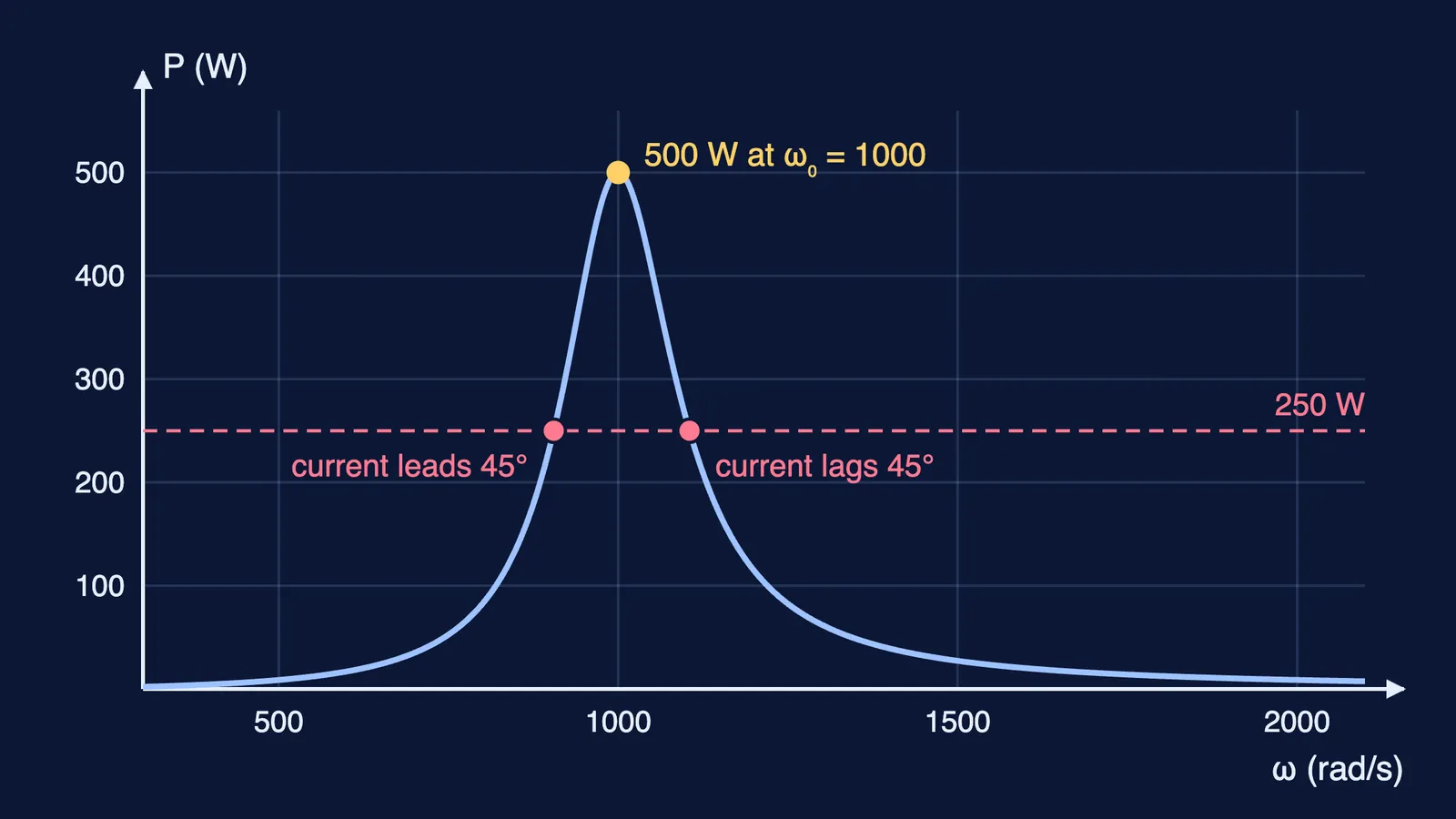
Q8 (hard). A series LCR circuit has R = 20 Ω, L = 0.10 H and C = 10 μF, connected to a 100 V rms source. The frequency is raised above resonance until the current lags the voltage by 45°. The average power drawn is now:
(A) 500 W (B) 354 W (C) 250 W (D) 177 W
Answer: (C). At 45°, X_L − X_C = R, so Z = R√2 = 28.3 Ω and I = 100/28.3 = 3.54 A. P = I²R = 3.54² × 20 = 250 W, half of the 500 W drawn at resonance (ω₀ = 1/√(LC) = 1000 rad/s). Trap: (B) is V × I with no power factor; cos 45° brings it down to 250 W.
What should you do after checking your answers?
Sort each miss: rate of change (Q1, Q7), direction and phase (Q3, Q6) or formulas and units (Q2, Q4, Q5, Q8). For direction errors, read three common mistakes in finding induced current direction. For phase and power, our explainer on phasors, impedance and resonance draws the triangle behind Q6 and Q8.
Redo every miss two days later. When a method breaks down, the Fermi Problem Library has worked problems with a step-by-step solver that explains the reasoning rather than printing an answer.