On this page
Chapter 6 of the NCERT Class 12 Physics Part I textbook, 2026-27 reprint derives five results from Faraday's law: motional emf, self-inductance, mutual inductance, the energy stored in an inductor and the emf of an AC generator. Each is set out below as you would write it: setup, numbered steps, result and the usual slip. For answer layout, Lenz's law directions and a revision week, read our electromagnetic induction board exam guide.
The CBSE Class XII Physics syllabus for 2026-27 lists Faraday's laws, induced emf and current, Lenz's law, and self and mutual induction for this chapter; it lists the AC generator under Chapter 7, Alternating Current.
Motional emf: how do you get ε = Blv?
Setup: a U-shaped conductor with a rod of length l sliding on it, all in a uniform field B perpendicular to the plane; x is the distance from the closed end to the rod.
The enclosed area is lx, so the flux is Φ = Blx.
Faraday's law gives the emf as ε = −dΦ/dt = −Bl (dx/dt).
The rod moves towards the closed end at speed v, so x shrinks: dx/dt = −v.
Substitute: ε = −Bl(−v).
Result: ε = Blv.
Second route, which NCERT also gives: a charge q in the rod moves with it at speed v, so it feels a magnetic force qvB along the rod. Carrying it the full length l takes work qvBl; dividing that work by q gives ε = Blv again.
Where students slip: dropping the minus sign in dx/dt = −v, or using the full rail length instead of the enclosed part.
Self-inductance of a long solenoid: L = μ0n²Al
Setup: a long air-cored solenoid of length l, cross-section area A and n turns per unit length, carrying current I; edge effects neglected.
Field inside: B = μ0nI, uniform over the cross-section.
Flux through one turn: BA = μ0nIA.
Number of turns: N = nl.
Flux linkage: NΦ = (nl)(μ0nIA) = μ0n²AlI.
By definition NΦ = LI, so L = NΦ/I.
Result: L = μ0n²Al, and L = μrμ0n²Al with a core of relative permeability μr.
Where students slip: writing n for the total number of turns. Here n is turns per metre, so the total is nl, and the answer has n² because n appears once in B and once in the turn count.
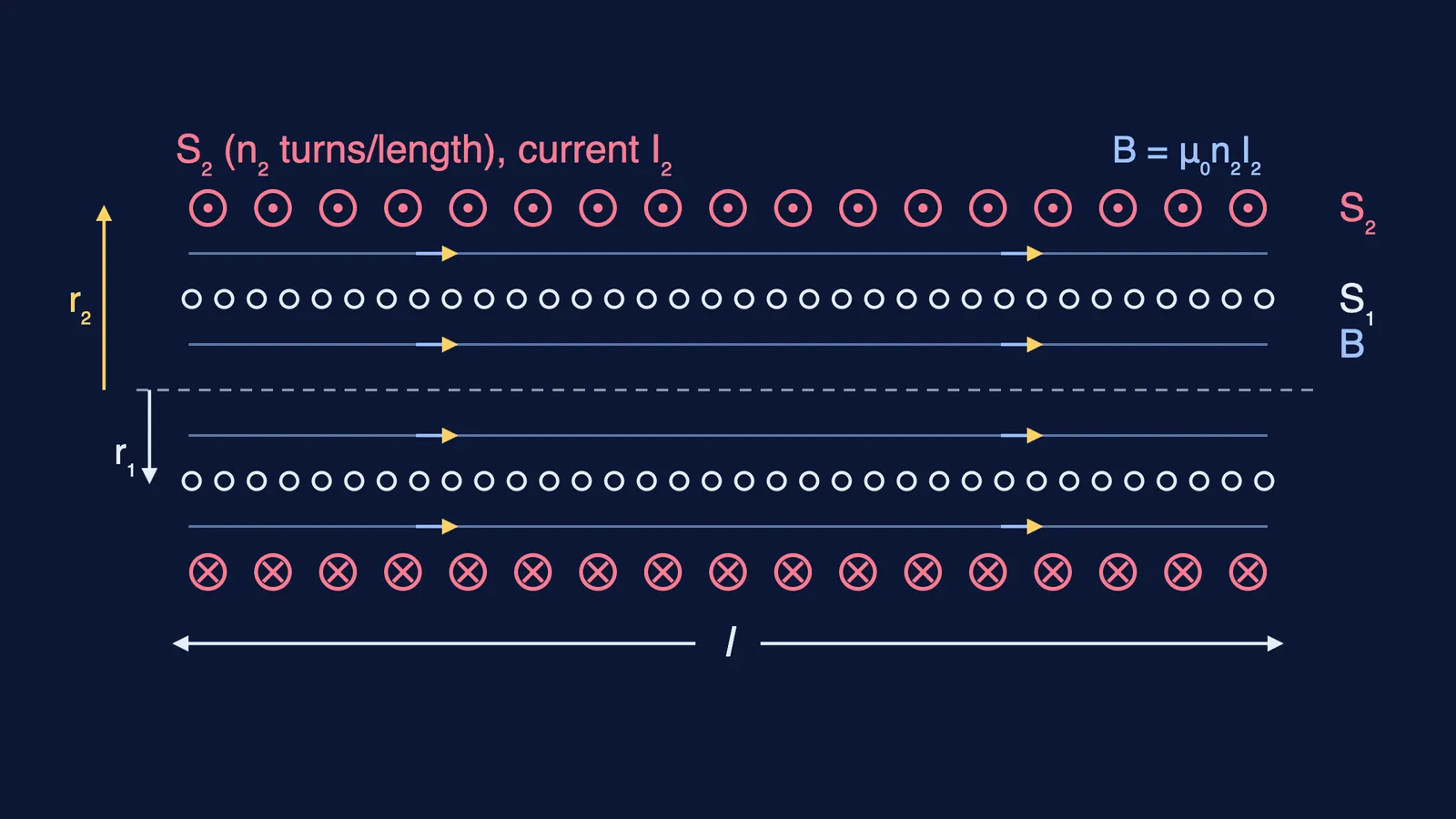
Mutual inductance of coaxial solenoids: M12 = M21 = μ0n1n2πr1²l
Setup: two long coaxial solenoids of the same length l, long enough (l ≫ r2) to neglect edge effects. The inner one, S1, has radius r1 and n1 turns per metre; the outer one, S2, has radius r2 and n2 turns per metre.
Pass current I2 through S2. The field inside it is μ0n2I2.
S1 sits wholly inside that field, so the flux through one turn of S1 is (πr1²)(μ0n2I2).
S1 has n1l turns, so its flux linkage is N1Φ1 = μ0n1n2πr1²lI2.
Define M12 by N1Φ1 = M12I2, which gives M12 = μ0n1n2πr1²l.
Now pass I1 through S1. Because S1 is long, its field μ0n1I1 is confined to its inside, an area πr1².
Flux linkage with S2's n2l turns: N2Φ2 = (n2l)(πr1²)(μ0n1I1), so M21 = μ0n1n2πr1²l.
Result: M12 = M21 = M = μ0n1n2πr1²l.
Where students slip: in step 6 they use πr2² because the turns belong to S2. The flux exists only where the field is, inside S1, so the area is πr1² both ways.
Energy stored in an inductor: why is W = ½LI²?
Setup: an inductor L whose current rises from 0 to I; resistance ignored.
The back emf has size L(di/dt), where i is the current at an instant.
The source must do work against it at the rate dW/dt = (back emf) × i = Li(di/dt).
So the work for a small rise di is dW = Li di.
Integrate from i = 0 to i = I: W = ∫ Li di = ½LI².
Result: W = ½LI², stored in the magnetic field.
Extension, worked in NCERT's Example 6.9: for a solenoid, put L = μ0n²Al and I = B/(μ0n) to get U = B²Al/(2μ0). Dividing by the volume Al gives the energy density uB = B²/(2μ0).
Where students slip: using the final current I inside the integral instead of the changing current i, which gives LI² with no half.
AC generator: how do you derive ε = NBAω sin ωt?
Setup: a coil of N turns and area A spins at constant angular speed ω in a uniform field B, about an axis perpendicular to B; at t = 0 the coil's area vector is along B.
Angle between area vector and field at time t: θ = ωt.
Flux through one turn: Φ = BA cos ωt.
Faraday's law for N turns: ε = −N dΦ/dt = −NBA × (−ω sin ωt).
Simplify: ε = NBAω sin ωt.
The largest value, when sin ωt = ±1, is ε0 = NBAω, so ε = ε0 sin ωt.
Result: ε = NBAω sin ωt, with peak ε0 = NBAω.
Where students slip: they expect the emf to peak when the flux is largest. It is the other way: the emf peaks at θ = 90° or 270°, where the flux is zero but changing fastest.
How should you practise these derivations?
Draw the figure first and label every symbol on it (l, x, n, r1, r2, θ).
Practise the three inductance-type results (L, M, generator) as one set, saying the field, area and turns aloud each time.
Check dimensions at the end: μ0n²Al should come out in henry, B²/(2μ0) in joules per cubic metre.
Do the motional emf by both routes, flux and force, then try the case-based sets in our electromagnetic induction case study questions.
If the rotating coil is hard to picture, the Fermi Simulation Lab has interactive simulations for ideas that are easier to see than to read.