On this page
This sheet covers NCERT Class 12 Physics Part II (Reprint 2026-27): Chapter 12, Atoms and Chapter 13, Nuclei, Unit VIII of the CBSE 2026-27 Physics syllabus. Not included: the syllabus treats hydrogen line spectra qualitatively and NCERT gives no Rydberg or series formula; radioactivity is not in the 2026-27 syllabus list, and NCERT only names alpha, beta and gamma decay, with no decay law or half-life.
Constants: e = 1.6 × 10⁻¹⁹ C, ε₀ = 8.85 × 10⁻¹² C² N⁻¹ m⁻² (permittivity of free space), 1/4πε₀ = 9.0 × 10⁹ N m² C⁻², h = 6.63 × 10⁻³⁴ J s, c = 3 × 10⁸ m/s, 1 eV = 1.6 × 10⁻¹⁹ J. For board answers, see our Atoms board exam guide and our Nuclei board exam guide.
What formulas come from Rutherford's alpha-scattering experiment?
Coulomb force: F = (1/4πε₀)(2e)(Ze)/r², where Z is the target's atomic number and r (m) the centre-to-centre distance. Repulsive, F in N.
Distance of closest approach (head-on, alpha momentarily at rest): d = 2Ze² / (4πε₀ K), where K (J) is the alpha's initial kinetic energy. Assumes pure Coulomb repulsion and a fixed nucleus.
Impact parameter b (m): perpendicular distance of the initial velocity line from the nucleus centre. Small b gives large deflection θ; a head-on collision (b = 0) gives a rebound, θ ≈ π.
Worked example: a 6.0 MeV alpha particle heads straight at silver (Z = 47). K = 9.6 × 10⁻¹³ J, so d = 2 × 47 × 9.0 × 10⁹ × (1.6 × 10⁻¹⁹)² / 9.6 × 10⁻¹³ ≈ 2.26 × 10⁻¹⁴ m, about 22.6 fm.
Watch for: the alpha's charge is 2e, not e. Convert MeV to joules before dividing.
What are the Bohr model formulas for the hydrogen atom?
Force balance: (1/4πε₀) e²/r² = mv²/r, where m = 9.1 × 10⁻³¹ kg is the electron mass.
Energies (J): K = e²/(8πε₀r), U = −e²/(4πε₀r), E = −e²/(8πε₀r). So K = −E and U = 2E.
Quantisation: L = m vₙ rₙ = nh/2π (L in J s), where n = 1, 2, 3, … is the principal quantum number.
Radius (m): rₙ = ε₀n²h²/(πme²) = n²a₀, Bohr radius a₀ ≈ 5.3 × 10⁻¹¹ m.
Speed: vₙ = e²/(2ε₀nh) ≈ (2.2 × 10⁶/n) m/s.
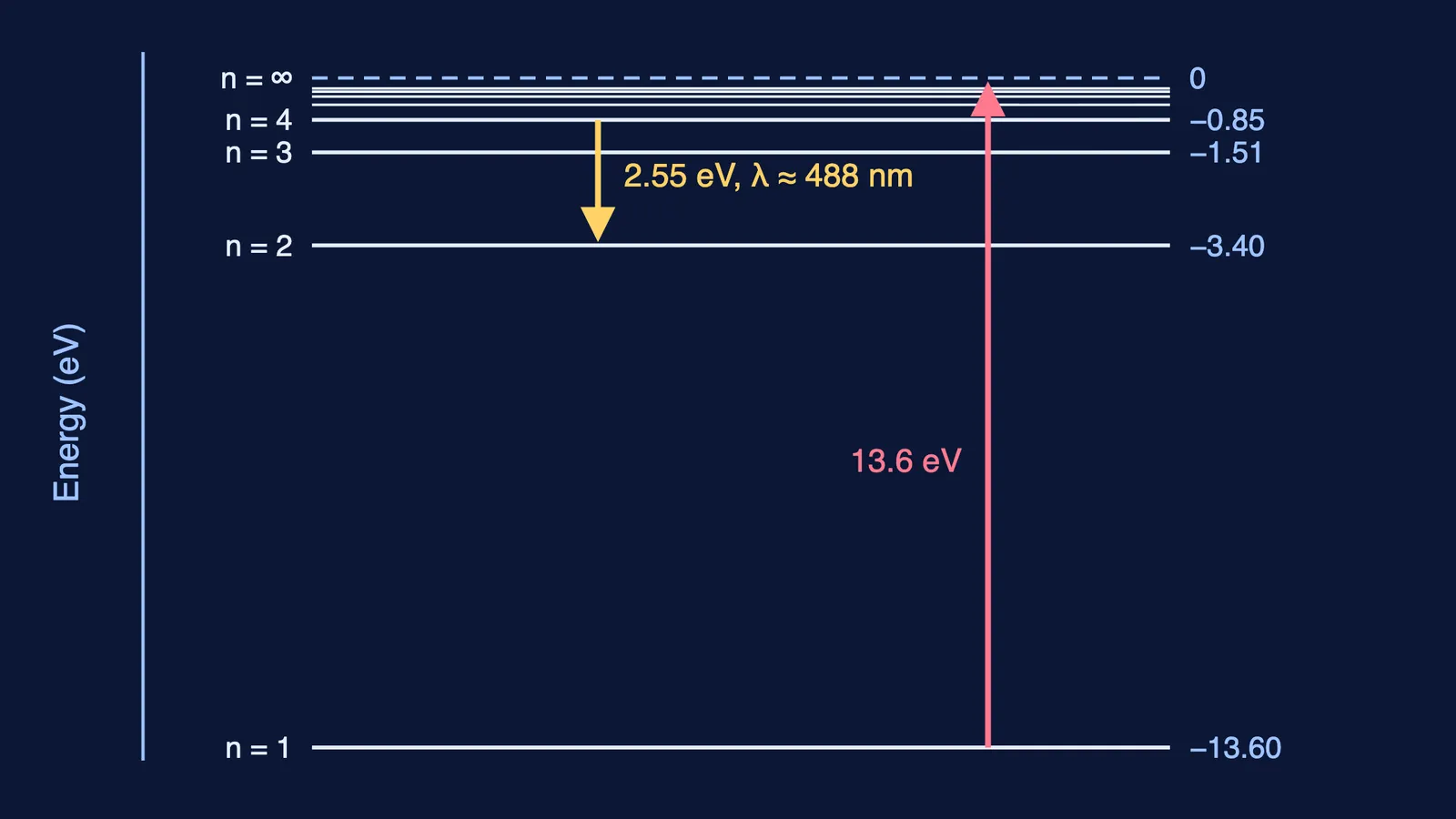
Energy: Eₙ = −me⁴/(8n²ε₀²h²) in J, which equals −13.6/n² eV.
Emission from level i to lower level f: hν = Eᵢ − E_f, so λ = hc/(Eᵢ − E_f), with ν in Hz, λ in m and energies in J. Absorption, lower level i to higher level f: hν = E_f − Eᵢ.
Ionisation energy from the ground state: 13.6 eV. First excitation: E₂ − E₁ = 10.2 eV.
de Broglie's explanation: 2πrₙ = nλ with λ = h/(mvₙ) in m, which gives back mvₙrₙ = nh/2π.
These hold for hydrogen (Z = 1); the model applies only to single-electron atoms.
Worked example: an electron falls from n = 4 to n = 2. ΔE = 13.6(1/4 − 1/16) = 2.55 eV = 4.08 × 10⁻¹⁹ J. λ = (6.63 × 10⁻³⁴ × 3 × 10⁸)/(4.08 × 10⁻¹⁹) ≈ 4.88 × 10⁻⁷ m, about 488 nm, blue-green light.
Watch for: rₙ grows as n², while vₙ falls as 1/n and |Eₙ| as 1/n². Keep the minus sign on Eₙ, and use a positive ΔE for λ.
How big is a nucleus?
Mass number: A = Z + N (protons plus neutrons).
Atomic mass unit: 1 u = (mass of one ¹²C atom)/12 = 1.660539 × 10⁻²⁷ kg. mₚ = 1.00727 u, mₙ = 1.00866 u.
Radius: R = R₀A^(1/3), R₀ = 1.2 fm = 1.2 × 10⁻¹⁵ m (spherical nucleus).
Volume (m³): (4/3)πR³ = (4/3)πR₀³A, proportional to A.
Density: about 2.3 × 10¹⁷ kg m⁻³, nearly the same for all nuclei.
Worked example: for A = 27, R = 1.2 × 3 = 3.6 fm; for A = 216, R = 1.2 × 6 = 7.2 fm. Eight times the nucleons gives twice the radius and eight times the volume, so density is unchanged.
Watch for: the cube root. Nuclear density does not depend on A; atomic density does.
How do you calculate mass defect and binding energy?
Mass-energy: E = mc² (m in kg, E in J).
Mass defect (u or kg): ΔM = [Zmₚ + (A − Z)mₙ] − M, where M is the nuclear mass, not the atomic mass.
Binding energy (J): E_b = ΔMc², with ΔM in kg. With 1 u = 931.5 MeV/c², E_b (MeV) = ΔM (u) × 931.5. Also 1 MeV = 1.6 × 10⁻¹³ J.
Per nucleon: E_bn = E_b/A (MeV per nucleon), about 8 MeV for A = 30 to 170, lower for lighter and heavier nuclei.
Q value (J or MeV): Q = (initial masses − final masses)c² = final KE − initial KE. Q > 0 releases energy.
Fission or fusion estimate: energy released (MeV) ≈ gain in E_bn (MeV) × number of nucleons.
Worked example: carbon-12. The atom is 12 u by definition; subtract 6 electrons (6 × 0.00055 u) for M = 11.99670 u. ΔM = 6 × 1.00727 + 6 × 1.00866 − 11.99670 = 0.09888 u. E_b ≈ 92.1 MeV, so E_bn ≈ 7.68 MeV.
Watch for: tabulated atomic masses include electrons. Subtract them, or use the hydrogen-atom mass for mₚ so they cancel; never mix the two.
How should you revise these formulas?
Derive rₙ, vₙ and Eₙ from two lines, force balance and L = nh/2π, instead of memorising three results. See our Atoms Class 12 derivations, step by step.
Learn hydrogen's numbers as a set: a₀ ≈ 0.53 Å, v₁ ≈ 2.2 × 10⁶ m/s, E₁ = −13.6, E₂ = −3.4, E₃ = −1.51 eV.
Sketch the energy level diagram and the binding energy per nucleon curve from memory.
Do one mass-defect calculation in u, MeV and joules, so the conversions become automatic.
If orbits and energy levels feel abstract, the Fermi Simulation Lab has interactive simulations for the ideas that are easier to see than to read.