On this page
The rationalised NCERT Class 12 Physics Part II, Chapter 12: Atoms (reprint 2026-27) works out five results in its own text and examples: the α-particle's distance of closest approach, the energy of an orbiting electron, the radius of the nth Bohr orbit, the energy of the nth level, and de Broglie's reason for quantised angular momentum. The CBSE Class XII Physics syllabus for 2026-27 names the expressions for radius, velocity and energy of the electron in the nth orbit, and treats hydrogen line spectra qualitatively only, so there is no Rydberg-formula derivation here. NCERT prints no separate equation for the nth-orbit speed, but it comes from the same steps as the radius.
Each derivation below has a setup, numbered steps, the result and a common slip. For the chapter plan, see our Atoms Class 12 board exam guide.
Distance of closest approach: d = 2Ze²/(4πε₀K)
Setup: an α-particle of charge 2e and kinetic energy K moves head-on towards a nucleus of charge Ze, which stays at rest; d is the centre-to-centre distance where the α-particle stops for an instant.
Far from the nucleus the energy is all kinetic, K, and the electric potential energy is zero.
At the turning point the speed is zero, so all the energy is potential: U = (1/4πε₀)(2e)(Ze)/d, where ε₀ is the permittivity of free space.
Energy is conserved, so K = 2Ze²/(4πε₀d).
Solve for d.
Result: d = 2Ze²/(4πε₀K).
In NCERT Example 12.2, a 7.7 MeV α-particle on gold (Z = 79) gives d ≈ 3.0 × 10⁻¹⁴ m, or 30 fm.
Where students slip: giving the α-particle charge e instead of 2e, or using K in MeV without converting to joules.
Energy of an electron in orbit: E = −e²/(8πε₀r)
Setup: a hydrogen atom with an electron (charge −e, mass m) moving at speed v in a circle of radius r around a proton held at rest.
Coulomb attraction provides the centripetal force: e²/(4πε₀r²) = mv²/r.
Multiply both sides by r/2 to get the kinetic energy: K = ½mv² = e²/(8πε₀r).
The potential energy of the electron–proton pair is U = −e²/(4πε₀r).
Add them: E = K + U = e²/(8πε₀r) − e²/(4πε₀r).
Result: E = −e²/(8πε₀r), so K = −E and U = 2E.
Where students slip: dropping the minus sign in U. A negative E means the electron cannot leave without being given energy.
How do you derive the radius and speed of the nth Bohr orbit?
Setup: the same force balance plus Bohr's second postulate, mvr = nh/2π, where h is Planck's constant and n = 1, 2, 3 and so on.
Rewrite the force balance as mv²r = e²/(4πε₀).
Divide it by the postulate, mvr = nh/2π: v = (e²/4πε₀)(2π/nh), which simplifies to vₙ = e²/(2ε₀nh).
From the postulate, r = nh/(2πmv).
Put in vₙ: rₙ = (nh/2πm)(2ε₀nh/e²) = ε₀n²h²/(πme²).
Result: rₙ = ε₀n²h²/(πme²) and vₙ = e²/(2ε₀nh). NCERT writes the same radius as rₙ = (n²/m)(h/2π)²(4πε₀/e²).
For n = 1 the radius is the Bohr radius, about 5.3 × 10⁻¹¹ m, and the speed about 2.2 × 10⁶ m/s. NCERT Example 12.3 reaches the same two values another way, starting from the measured 13.6 eV needed to split a hydrogen atom. So rₙ = n² × (first radius) and vₙ = (first speed)/n.
Where students slip: making the radius grow as n instead of n², or writing h where the postulate needs h/2π.
Energy of the nth level: Eₙ = −me⁴/(8ε₀²n²h²) = −13.6/n² eV
Setup: put rₙ from the last derivation into E = −e²/(8πε₀r).
Substitute: Eₙ = −(e²/8πε₀) × (πme²/ε₀n²h²).
Cancel π and collect powers: Eₙ = −me⁴/(8ε₀²n²h²).
Put in the constants: Eₙ = −2.18 × 10⁻¹⁸/n² J.
Divide by 1 eV = 1.6 × 10⁻¹⁹ J to get electron volts.
Result: Eₙ = −me⁴/(8ε₀²n²h²) = −13.6/n² eV.
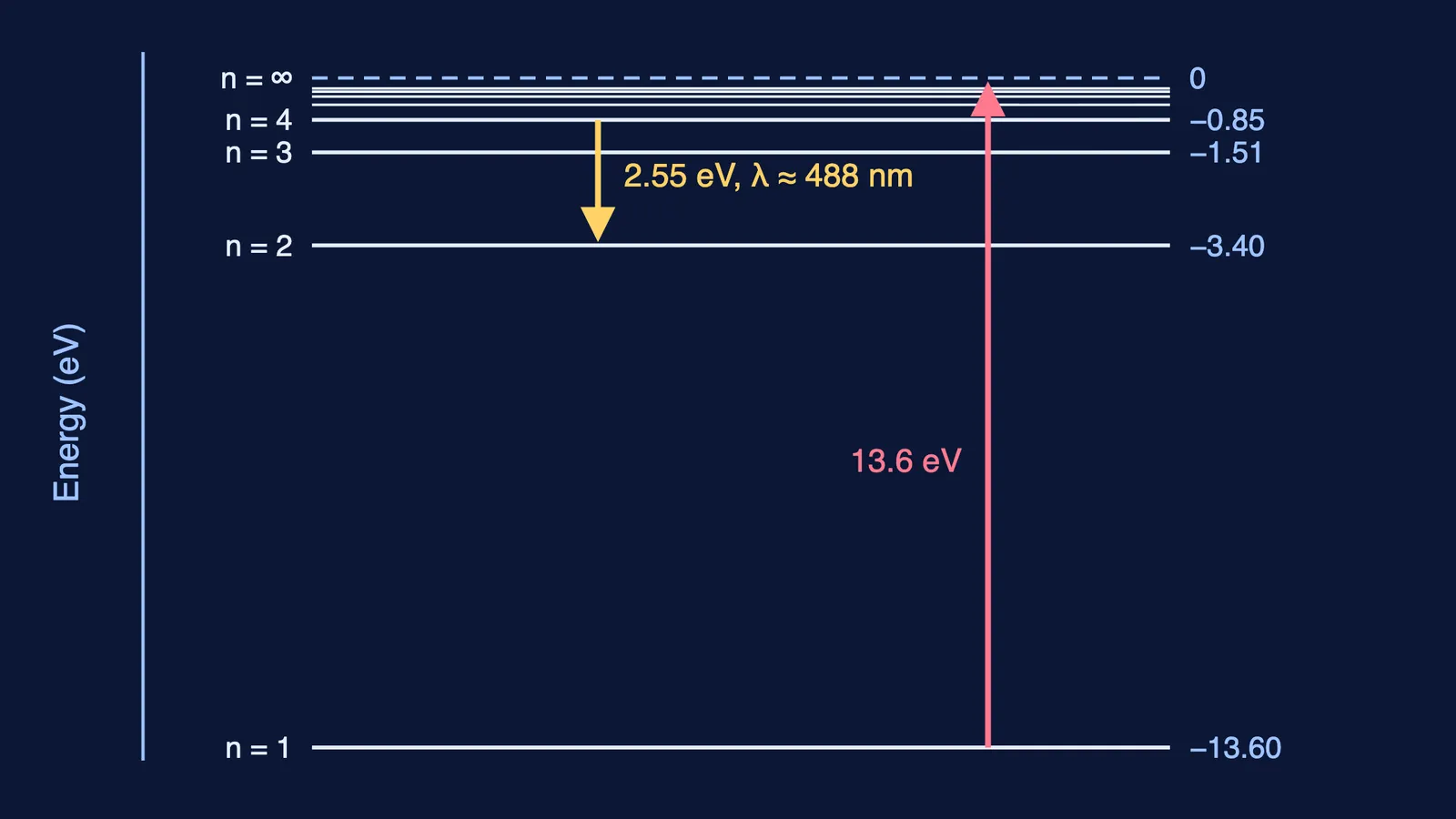
The NCERT chapter uses this to get the ground state, −13.6 eV, so freeing the electron takes 13.6 eV (the ionisation energy), and n = 2 sits at −3.40 eV. By Bohr's third postulate, a jump from level i to a lower level f emits a photon of energy hν = Eᵢ − E_f, where ν is its frequency.
Where students slip: writing ε₀ instead of ε₀² in the denominator, or quoting the ionisation energy as −13.6 eV. It is +13.6 eV.
How does de Broglie explain why angular momentum is quantised?
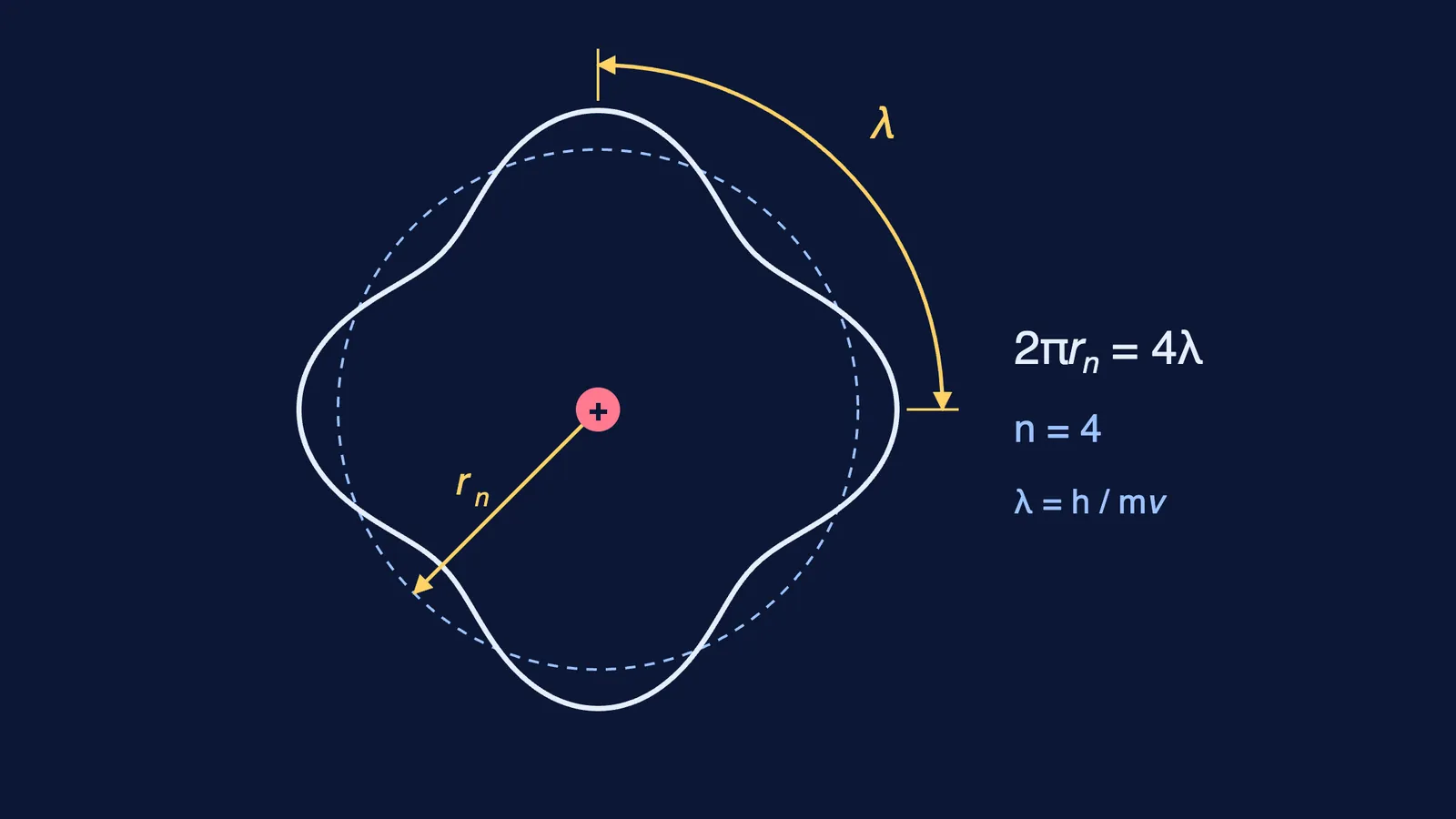
Setup: treat the orbiting electron as a wave travelling round a circle of radius rₙ; only waves that join up with themselves form a standing wave and survive. NCERT's Fig. 12.8 and the diagram at the top show n = 4.
For a standing wave, the circumference must hold a whole number of wavelengths: 2πrₙ = nλ.
The de Broglie wavelength is λ = h/p, and for speeds well below light p = mvₙ.
Substitute: 2πrₙ = nh/(mvₙ).
Rearrange: mvₙrₙ = nh/2π.
Result: mvₙrₙ = nh/2π, which is exactly Bohr's second postulate.
Where students slip: copying the fixed-ends string rule and writing 2πrₙ = nλ/2. A closed loop has no ends, so a whole number of full wavelengths must fit.
How should you practise the Atoms derivations?
Learn the order, not five separate proofs. Force balance, energy in terms of r, the postulate for vₙ and rₙ, then Eₙ. Forget one and rebuild it from the one before.
Write the setup line every time. State the charges and their signs (2e and Ze; −e and +e) before any algebra. A wrong charge spoils every line after it.
Check by scaling and by n = 1. rₙ grows as n², vₙ falls as 1/n, and Eₙ goes as −1/n². Put n = 1 and you should get about 5.3 × 10⁻¹¹ m and −13.6 eV, the values in the NCERT chapter.
Reproduce from a blank page. Write each derivation without notes, then compare with Eqs. 12.2 to 12.12 in the chapter and mark the first line that differs.
Picture it, then write it. If the standing-wave picture is hard to hold in your head, the Fermi Simulation Lab has interactive simulations for ideas that are easier to see than to read.
When the derivations come easily, try them inside longer questions with the Atoms and Nuclei case study questions for Class 12.