On this page
The CBSE Physics syllabus for 2026-27 covers fields from currents, forces in fields, torque on a loop and the moving coil galvanometer; the NCERT chapter (Reprint 2026-27) sets out the formulas. Below: key formulas with symbols, units, a worked example and a common slip per section.
The syllabus gives the solenoid "only qualitative treatment", so its formula is for reference. SI units throughout; μ₀ = 4π × 10⁻⁷ T m A⁻¹.
What is the formula for magnetic force on a moving charge?
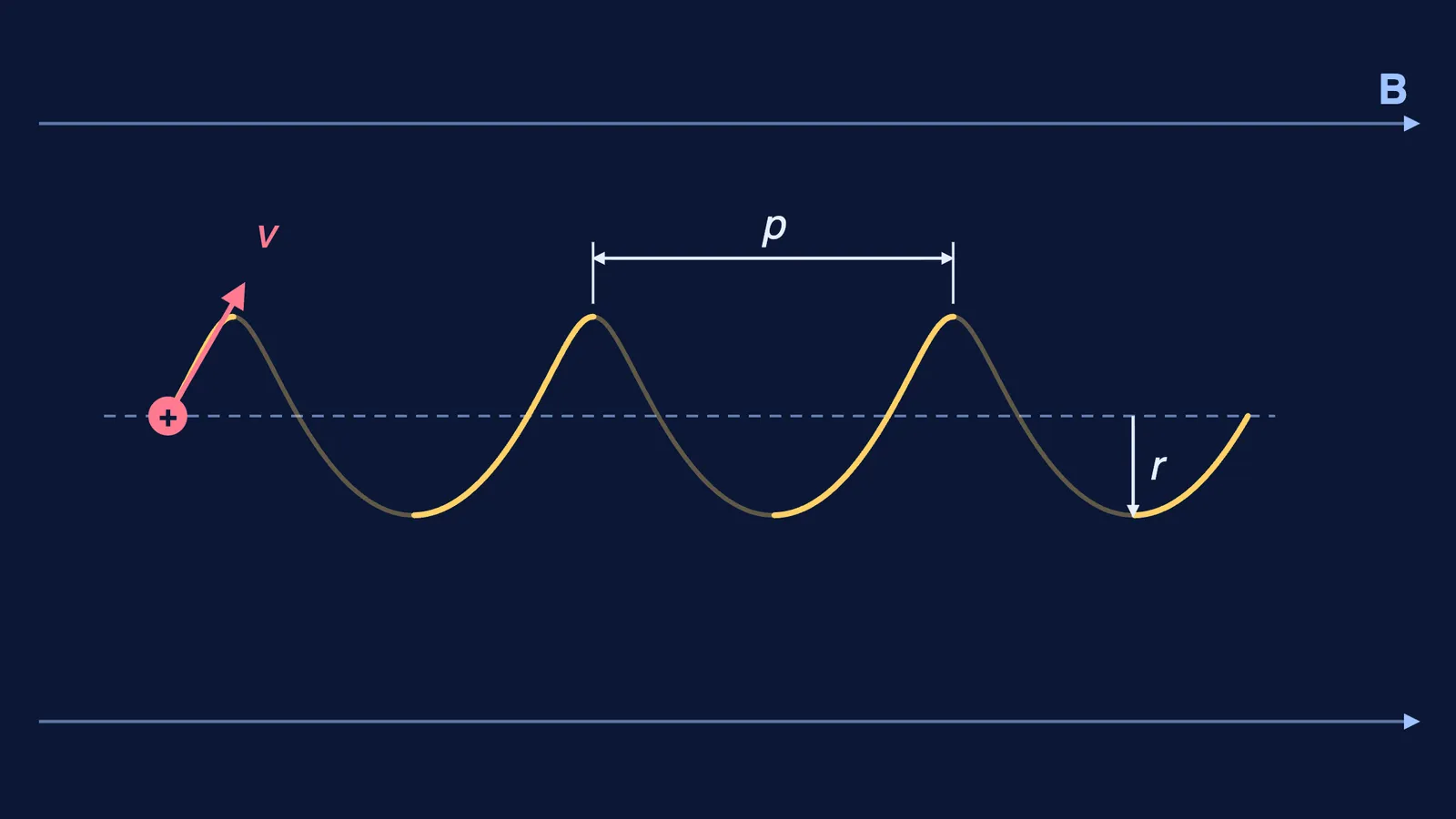
Symbols: q charge (C), v velocity (m/s), B field (tesla, T; 1 gauss = 10⁻⁴ T), E electric field (V/m), θ angle between v and B, m mass (kg), I current (A), l conductor length (m) along the current, r radius (m), p pitch (m).
Lorentz force: F = q(E + v × B).
Magnetic part: F = qvB sin θ, perpendicular to v and B. It does no work, so speed is constant.
Straight conductor in a uniform field: F = I l × B, so F = IlB sin θ.
Circle (v perpendicular to B): r = mv/(qB).
Angular frequency ω = qB/m (rad/s), frequency ν = qB/(2πm) (Hz), period T = 2πm/(qB) (s), all independent of speed and radius.
Helix (v at θ to B): r = mv sin θ/(qB); pitch p = 2πm v cos θ/(qB).
Worked example: a proton (m = 1.67 × 10⁻²⁷ kg, q = 1.6 × 10⁻¹⁹ C) enters a 0.50 T field at 2.0 × 10⁶ m/s, 30° to B. Then r = 2.09 cm, T = 1.31 × 10⁻⁷ s, p = 22.7 cm.
Watch for: radius uses v sin θ, pitch uses v cos θ.
What does the Biot-Savart law give for a circular loop?
Symbols: dl current element (m), r vector from element to point (m), θ angle between dl and r, R loop radius (m), x distance along the axis from the centre (m), N turns.
Biot-Savart: dB = (μ₀/4π) I (dl × r)/r³; magnitude dB = (μ₀/4π) I dl sin θ/r².
Axis of a loop: B = μ₀ N I R²/[2(x² + R²)^(3/2)], along the axis by the right-hand thumb rule.
Centre (x = 0): B = μ₀ N I/(2R).
Centre of a semicircular arc: B = μ₀ I/(4R).
Worked example: a 50-turn coil, radius 5.0 cm, carries 2.0 A. At the centre B = 1.26 × 10⁻³ T; on the axis at x = 5.0 cm, B = 4.44 × 10⁻⁴ T, which is 1/(2√2) of the centre value.
Watch for: R² on top, (x² + R²)^(3/2) below. Put x = 0 and check you get μ₀NI/(2R).
How do you use Ampere's circuital law?
Symbols: I_e net current enclosed (A), L loop length (m), r distance from a wire's axis (m), a wire radius (m), d wire separation (m), n turns per metre (m⁻¹).
∮ B · dl = μ₀ I_e; if B is tangential and constant along the loop, BL = μ₀ I_e.
Long straight wire, r ≥ a: B = μ₀ I/(2πr), in circles around the wire.
Inside a wire with uniform current, r < a: B = μ₀ I r/(2πa²).
Long solenoid, inside (qualitative only): B = μ₀ n I.
Parallel wires: force per metre f = μ₀ I₁ I₂/(2πd). Parallel currents attract; antiparallel repel.
The ampere (NCERT's 1946 definition): the current that gives 2 × 10⁻⁷ N per metre between two long parallel wires 1 m apart in vacuum. Since 2019 the SI defines it via the electron charge.
Worked example: a long wire carries 10 A; a parallel wire 2.0 cm away carries 5.0 A the other way. f = 4π × 10⁻⁷ × 10 × 5.0/(2π × 0.02) = 5.0 × 10⁻⁴ N/m, repulsive.
Watch for: like charges repel, but like (parallel) currents attract. Inside a wire, use the enclosed current, not the total.
Torque on a current loop and the magnetic dipole
Symbols: A loop area (m²), m magnetic moment (A m²), θ angle between m (the normal) and B, τ torque (N m).
m = N I A, direction by the right-hand thumb rule.
τ = m × B, so τ = N I A B sin θ.
Net force on a loop in a uniform field: zero.
Far field (x ≫ R): on the axis B = (μ₀/4π)(2m/x³); in the loop's plane B = (μ₀/4π)(m/x³), opposite to m.
Worked example: a 20-turn coil, 4.0 cm × 5.0 cm, carries 0.50 A in 0.30 T with its normal at 60° to B. m = 0.020 A m², τ = 0.020 × 0.30 × sin 60° = 5.2 × 10⁻³ N m.
Watch for: θ is from the normal, not the plane. A plane at 30° to B means θ = 60°.
How does a galvanometer become an ammeter or voltmeter?
Symbols: k torsion constant (N m rad⁻¹), φ deflection (rad), R_G galvanometer resistance (Ω), I_g full-scale current (A), r_s shunt (Ω), R series resistance (Ω).
Radial field: kφ = N I A B, so φ = (NAB/k) I.
Current sensitivity φ/I = NAB/k (rad/A); voltage sensitivity φ/V = NAB/(k R_G) (rad/V). Doubling N (with twice the wire) doubles the first but not the second, since R_G also doubles.
Ammeter, shunt in parallel: r_s = I_g R_G/(I − I_g).
Voltmeter, resistance in series: R = V/I_g − R_G.
Worked example: R_G = 50 Ω, I_g = 2.0 mA. A 0–1.0 A ammeter needs r_s = 0.100/0.998 = 0.100 Ω in parallel; a 0–10 V voltmeter needs R = 5000 − 50 = 4950 Ω in series.
Watch for: R = V/I_g alone forgets the galvanometer's own resistance.
How to revise this formula sheet
Sort formulas into "field makes force" and "current makes field"; many numericals use one of each.
Rebuild r = mv/(qB) from mv²/r = qvB instead of memorising it.
Draw the right-hand rule on the figure before writing any magnitude.
For exam pattern and derivations, see the Moving Charges and Magnetism Class 12 board exam guide, then Magnetism and Matter Class 12: board answers, traps and a plan. If the helix is hard to picture, the Fermi Simulation Lab has interactive simulations for the ideas that are easier to see than to read.