On this page
Trigonometric Functions is Chapter 3 of the NCERT Class 11 Mathematics textbook (Reprint 2026-27), and the chapter is part of the CBSE 2026-27 Mathematics curriculum. Not here: general solutions of sin y = sin a and similar equations, which the rationalised chapter omits.
Angles are in radians unless marked °; n is any integer.
How do you convert between degrees and radians?
l = rθ: arc l, radius r, angle θ at the centre in radians
π radian = 180°
Radians = (π/180) × degrees; degrees = (180/π) × radians
1 radian = 180°/π, about 57.3°
Worked example. Radius 20 cm, angle 54°: 54 × π/180 = 3π/10, so l = 20 × 3π/10 = 6π cm, about 18.85 cm.
Watch for: putting 54 into l = rθ gives 1,080 cm, longer than the whole circle.
What are the domain, range and signs of the six trigonometric functions?
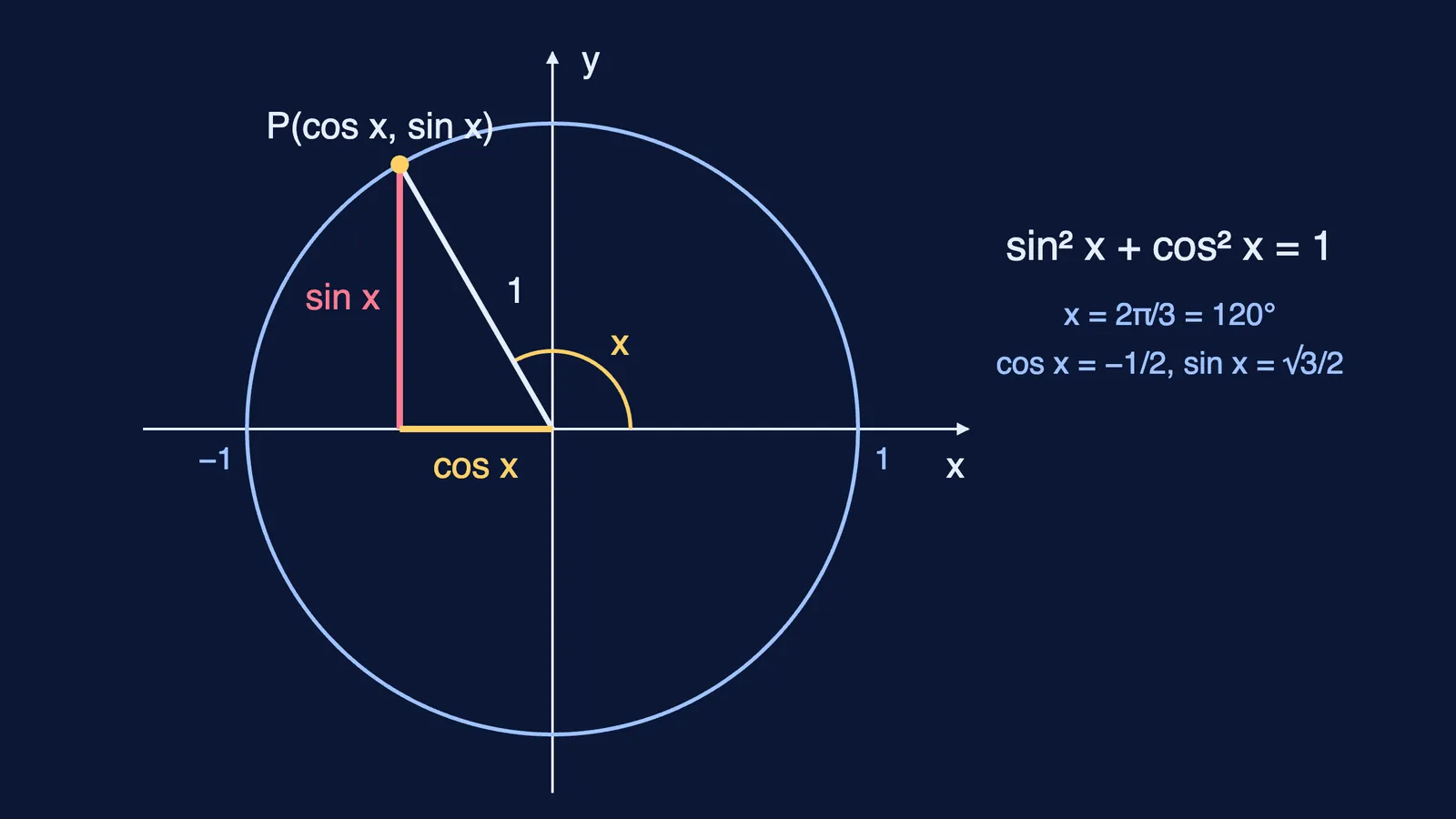
sin² x + cos² x = 1, for all real x
1 + tan² x = sec² x, for x ≠ (2n + 1)π/2
1 + cot² x = cosec² x, for x ≠ nπ
sin x = 0 only when x = nπ; cos x = 0 only when x = (2n + 1)π/2
sin x, cos x: domain all reals, range [−1, 1]
tan x = sin x/cos x and sec x = 1/cos x: domain x ≠ (2n + 1)π/2
cot x = cos x/sin x and cosec x = 1/sin x: domain x ≠ nπ
Range of tan x and cot x: all reals; of sec x and cosec x: y ≤ −1 or y ≥ 1
Positive: all in quadrant I; sin, cosec in II; tan, cot in III; cos, sec in IV
sin(2nπ + x) = sin x and cos(2nπ + x) = cos x; tan and cot repeat after π
sin(−x) = −sin x, cos(−x) = cos x
Worked example. cos x = −5/13, x in quadrant III. sin² x = 144/169, and sine is negative in III, so sin x = −12/13, tan x = 12/5, cosec x = −13/12, sec x = −13/5, cot x = 5/12.
Watch for: the identity gives ±12/13; the quadrant picks the sign.
What are the sum and difference formulas?
sin(x ± y) = sin x cos y ± cos x sin y
cos(x + y) = cos x cos y − sin x sin y
cos(x − y) = cos x cos y + sin x sin y
tan(x ± y) = (tan x ± tan y)/(1 ∓ tan x tan y), if none of x, y, x ± y is an odd multiple of π/2
cot(x + y) = (cot x cot y − 1)/(cot y + cot x) and cot(x − y) = (cot x cot y + 1)/(cot y − cot x), if none of x, y, x ± y is a multiple of π
Allied angles: sin(π/2 − x) = cos x, cos(π/2 − x) = sin x, sin(π/2 + x) = cos x, cos(π/2 + x) = −sin x
sin(π − x) = sin x, cos(π − x) = −cos x; sin(π + x) = −sin x, cos(π + x) = −cos x; sin(2π − x) = −sin x, cos(2π − x) = cos x
Worked example. tan 75° = tan(45° + 30°) = (1 + 1/√3)/(1 − 1/√3) = (√3 + 1)/(√3 − 1). Rationalising gives 2 + √3, about 3.732.
Watch for: the tan denominator takes the opposite sign to the numerator.
See also allied angles and the ASTC rule.
Which double and triple angle formulas do you need?
sin 2x = 2 sin x cos x = 2 tan x/(1 + tan² x)
cos 2x = cos² x − sin² x = 2cos² x − 1 = 1 − 2sin² x = (1 − tan² x)/(1 + tan² x)
Tan forms of sin 2x and cos 2x: x ≠ nπ + π/2
tan 2x = 2 tan x/(1 − tan² x), if neither x nor 2x is an odd multiple of π/2
sin 3x = 3 sin x − 4 sin³ x
cos 3x = 4 cos³ x − 3 cos x
tan 3x = (3 tan x − tan³ x)/(1 − 3 tan² x), if neither x nor 3x is an odd multiple of π/2
Worked example. sin x = 8/17, x in quadrant II, so cos x = −15/17. sin 2x = 2(8/17)(−15/17) = −240/289, cos 2x = 225/289 − 64/289 = 161/289, sin 3x = 24/17 − 4(512/4913) = 4888/4913 and cos 3x = 4(−3375/4913) + 45/17 = −495/4913.
Watch for: sin 3x starts with 3 sin x; cos 3x starts with the cube.
How do sum-to-product and product-to-sum formulas work?
cos x + cos y = 2 cos((x + y)/2) cos((x − y)/2)
cos x − cos y = −2 sin((x + y)/2) sin((x − y)/2)
sin x + sin y = 2 sin((x + y)/2) cos((x − y)/2)
sin x − sin y = 2 cos((x + y)/2) sin((x − y)/2)
2 cos x cos y = cos(x + y) + cos(x − y)
−2 sin x sin y = cos(x + y) − cos(x − y)
2 sin x cos y = sin(x + y) + sin(x − y)
2 cos x sin y = sin(x + y) − sin(x − y)
Worked example. cos 100° + cos 20° = 2 cos 60° cos 40° = cos 40°, and cos 140° = −cos 40°, so cos 20° + cos 100° + cos 140° = 0.
Watch for: the leading minus in cos x − cos y. Without it, cos 0 − cos 60° comes out −1/2, not 1/2.
Longer problems: trigonometric functions case study questions.
How to revise this formula sheet
Learn sin(x ± y) and cos(x ± y) cold; derive the rest from them.
Write the condition beside every tan and cot formula.
Test any identity at x = 30° before relying on it.
If a proof stalls, the Fermi Problem Library has worked problems with a step-by-step solver that explains the reasoning rather than printing an answer.
For proofs and solved examples, see our Trigonometric Functions Class 11 guide.