On this page
Every formula below comes from Chapter 9 of the rationalised NCERT Class 12 Physics Part 2 textbook, Ray Optics and Optical Instruments, and sits inside the CBSE 2026-27 Physics curriculum. That syllabus entry does not list dispersion or the human eye, so they get no formulas here.
Sign convention (NCERT, Cartesian): distances are measured from the pole or optical centre, positive along the incident light, negative against it; heights above the axis are positive. Lengths are in metres (cm in examples).
Mirror formula and magnification: what are the formulas?
f = R/2 (f = focal length, R = radius of curvature; paraxial rays)
1/v + 1/u = 1/f (u = object distance, v = image distance; f negative for concave, positive for convex)
m = h′/h = −v/u (h = object height, h′ = image height; negative m means real and inverted)
Worked example: concave mirror, f = −10 cm, object at u = −14 cm. 1/v = −1/10 + 1/14 = −2/70, so v = −35 cm. Then m = −(−35)/(−14) = −2.5: real, inverted, 2.5 times larger.
Watch for: writing f = +10 cm for a concave mirror. The question gives the magnitude; the sign comes from the convention.
Refraction, apparent depth and total internal reflection
sin i / sin r = n21 (Snell's law; i, r measured from the normal; n21 = index of medium 2 relative to medium 1)
n12 = 1/n21, and n32 = n31 × n12
Apparent depth = real depth / n (viewing near the normal only)
sin ic = n21 (ic = critical angle, light from denser medium 1 into rarer medium 2); in air, sin ic = 1/n
Worked example: an optical fibre core has index 1.58, its cladding 1.46. At the boundary sin ic = 1.46/1.58 ≈ 0.924, so ic ≈ 67.5°.
Watch for: dividing the wrong way round. sin ic is (rarer index)/(denser index), always below 1, and total internal reflection needs light going denser to rarer.
What are the lens formulas in Class 12 ray optics?
n2/v − n1/u = (n2 − n1)/R (one spherical surface, light going from n1 into n2)
1/f = (n21 − 1)(1/R1 − 1/R2) (lens maker's formula, thin lens; n21 = lens index relative to the surrounding medium; R1, R2 = radii of the first and second surfaces)
1/v − 1/u = 1/f (thin lens formula; f positive for convex, negative for concave)
m = h′/h = v/u
P = 1/f (P = power in dioptre, D, with f in metres; 1 D = 1 m⁻¹)
1/f = 1/f1 + 1/f2 + 1/f3 + … and P = P1 + P2 + P3 + … (thin lenses in contact; algebraic sum)
m = m1 × m2 × m3 × … (magnification of a combination)
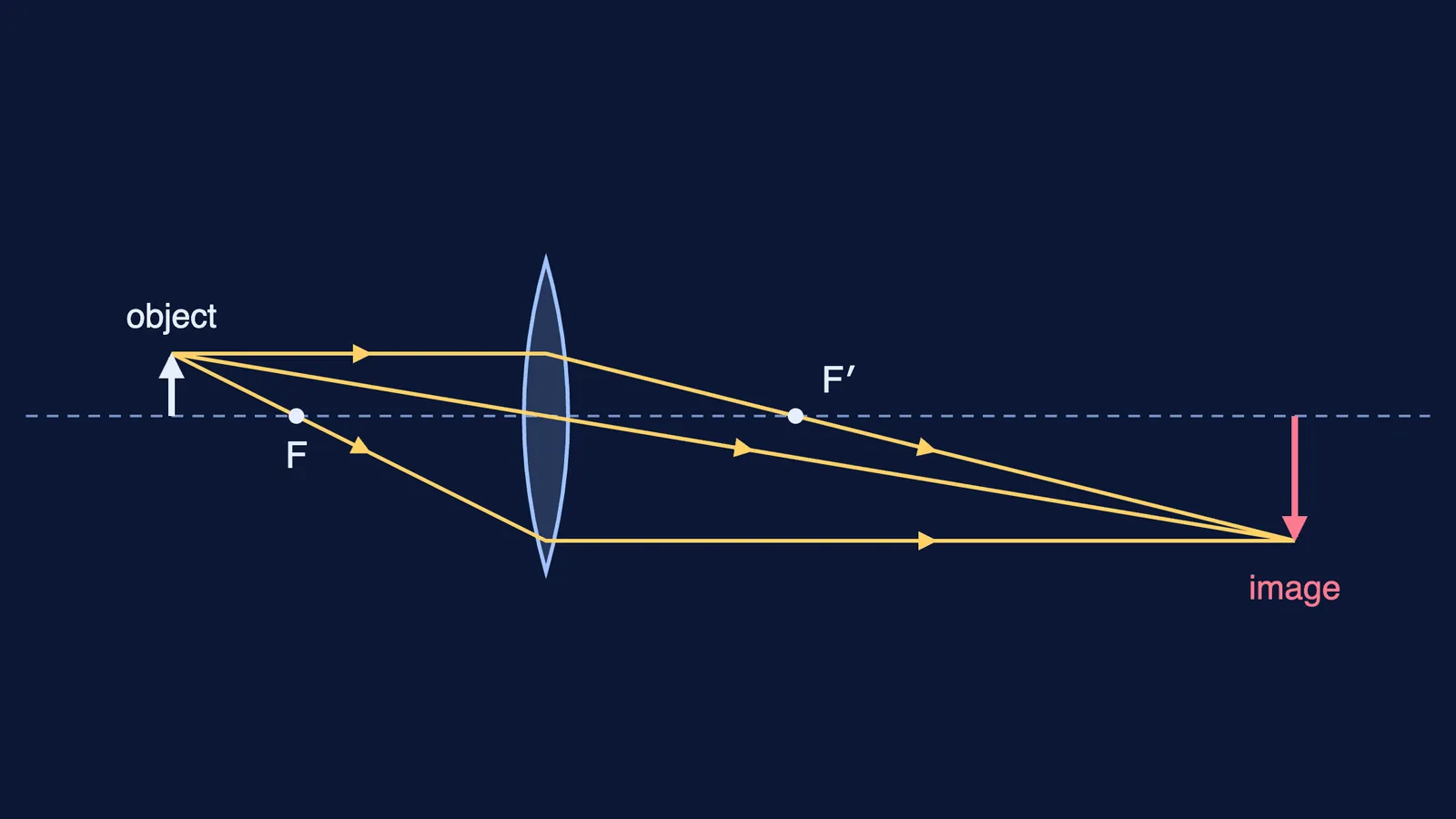
Worked example: a glass biconvex lens (n = 1.5) has R1 = +20 cm, R2 = −30 cm. Then 1/f = 0.5 × (1/20 + 1/30) = 1/24, so f = +24 cm and P = 100/24 ≈ +4.17 D. An object at u = −36 cm gives 1/v = 1/24 − 1/36 = 1/72, so v = +72 cm and m = 72/(−36) = −2. The hero diagram is this case. A +20 cm lens (+5 D) in contact with a −50 cm lens (−2 D) gives P = +3 D, so f ≈ +33.3 cm.
Watch for: the R2 sign. On a biconvex lens R2 is negative, so the two terms add.
Prism formulas: deviation and refractive index
r1 + r2 = A (A = prism angle; r1, r2 = refraction angles inside at the two faces)
δ = i + e − A (δ = deviation, i = incidence, e = emergence)
At minimum deviation Dm: i = e, r1 = r2 = A/2, and i = (A + Dm)/2
n21 = sin[(A + Dm)/2] / sin(A/2) (n21 = prism index relative to the surroundings)
Dm = (n21 − 1)A (thin prism, small A only)
Worked example: a 50° prism, minimum deviation 30°. Then n = sin 40° / sin 25° = 0.643/0.423 ≈ 1.52. A thin 4° prism with n = 1.5 deviates light by Dm = 0.5 × 4° = 2°.
Watch for: using the thin-prism formula on a 50° prism. It needs small A.
Microscope and telescope magnifying power formulas
Simple microscope: m = 1 + D/f (image at the near point; D ≈ 25 cm, least distance of distinct vision); m = D/f (image at infinity)
Compound microscope: m = mo × me, with mo = L/fo and me = 1 + D/fe (final image at the near point) or me = D/fe (at infinity), so m ≈ (L/fo)(D/fe) (fo, fe = focal lengths of objective and eyepiece; L = tube length)
Astronomical telescope (final image at infinity): m = β/α = fo/fe (β, α = angles subtended at the eye by image and object); tube length = fo + fe
Worked example: a compound microscope with fo = 1.2 cm, fe = 5 cm, L = 18 cm gives m = (18/1.2) × (25/5) = 15 × 5 = 75 with the image at infinity, or 15 × 6 = 90 at the near point. A telescope with fo = 120 cm and fe = 4 cm gives m = 30 and a tube 124 cm long.
Watch for: L is not the distance between the lenses. NCERT defines it from the objective's second focal point to the eyepiece's first focal point.
How to revise this formula sheet
Rebuild the sheet from memory weekly and check every sign.
Say each formula's condition aloud: paraxial, thin lens, small A, denser to rarer.
Pair every formula with a ray diagram; our guide to drawing ray diagrams in the CBSE Class 12 paper shows the layout. For ideas that are easier to see than to read, the Fermi Simulation Lab has interactive simulations.
Learn where each formula comes from with the ray optics Class 12 derivations.
When the formulas feel steady, move to answer layout in the ray optics Class 12 board exam guide.