On this page
Chapter 9 of the NCERT Class 12 Physics Part 2 textbook (Reprint 2026-27) derives the six results below; here they are in short steps. All six sit inside the CBSE Class XII Physics syllabus for 2026-27. For answer layout across the chapter, see our ray optics Class 12 board exam guide.
Sign convention throughout: measure from the pole or optical centre; along the incident light is positive, against it negative.
Mirror equation: how do you get 1/v + 1/u = 1/f?
Setup: concave mirror, pole P, focus F; object AB (height h), real image A′B′ (height h′); the ray from A parallel to the axis hits the mirror at M. Rays are paraxial.
Triangles A′B′F and MPF are similar, and PM = AB, so B′A′/BA = B′F/FP.
Triangles A′B′P and ABP are similar (equal angles at P), so B′A′/BA = B′P/BP.
Equate the two and write B′F = B′P − FP: (B′P − FP)/FP = B′P/BP.
All three points lie against the incident light, so B′P = −v, FP = −f, BP = −u.
Substitute: (v − f)/f = v/u, so v/f = 1 + v/u; divide by v.
Result: 1/v + 1/u = 1/f, and magnification m = h′/h = −v/u.
Where students slip: adding signs in step 1. Steps 1-3 use lengths; signs enter at step 4.
Refraction at a spherical surface: n₂/v − n₁/u = (n₂ − n₁)/R
Setup: a convex surface, centre C and radius R, separates indices n₁ (object side) and n₂. A ray from O meets the surface at N and reaches image I; M is the foot of the perpendicular from N. Angles are small.
In triangle NOC, the angle of incidence i is an exterior angle: i = MN/OM + MN/MC.
The refraction angle is r = ∠NCM − ∠NIM = MN/MC − MN/MI.
Snell's law for small angles: n₁i = n₂r.
Substitute and cancel MN: n₁/OM + n₂/MI = (n₂ − n₁)/MC.
Apply signs: OM = −u, MI = +v, MC = +R.
Result: n₂/v − n₁/u = (n₂ − n₁)/R.
Where students slip: writing i as a difference. Check which angle is exterior.
Lens maker's formula: 1/f = (n₂₁ − 1)(1/R₁ − 1/R₂)
Setup: a thin double convex lens (index n₂) in a medium n₁, radii R₁ and R₂. The first surface images the object at v₁; that image is the object for the second surface.
First surface (n₁ to n₂): n₂/v₁ − n₁/u = (n₂ − n₁)/R₁.
Second surface (n₂ to n₁), object at v₁ since the lens is thin: n₁/v − n₂/v₁ = (n₁ − n₂)/R₂.
Add; the n₂/v₁ terms cancel: n₁/v − n₁/u = (n₂ − n₁)(1/R₁ − 1/R₂).
Object at infinity puts the image at the focus: 1/f = (n₂/n₁ − 1)(1/R₁ − 1/R₂), where n₂₁ = n₂/n₁.
Divide step 3 by n₁ and compare with step 4.
Result: 1/f = (n₂₁ − 1)(1/R₁ − 1/R₂), and 1/v − 1/u = 1/f.
Where students slip: for a concave lens, R₁ negative and R₂ positive already make f negative; do not add another minus.
Thin lenses in contact: 1/f = 1/f₁ + 1/f₂
Setup: thin lenses of focal lengths f₁ and f₂ touch, so their optical centres coincide; the first lens's image is the second's object.
Lens A: 1/v₁ − 1/u = 1/f₁.
Lens B, object at v₁: 1/v − 1/v₁ = 1/f₂.
Add: 1/v − 1/u = 1/f₁ + 1/f₂.
A single equivalent lens obeys 1/v − 1/u = 1/f; compare.
Result: 1/f = 1/f₁ + 1/f₂, so with power P = 1/f, P = P₁ + P₂, and m = m₁m₂.
Where students slip: concave lenses have negative power; the sum is algebraic.
Prism at minimum deviation: n = sin[(A + Dm)/2] / sin(A/2)
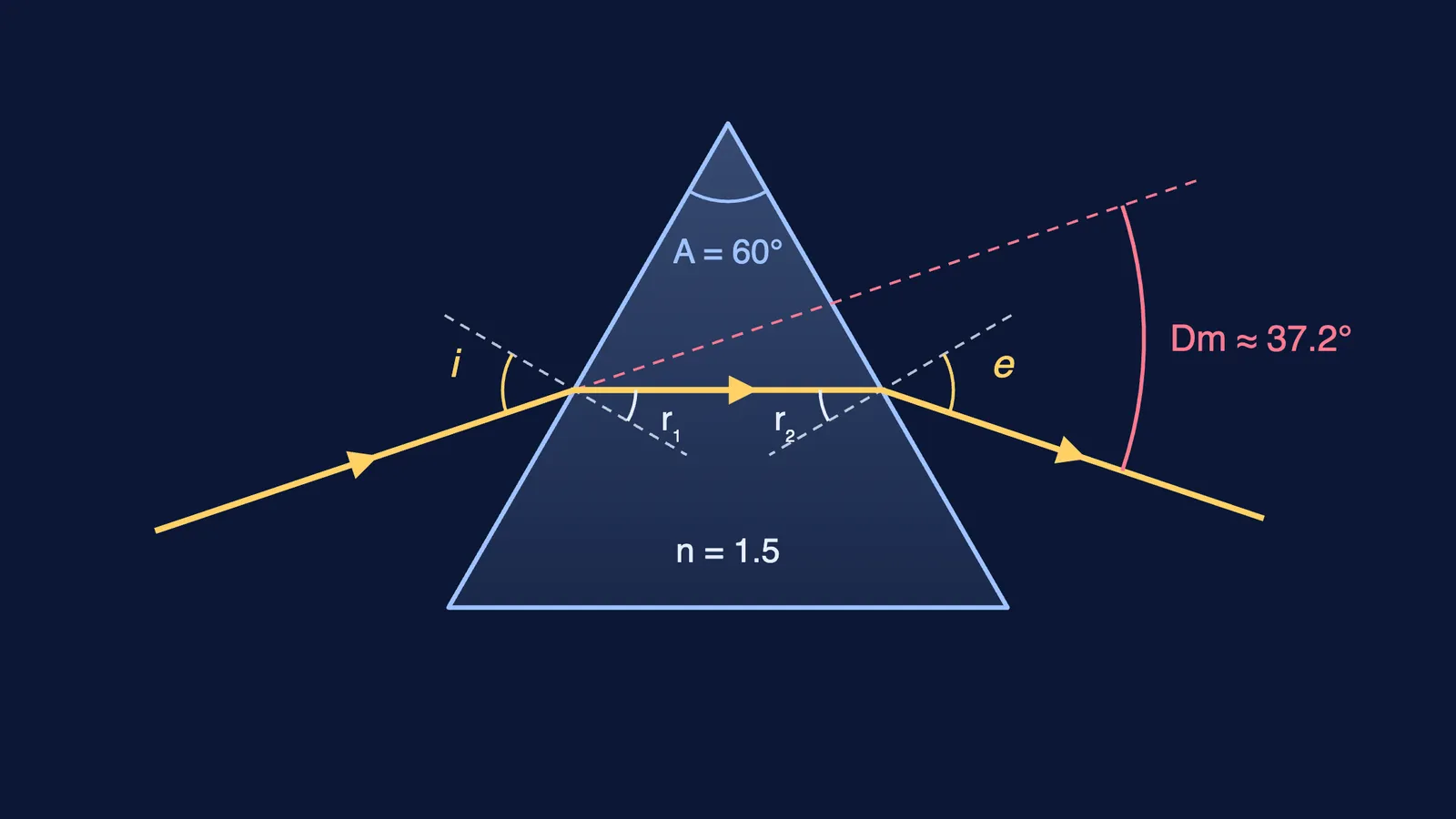
Setup: a ray enters face AB at Q (angle i, refracted at r₁), meets face AC at R (angle r₂) and leaves at e; the normals meet at N. The figure above draws A = 60°, n = 1.5.
In quadrilateral AQNR the angles at Q and R are 90°, so A + ∠QNR = 180°.
In triangle QNR, r₁ + r₂ + ∠QNR = 180°. Compare: r₁ + r₂ = A.
Add the bends at both faces: δ = (i − r₁) + (e − r₂) = i + e − A.
At minimum deviation (δ = Dm) the path is symmetric: i = e and r₁ = r₂ = A/2.
Then Dm = 2i − A, so i = (A + Dm)/2. Apply Snell's law at the first face.
Result: n₂₁ = sin[(A + Dm)/2] / sin(A/2); for a thin prism, Dm ≈ (n₂₁ − 1)A.
Where students slip: swapping A and Dm inside the sines. Check: sin 48.6° / sin 30° ≈ 1.5.
Compound microscope: m = (L/fₒ)(D/fₑ)
Setup: the objective (focal length fₒ) forms a real image h′ of object h; tube length L runs from the objective's second focal point to the eyepiece's first (eyepiece focal length fₑ). Final image at infinity; D ≈ 25 cm is the near-point distance.
The axis-parallel ray from the object's top crosses the objective's second focal point; similar triangles give tan β = h/fₒ = h′/L, so mₒ = h′/h = L/fₒ.
The eyepiece works as a simple magnifier with the object at its focus: angle with lens h′/fₑ, angle at the near point without it h′/D, so mₑ = D/fₑ.
The magnifications multiply: m = mₒmₑ.
Result: m = (L/fₒ)(D/fₑ); with the final image at the near point, mₑ = 1 + D/fₑ instead.
Where students slip: taking L as the lens separation. NCERT's numbers (fₒ = 1.0 cm, fₑ = 2.0 cm, L = 20 cm) give m = 20 × 12.5 = 250.
How should you practise these derivations?
Draw the labelled figure first; each result comes out of it.
Mark the one line where signs enter.
Test each result with a number: a 60° prism with n = 1.5 gives Dm ≈ 37°; two +20 cm lenses in contact give +10 cm.
For ideas that are easier to see than to read, the Fermi Simulation Lab has interactive simulations.
Practise diagrams separately with our guide to drawing ray diagrams in the CBSE Class 12 physics paper.